
Genus · Aniliidae
Anilius
The genus Anilius contains a single species. It is not considered dangerous to humans.
About False coral snake (American pipe snake)
A single burrowing South American species, banded in red and black, that is one of the most primitive living snakes.
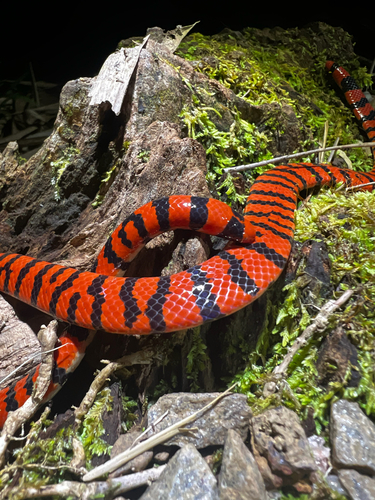
Anilius is a genus that contains just one recognized living species, Anilius scytale, commonly called the false coral snake or American pipe snake. It is the only member of the family Aniliidae. This snake belongs to an ancient lineage and sits near the base of the snake family tree, which is why it keeps several primitive traits that most modern snakes have lost, including small vestigial hind limb remnants called pelvic spurs and a left lung that remains well developed. It lives in the tropical lowlands of northern South America, across the Amazon Basin and the Guianas, in countries such as Brazil, Colombia, Venezuela, Peru, and Guyana, where it favors moist forest floors, leaf litter, soft soil, and the banks of slow water.
It is a fossorial animal, meaning it spends most of its life burrowing and hidden underground or under cover, so it is rarely seen even where it is common. In general terms you can recognize it by its cylindrical body of nearly uniform thickness, a short blunt tail, smooth glossy scales, a small head that is not distinct from the neck, and tiny eyes covered by a scale, all adaptations for a digging life. Its bold pattern of red and black rings is the source of the false coral name, because it resembles the genuinely venomous coral snakes that share its range. This is a case of mimicry, where a harmless animal gains protection by looking like a dangerous one.
Anilius scytale is not a danger to people. It lacks the long fangs and potent venom of true coral snakes, and it is not aggressive toward humans. Its diet leans heavily on other elongate prey such as small snakes, amphibians like caecilians, and eels found in its damp habitat, which it overpowers by constriction and swallowing. Unlike most snakes in its region it gives live birth rather than laying eggs, producing a small litter. Because it so closely resembles true coral snakes, you should never handle a red and black banded snake in the wild on the assumption it is harmless. If anyone is bitten by a snake they cannot positively identify, treat it as a medical emergency and contact US Poison Control at 1-800-222-1222 or local emergency services right away.
Anilius belongs to the Aniliidae family (American pipe snake). A single burrowing snake that mimics a coral snake. Cylindrical body ringed in red and black, with a blunt head and tiny eyes.
Danger: Harmless. Non-venomous, despite its coral-snake-like rings.
All species (1)
Keep learning
- What Is a Snake? Anatomy and the BasicsA clear overview of what makes a snake a snake: limbless body plan, anatomy, evolution from lizards, species diversity, and why they are ectothermic.
- How Snakes Move, Hunt, and EatHow snakes move without legs, hunt as ambushers or active foragers, kill by constriction or venom, and swallow prey wider than their head.
- What Do Snakes Eat?All snakes are carnivores. Learn what snakes eat, how diet changes with size and age, how often they feed, and how they hunt and swallow prey.
- Venomous vs Nonvenomous: How to Tell the DifferenceThe folk rules for telling venomous snakes apart, where each one fails, and why location-based identification beats guessing by sight.