
Genus · Typhlopidae
Types of blind snakes
3 species make up the genus Xerotyphlops, the snakes commonly called blind snakes. None are considered dangerous to humans.
About blind snakes
Tiny, burrowing, worm-like snakes of dry country that spend almost their whole lives underground.
Xerotyphlops is a genus of blind snakes in the family Typhlopidae, the largest family of typhlopid snakes. The name combines the Greek roots for dry, blind, and snake, which captures the group well: these are small fossorial snakes adapted to arid and semi-arid landscapes. They are part of a broader lineage often called the scolecophidians, the burrowing blind and thread snakes that branch off near the base of the snake family tree.
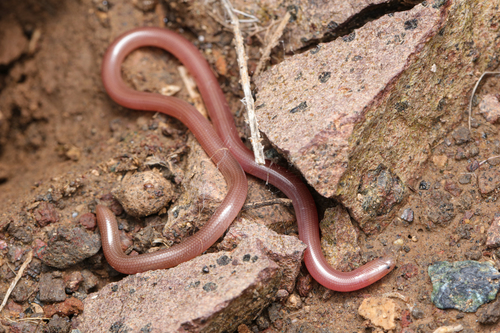
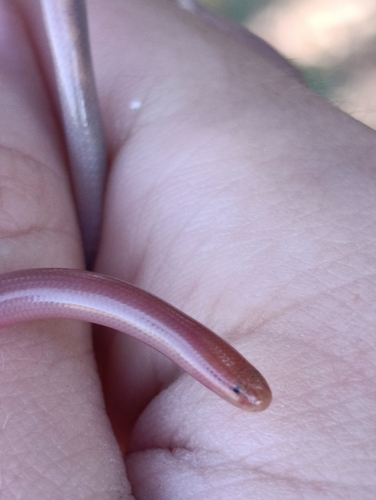
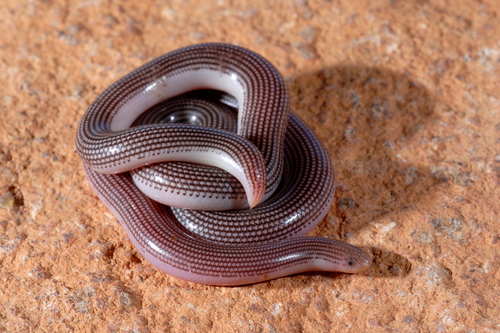
Members of this genus are easy to mistake for earthworms. The body is slender, cylindrical, and roughly the same thickness from head to tail, covered in smooth, tightly overlapping scales that give a glossy, polished look. The eyes are reduced to dark spots beneath translucent head scales and detect little more than light and dark, which is all a tunnel dweller needs. The mouth is small and set under a rounded snout, and the tail ends in a short spine the snake uses for purchase while pushing through soil.
The genus is centered on the drier parts of the Mediterranean basin and Western Asia, extending across parts of southeastern Europe, the Middle East, and nearby arid regions, with members reaching offshore islands such as Socotra. Typical habitat is loose, well-drained soil under stones, leaf litter, and vegetation, where the animals can move through the ground and find their prey. They surface mainly at night or after rain and are rarely seen in the open.
These snakes are completely harmless to people. They are not venomous, they have no fangs, and their tiny mouths cannot meaningfully bite a human. They have no defensive interest in us at all; a blind snake found under a rock will simply try to wriggle back into cover. There is no medical concern associated with them.
Ecologically, blind snakes are specialist insect hunters. They feed largely on ants and termites, including the eggs, larvae, and pupae found inside nests, which they enter and raid. Reproduction in typhlopids is typically by laying small clutches of eggs, and some blind snake species elsewhere are known to reproduce without males, though specifics vary by species. Their burrowing and nest-raiding behavior makes them quiet but useful members of the soil ecosystem.
Xerotyphlops belongs to the Typhlopidae family (Blindsnakes). Tiny, worm-like burrowing snakes that raid ant and termite nests. Looks like a small, glossy earthworm with smooth scales and no obvious neck, eyes, or pattern.
Danger: Harmless. They do not bite people and have no venom.
All species (3)
Keep learning
- What Is a Snake? Anatomy and the BasicsA clear overview of what makes a snake a snake: limbless body plan, anatomy, evolution from lizards, species diversity, and why they are ectothermic.
- How Snakes Move, Hunt, and EatHow snakes move without legs, hunt as ambushers or active foragers, kill by constriction or venom, and swallow prey wider than their head.
- What Do Snakes Eat?All snakes are carnivores. Learn what snakes eat, how diet changes with size and age, how often they feed, and how they hunt and swallow prey.
- Venomous vs Nonvenomous: How to Tell the DifferenceThe folk rules for telling venomous snakes apart, where each one fails, and why location-based identification beats guessing by sight.