
Genus · Colubridae
Xenoxybelis
2 species make up the genus Xenoxybelis. None are considered dangerous to humans.
About South American vine snakes
Slender, sharp-nosed tree snakes that drift through Amazonian foliage like living vines.
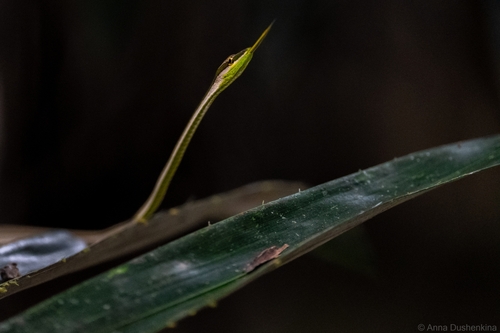
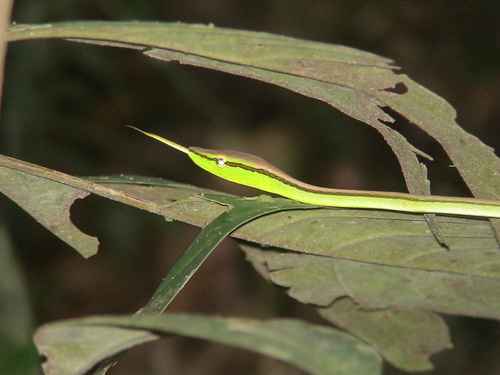
Xenoxybelis is a small genus of slender, arboreal snakes in the family Colubridae, the largest and most diverse snake family on Earth. The best known member is the Striped Sharpnose Snake (Xenoxybelis argenteus), a thin green to bronze snake of the Amazon Basin. Like many narrow tree snakes, members of this group have an elongated, pointed snout and a whip-thin body, traits that have evolved repeatedly across unrelated vine snake lineages. Within Colubridae, Xenoxybelis sits among the New World forest colubrids, and taxonomists have at times shuffled these snakes between related genera as classification has been refined, so you may see the same animals listed under other names in older sources.
These snakes live in the humid lowland rainforests of northern South America, especially around the Amazon and its tributaries. They are tree and shrub dwellers, moving slowly and deliberately through branches and tangled vegetation where their slim shape and muted green or silvery coloring make them very hard to spot. In general terms you would recognize a member of this genus by the combination of a very long thin body, a distinctly elongated head with a pointed nose, and large eyes set well forward, an arrangement that supports the precise vision an ambush forager needs among leaves.
Like the vast majority of colubrids, these are not dangerous to people. Some forest colubrids are rear-fanged, meaning they have enlarged grooved teeth toward the back of the jaw and a mild saliva that helps subdue small prey such as lizards and frogs, but they pose no serious threat to humans and are not front-fanged venomous snakes like vipers or elapids. The honest framing is that they are best left alone and observed rather than handled, both for the animal's sake and because any wild snake can bite. If a bite from any wild snake ever causes a reaction beyond a minor scratch, do not wait it out; contact US Poison Control at 1-800-222-1222 or your local emergency services. As slow, secretive vine snakes they feed on small vertebrates, and like most colubrids in this region they are egg-laying, though detailed life-history records for this obscure genus remain limited.
Xenoxybelis belongs to the Colubridae family (Colubrids). The largest snake family, and the one most snakes you meet belong to. Typically round pupils, a head only slightly wider than the neck, and no heat-sensing facial pit or rattle. Scales may be smooth and glossy or keeled and matte depending on the species.
Danger: Almost all colubrids are harmless. A small number are rear-fanged with medically significant venom, the boomslang and the twig (vine) snakes of Africa being the dangerous exceptions. Most colubrids will flee or bluff rather than bite.
All species (2)
Keep learning
- What Is a Snake? Anatomy and the BasicsA clear overview of what makes a snake a snake: limbless body plan, anatomy, evolution from lizards, species diversity, and why they are ectothermic.
- How Snakes Move, Hunt, and EatHow snakes move without legs, hunt as ambushers or active foragers, kill by constriction or venom, and swallow prey wider than their head.
- What Do Snakes Eat?All snakes are carnivores. Learn what snakes eat, how diet changes with size and age, how often they feed, and how they hunt and swallow prey.
- Venomous vs Nonvenomous: How to Tell the DifferenceThe folk rules for telling venomous snakes apart, where each one fails, and why location-based identification beats guessing by sight.