
Genus · Colubridae
Types of ground snakes
3 species make up the genus Xenopholis, the snakes commonly called ground snakes. None are considered dangerous to humans.
About ground snakes
Small, secretive South American ground snakes that spend most of their lives hidden in leaf litter and damp soil.
Xenopholis is a small genus of snakes in the large family Colubridae, the most diverse snake family on Earth. The genus is native to South America and contains only a handful of described species, including Wucherer's Ground Snake and Jensen's Ground Snake. Because the genus is small and rarely encountered, much of what can be said confidently comes from family-level and regional patterns rather than detailed species accounts.
These are ground-dwelling snakes of tropical South America, found across the Amazon Basin and adjacent forest and savanna regions. Like many small colubrids, they favor moist environments and are typically found in leaf litter, under logs, and in loose soil. They are fossorial to semi-fossorial, meaning they spend much of their time burrowing or sheltering below the surface rather than moving in the open, which is a large part of why they are seldom seen.
Members are small and slender with smooth or weakly keeled scales, a rounded head not strongly distinct from the neck, and modest eyes typical of snakes that live in low light underground. Coloration tends toward muted browns and grays, often with darker markings, which suits a life among soil and decaying leaves. Identification to species generally requires close examination of scale counts and locality, so general appearance alone is rarely enough.
Ecologically these snakes are small predators of the forest floor. As with many small leaf-litter colubrids, the diet is expected to consist of small soft-bodied prey such as frogs, lizards, and invertebrates, taken as they move through litter and soil. South American ground colubrids in this group are generally egg-laying, and like most snakes they are non-aggressive, relying on concealment and quick retreat rather than confrontation when disturbed.
On safety, Xenopholis is not considered a danger to people. These are small, non-aggressive snakes with no reputation for medically significant bites. Many colubrids carry mild rear-positioned secretions used to subdue small prey, and the toxicology of this obscure genus is not well documented, so the honest framing is that it poses no known threat to humans rather than a guarantee. As with any wild snake, the right approach is to leave it undisturbed and observe from a distance. If anyone is bitten by an unidentified snake and symptoms develop, contact US Poison Control at 1-800-222-1222 or local emergency services.
Xenopholis belongs to the Colubridae family (Colubrids). The largest snake family, and the one most snakes you meet belong to. Typically round pupils, a head only slightly wider than the neck, and no heat-sensing facial pit or rattle. Scales may be smooth and glossy or keeled and matte depending on the species.
Danger: Almost all colubrids are harmless. A small number are rear-fanged with medically significant venom, the boomslang and the twig (vine) snakes of Africa being the dangerous exceptions. Most colubrids will flee or bluff rather than bite.
All species (3)
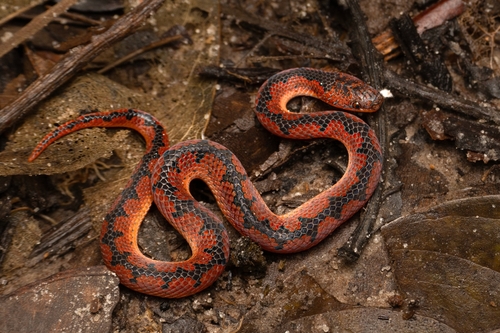
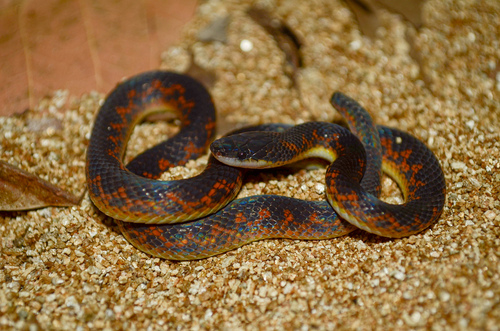
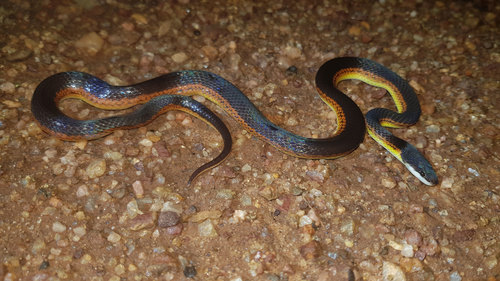
Keep learning
- What Is a Snake? Anatomy and the BasicsA clear overview of what makes a snake a snake: limbless body plan, anatomy, evolution from lizards, species diversity, and why they are ectothermic.
- How Snakes Move, Hunt, and EatHow snakes move without legs, hunt as ambushers or active foragers, kill by constriction or venom, and swallow prey wider than their head.
- What Do Snakes Eat?All snakes are carnivores. Learn what snakes eat, how diet changes with size and age, how often they feed, and how they hunt and swallow prey.
- Venomous vs Nonvenomous: How to Tell the DifferenceThe folk rules for telling venomous snakes apart, where each one fails, and why location-based identification beats guessing by sight.