
Genus · Colubridae
Types of brown snakes
2 species make up the genus Xenelaphis, the snakes commonly called brown snakes. None are considered dangerous to humans.
About Malaysian brown snakes
A small genus of large, slender forest colubrids from Southeast Asia, harmless to people and rarely seen.
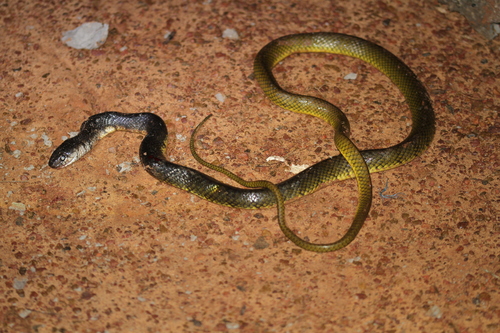
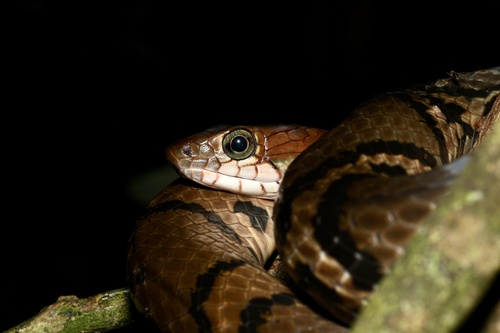
Xenelaphis is a genus in the family Colubridae, the largest snake family and the group that contains most of the world's typical, non-front-fanged snakes. It holds only two recognized species, the Malaysian Brown Snake (Xenelaphis hexagonotus) and the Ocellated Brown Snake (Xenelaphis ellipsifer). Both live in the wet tropical lowlands of Southeast Asia, including the Malay Peninsula, Sumatra, Borneo, and nearby areas, where they keep to forests, swampy ground, and the edges of rivers, ponds, and rice fields.
These are big but lightly built snakes. Large individuals can reach roughly 1.5 to 2 meters, with a long tail, smooth to weakly keeled scales, and a brownish body that may show darker crossbars or eye-like markings depending on the species. They are mostly ground-dwelling and active by day, drawn to damp habitats near water where their prey concentrates. Like many lowland forest colubrids, they feed on small vertebrates such as frogs, fish, lizards, and rodents.
Xenelaphis snakes are not considered dangerous to people. They are not front-fanged venomous snakes like cobras or vipers, and there is no evidence they pose a medical threat. As a general rule, though, wild snakes should never be handled, both for your safety and the animal's. If anyone is ever bitten by a snake they cannot confidently identify, treat it seriously, stay calm, keep the limb still, and seek emergency care right away. In the United States contact Poison Control at 1-800-222-1222, and elsewhere call your local emergency services.
Xenelaphis belongs to the Colubridae family (Colubrids). The largest snake family, and the one most snakes you meet belong to. Typically round pupils, a head only slightly wider than the neck, and no heat-sensing facial pit or rattle. Scales may be smooth and glossy or keeled and matte depending on the species.
Danger: Almost all colubrids are harmless. A small number are rear-fanged with medically significant venom, the boomslang and the twig (vine) snakes of Africa being the dangerous exceptions. Most colubrids will flee or bluff rather than bite.
All species (2)
Keep learning
- What Is a Snake? Anatomy and the BasicsA clear overview of what makes a snake a snake: limbless body plan, anatomy, evolution from lizards, species diversity, and why they are ectothermic.
- How Snakes Move, Hunt, and EatHow snakes move without legs, hunt as ambushers or active foragers, kill by constriction or venom, and swallow prey wider than their head.
- What Do Snakes Eat?All snakes are carnivores. Learn what snakes eat, how diet changes with size and age, how often they feed, and how they hunt and swallow prey.
- Venomous vs Nonvenomous: How to Tell the DifferenceThe folk rules for telling venomous snakes apart, where each one fails, and why location-based identification beats guessing by sight.