
Genus · Colubridae
Types of water snakes
7 species make up the genus Trimerodytes, the snakes commonly called water snakes. None are considered dangerous to humans.
About Asian water snakes
Stream-dwelling Asian water snakes built for life in cool, flowing water.
Trimerodytes is a genus of semiaquatic snakes in the family Colubridae, the largest and most varied snake family in the world. Members live tied to fresh water and are commonly called Asian water snakes. The roughly seven species recognized here include the Mountain Water Snake, the Asiatic Water Snake, the Ringed Water Snake, and the Banded Stream Snake, names that reflect both the habitat and the banded look many of them share.
These snakes are native to East and Southeast Asia, where they favor clear, flowing freshwater such as mountain streams, rocky creeks, rivers, and the margins of ponds and rice paddies. Several species are tied to cooler upland and forested watercourses, which is why mountain and stream turn up so often in their common names. They are strong swimmers and rarely stray far from the water that feeds them.
In general terms, Trimerodytes are medium-sized, smooth to weakly keeled snakes with fairly stout bodies and eyes set for an aquatic life. Many carry dark crossbands or rings along the back and sides over a paler or olive ground color, which is where labels like Ringed and Banded come from. Banding patterns vary between species and individuals, so exact field identification is best confirmed by an expert familiar with the local fauna rather than by color alone.
On safety, these are not front-fanged vipers or elapids and are not considered dangerous to people. Like many colubrids they are best treated as harmless to humans in terms of medically significant venom, though as a rule no wild snake should be handled. A frightened snake can bite and bites can carry infection, so the right move is to observe from a distance and leave the animal alone. If anyone is bitten by a snake they cannot positively identify, treat it as a medical matter, stay calm, and contact emergency services or US Poison Control at 1-800-222-1222 rather than attempting any home first aid.
Ecologically, Trimerodytes are aquatic foragers. Their diet centers on fish and amphibians, including frogs and tadpoles taken in and around the water, which is typical of stream-adapted colubrids. They are generally secretive and most active in or near water, often under cover of rocks and banks. Reproduction across the family includes both egg-laying and live-bearing species, and detailed breeding habits for individual Trimerodytes can differ, so specifics should be checked against current regional herpetological sources.
Trimerodytes belongs to the Colubridae family (Colubrids). The largest snake family, and the one most snakes you meet belong to. Typically round pupils, a head only slightly wider than the neck, and no heat-sensing facial pit or rattle. Scales may be smooth and glossy or keeled and matte depending on the species.
Danger: Almost all colubrids are harmless. A small number are rear-fanged with medically significant venom, the boomslang and the twig (vine) snakes of Africa being the dangerous exceptions. Most colubrids will flee or bluff rather than bite.
All species (7)
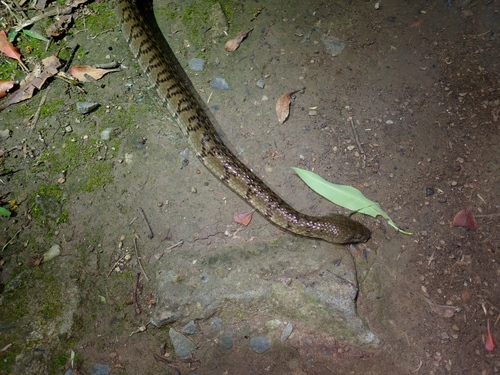 Mountain Water SnakeTrimerodytes percarinatusHarmless
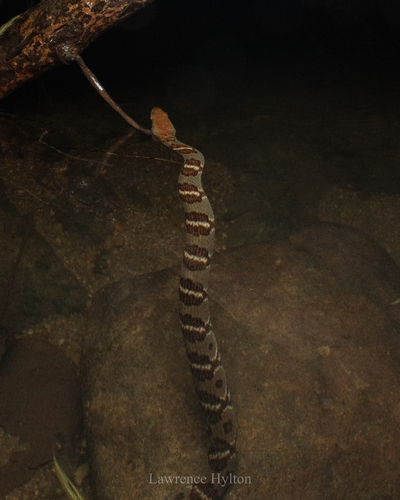 Asiatic Water SnakeTrimerodytes aequifasciatusHarmless
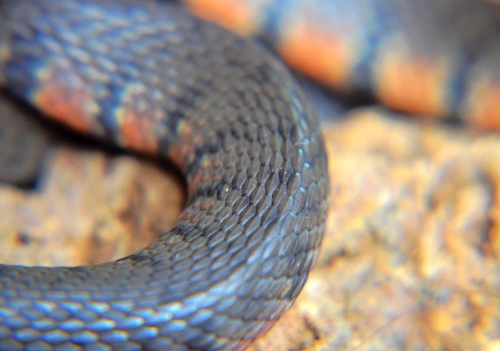 Ringed Water SnakeTrimerodytes annularisHarmless
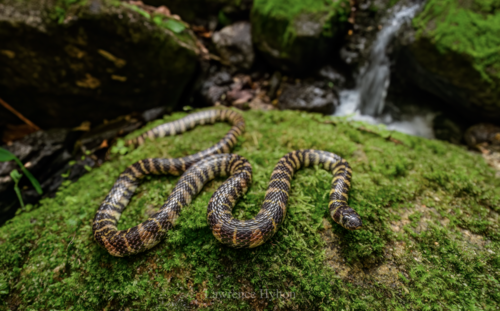 Banded Stream SnakeTrimerodytes balteatusHarmless
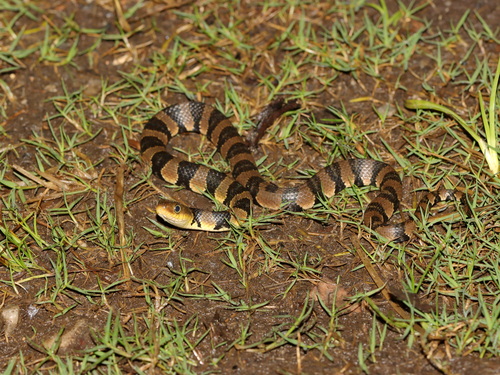 Yunnan Keelback Water SnakeTrimerodytes yunnanensisHarmless
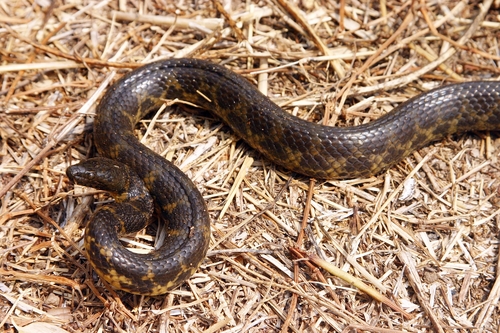 Angel's Mountain KeelbackTrimerodytes praemaxillarisHarmless
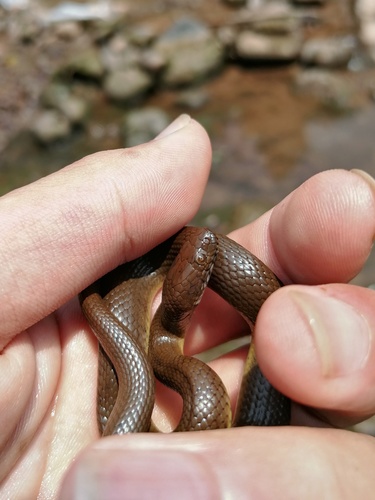 Trimerodytes yapingiHarmless
Keep learning
- What Is a Snake? Anatomy and the BasicsA clear overview of what makes a snake a snake: limbless body plan, anatomy, evolution from lizards, species diversity, and why they are ectothermic.
- How Snakes Move, Hunt, and EatHow snakes move without legs, hunt as ambushers or active foragers, kill by constriction or venom, and swallow prey wider than their head.
- What Do Snakes Eat?All snakes are carnivores. Learn what snakes eat, how diet changes with size and age, how often they feed, and how they hunt and swallow prey.
- Venomous vs Nonvenomous: How to Tell the DifferenceThe folk rules for telling venomous snakes apart, where each one fails, and why location-based identification beats guessing by sight.