
Genus · Elapidae
Types of forest snakes
3 species make up the genus Toxicocalamus, the snakes commonly called forest snakes. All of them are venomous.
About New Guinea forest snakes
Small, secretive burrowing elapids found almost entirely on New Guinea and its satellite islands.
Toxicocalamus is a genus of slender, ground-dwelling snakes in the family Elapidae, the same family that includes cobras, mambas, sea snakes, and the venomous land snakes of Australia. The name translates roughly to "poison reed," a nod to the slim, reed-like body shape. Members go by names like Owen Stanley Range Forest Snake, Preuss's Forest Snake, and Woodlark Forest Snake, and the group is often called the New Guinea forest snakes or forest snakes. Within the elapid family they belong to the Australo-Papuan radiation, the same broad lineage that produced Australia's terrestrial elapids.
These snakes are tied almost exclusively to New Guinea, including the Indonesian and Papua New Guinea portions of the island, along with several smaller offshore islands such as Woodlark. They favor wet tropical environments: rainforest floor, leaf litter, soft soil, garden edges, and the margins of cultivated land from the lowlands up into mid-elevation montane forest. They are fossorial to semi-fossorial, meaning they spend much of their lives burrowing through soil and decaying vegetation rather than out in the open.
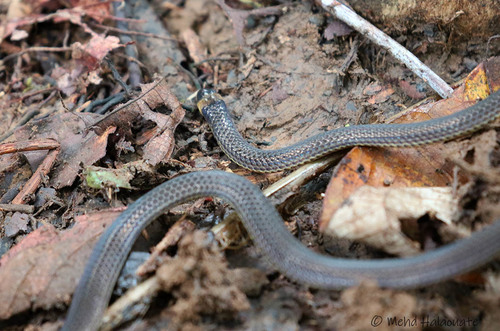
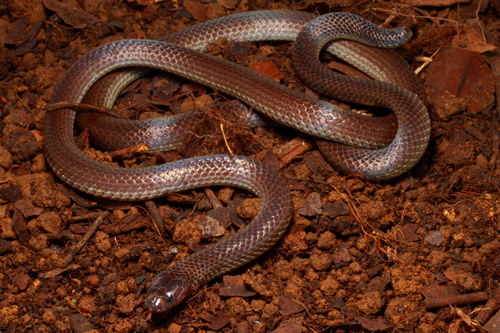
In general terms, expect a small, smooth-scaled snake with a narrow, blunt head not much wider than the neck, small eyes suited to a life underground, and a cylindrical body. Coloration across the genus tends toward plain browns, grays, and blackish tones, sometimes with lighter underparts or faint markings. Their burrowing build and modest size make them easy to mistake for harmless ground-dwelling snakes, which is exactly why a confident field identification of any small New Guinea snake should be left to specialists.
Like all elapids, Toxicocalamus snakes are venomous and possess fixed front fangs. That said, they are small, reclusive, and not considered a major medical threat to people, and bites are rare given how seldom they are encountered. This is not a reason to treat one as safe. Never handle a wild venomous snake, and never rely on appearance or reputation to judge that a snake is harmless. If anyone is bitten, treat it as a medical emergency: keep the person calm and still and get professional care immediately by contacting local emergency services, or in the United States US Poison Control at 1-800-222-1222.
Ecologically these snakes are diet specialists. Several species are known or strongly suspected to feed heavily on earthworms and other soft-bodied soil invertebrates, which fits their burrowing lifestyle. They are secretive and rarely seen above ground, often turning up only when soil is disturbed or after heavy rain. Reproduction in the genus is poorly documented, but like many elapids they are believed to be egg-layers. Because many species are known from very few specimens, much of their natural history remains genuinely unknown, and reliable details are best drawn from broader elapid biology rather than assumed for any single obscure species.
Toxicocalamus belongs to the Elapidae family (Cobras, mambas, coral & sea snakes). Front-fanged venomous snakes, many with potent neurotoxic venom. Usually slender with a head barely wider than the neck and fixed front fangs (not the folding fangs of vipers). Coral snakes are boldly ringed; sea snakes have a flattened, paddle-like tail.
Danger: All elapids are venomous and the family is responsible for a large share of fatal snakebites worldwide. Many are shy, but bites can be life-threatening. Treat any bite as a medical emergency.
All species (3)
Keep learning
- Venomous vs Nonvenomous: How to Tell the DifferenceThe folk rules for telling venomous snakes apart, where each one fails, and why location-based identification beats guessing by sight.
- Are Snakes Dangerous? The Real Risk, in PerspectiveMost snakes are harmless and avoid people. Here is the honest picture of snakebite risk worldwide and how to lower your own.
- Snake Venom Explained: How It Works and WhyWhat snake venom actually is, why it evolved, the main venom types, fang delivery, how antivenom works, and why ranking the most venomous snake is hard.
- How Snakes Move, Hunt, and EatHow snakes move without legs, hunt as ambushers or active foragers, kill by constriction or venom, and swallow prey wider than their head.