
Genus · Colubridae
Types of tree snakes
4 species make up the genus Thrasops, the snakes commonly called tree snakes. None are considered dangerous to humans.
About black tree snakes
Large, glossy black African tree snakes built for life in the forest canopy.
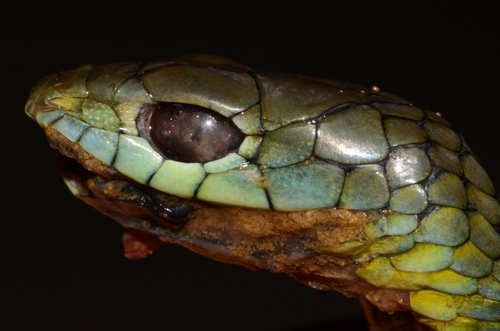
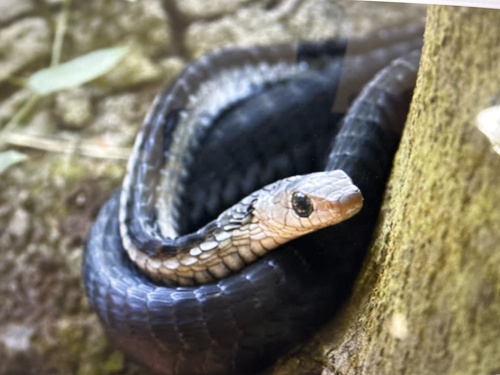
Thrasops is a small genus of African snakes in the family Colubridae, the largest and most diverse snake family in the world. The genus holds a handful of slender, agile, tree-dwelling species found across the forests of sub-Saharan Africa. Members are often called black tree snakes or bold-eyed tree snakes, the latter name pointing to their notably large eyes.
These snakes live in the rainforests and moist woodlands of Central, West, and East Africa, ranging through regions of the Congo Basin and the forest belts that surround it. They are strongly arboreal, meaning they spend most of their lives up in trees and shrubs rather than on the ground. The large eyes are a clue to their lifestyle: good vision helps an active, daytime hunter move and strike among branches.
In general terms, you recognize a Thrasops by its long, thin body, a fairly distinct head, and large round eyes. Adults are typically dark, often glossy black or near-black, which is the source of the common name. They are fast and alert, and when threatened some species can inflate the neck or forebody to look larger. Because several harmless or mildly venomous African tree snakes share a similar slim black build, identification by color alone is unreliable, and a confident ID usually needs an expert or clear photos of head and scale detail.
Thrasops are not considered dangerous to people and are generally regarded as harmless to humans. Like many colubrids they are not front-fanged vipers or cobras, and they pose no serious medical threat in the way a true venomous snake does. That said, the responsible rule with any wild snake you cannot positively identify is to leave it alone: do not handle, corner, or try to catch it, since misidentification is the real risk in the field. If a bite from any snake breaks the skin and you are unsure what species it was, treat it as a medical matter, keep the limb still, and contact emergency care. In the US that is Poison Control at 1-800-222-1222 or local emergency services; elsewhere, contact your local emergency number.
Ecologically these are active hunters. Their diet centers on the kinds of prey available in the canopy, and their slender, climbing build suits chasing fast, agile targets through vegetation. Like the great majority of colubrids, Thrasops species reproduce by laying eggs rather than giving live birth. Their behavior is typically shy and flight-prone around people, relying on speed and the cover of dense foliage to escape rather than on any aggressive defense.
Thrasops belongs to the Colubridae family (Colubrids). The largest snake family, and the one most snakes you meet belong to. Typically round pupils, a head only slightly wider than the neck, and no heat-sensing facial pit or rattle. Scales may be smooth and glossy or keeled and matte depending on the species.
Danger: Almost all colubrids are harmless. A small number are rear-fanged with medically significant venom, the boomslang and the twig (vine) snakes of Africa being the dangerous exceptions. Most colubrids will flee or bluff rather than bite.
All species (4)
Keep learning
- What Is a Snake? Anatomy and the BasicsA clear overview of what makes a snake a snake: limbless body plan, anatomy, evolution from lizards, species diversity, and why they are ectothermic.
- How Snakes Move, Hunt, and EatHow snakes move without legs, hunt as ambushers or active foragers, kill by constriction or venom, and swallow prey wider than their head.
- What Do Snakes Eat?All snakes are carnivores. Learn what snakes eat, how diet changes with size and age, how often they feed, and how they hunt and swallow prey.
- Venomous vs Nonvenomous: How to Tell the DifferenceThe folk rules for telling venomous snakes apart, where each one fails, and why location-based identification beats guessing by sight.