
Genus · Colubridae
Types of twig snakes
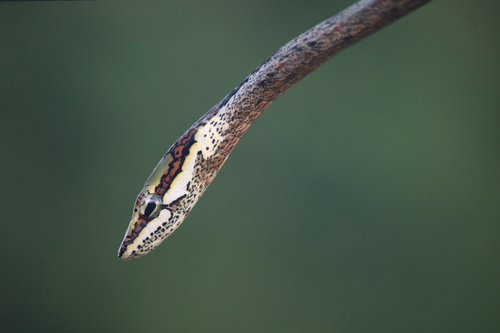
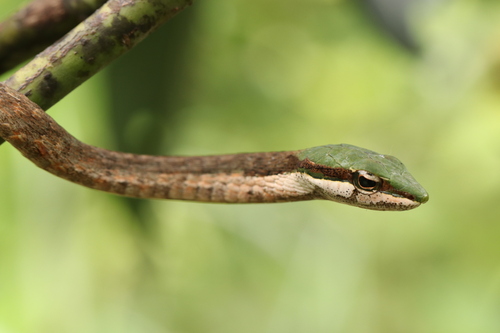
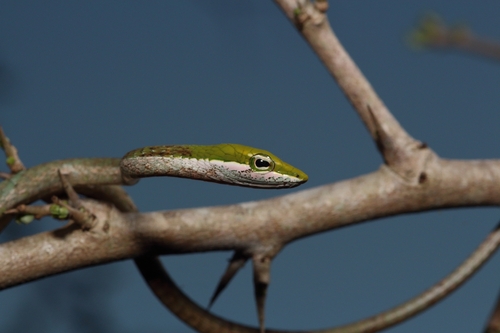
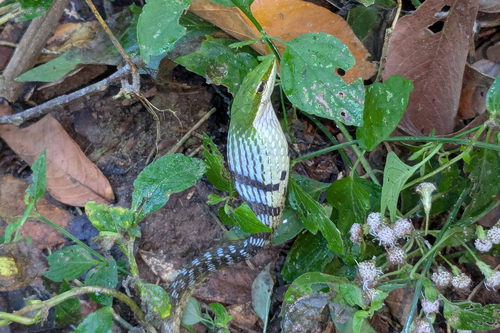
4 species make up the genus Thelotornis, the snakes commonly called twig snakes. All of them are venomous.
About twig snakes (vine snakes / bird snakes)
Twig snakes are slender, tree-dwelling African colubrids whose rear-fanged venom is genuinely dangerous and has no antivenom.
Thelotornis is a genus of slim, arboreal snakes in the family Colubridae, the largest snake family. They live in sub-Saharan Africa and are best known by the common names twig snake, vine snake, and bird snake. The genus holds about four recognized species, including the savanna twig snake, the eastern twig snake, and the forest or Usambara forms. They share their general look and lifestyle with several other African tree snakes, most famously the boomslang, to which they are related and ecologically similar.
These snakes are built for life in trees and shrubs. The body is extremely long and thin, the tail makes up a large share of the total length, and the head is narrow and elongated with a pointed snout. A standout feature is the eye: the pupil is horizontal and keyhole shaped, which gives binocular forward vision useful for judging distance when striking. Coloration is cryptic, a mix of grays, browns, and lichen-like speckling that lets a motionless twig snake vanish against bark and dead branches. When threatened, a twig snake may inflate its throat to show bright interscale skin, a warning display.
Recognizing the genus in the field comes down to the combination of a whip-thin body, a long pointed head, the distinctive horizontal keyhole pupil, and a habit of resting stretched out and rigid among branches to mimic a twig or vine. They are slow, deliberate movers that rely on camouflage and patience rather than speed.
Twig snakes are rear-fanged and venomous, and they are not harmless. Unlike most rear-fanged colubrids, members of this genus carry venom that is medically significant. It is a potent hemotoxin that disrupts blood clotting, and serious envenomations can cause internal bleeding that develops slowly over hours to days. There is no commercially available antivenom for Thelotornis bites, which makes the genus especially serious. Do not handle wild twig snakes. Any suspected bite is a medical emergency: seek professional care immediately and contact local emergency services, or in the US contact Poison Control at 1-800-222-1222.
Ecologically, twig snakes are sit-and-wait predators of small vertebrates. They feed heavily on lizards such as chameleons and geckos, along with frogs, small birds, and nestlings, using their forward vision and slow stalking to ambush prey, then chewing to work the venom in. They are diurnal and almost entirely arboreal. Like many colubrids they reproduce by laying eggs, with elongated clutches deposited in sheltered spots, and the young hatch as miniature versions of the adults.
Thelotornis belongs to the Colubridae family (Colubrids). The largest snake family, and the one most snakes you meet belong to. Typically round pupils, a head only slightly wider than the neck, and no heat-sensing facial pit or rattle. Scales may be smooth and glossy or keeled and matte depending on the species.
Danger: Almost all colubrids are harmless. A small number are rear-fanged with medically significant venom, the boomslang and the twig (vine) snakes of Africa being the dangerous exceptions. Most colubrids will flee or bluff rather than bite.
All species (4)
Keep learning
- Venomous vs Nonvenomous: How to Tell the DifferenceThe folk rules for telling venomous snakes apart, where each one fails, and why location-based identification beats guessing by sight.
- Are Snakes Dangerous? The Real Risk, in PerspectiveMost snakes are harmless and avoid people. Here is the honest picture of snakebite risk worldwide and how to lower your own.
- Snake Venom Explained: How It Works and WhyWhat snake venom actually is, why it evolved, the main venom types, fang delivery, how antivenom works, and why ranking the most venomous snake is hard.
- How Snakes Move, Hunt, and EatHow snakes move without legs, hunt as ambushers or active foragers, kill by constriction or venom, and swallow prey wider than their head.