
Genus · Colubridae
Thamnodynastes
4 species make up the genus Thamnodynastes. None are considered dangerous to humans.
About South American mock vipers
Small, keel-scaled, rear-fanged colubrids of South America that flatten and pose like vipers when alarmed.
Thamnodynastes is a genus of small to medium snakes in the family Colubridae, the largest and most diverse snake family in the world. Its members are often called mock vipers or coastal house snakes because of the way they bluff a defensive, broad-headed posture that resembles a true viper. The genus is South American, and most species are found across tropical and subtropical lowlands, with several reaching the warmer fringes of the continent.
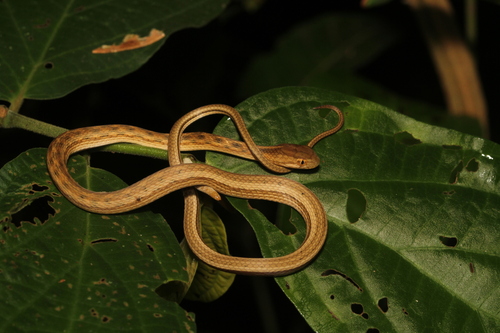
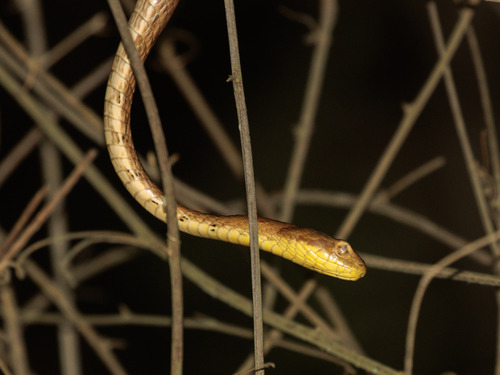
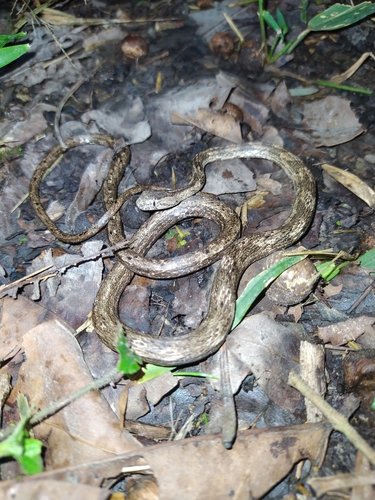
These snakes are generally slender to moderately built with a fairly distinct head, vertically elliptical pupils that hint at their crepuscular and nocturnal habits, and keeled body scales that give them a rough, matte appearance. Color is usually muted brown, gray, or olive, frequently marked with longitudinal stripes or rows of darker blotches that break up the outline. Because many species look similar and the genus has a tangled taxonomy that is still being revised, confident species identification typically depends on close examination and knowing the region, rather than color alone.
Thamnodynastes are mostly active in the evening and at night, when they hunt on the ground and in low vegetation, and many are associated with damp habitats near water, marshes, fields, and forest edges. Their diet leans toward small ectothermic prey such as frogs, tadpoles, fish, and lizards, with some species taking small mammals. A notable trait in the genus is that many species are live-bearing, giving birth to litters of young rather than laying eggs, which is less common across colubrids as a whole.
Members of this genus are rear-fanged, meaning they have enlarged grooved teeth set toward the back of the upper jaw and a mild venom that helps subdue small prey. They are not front-fanged venomous snakes like vipers, cobras, or pit vipers, and they are not regarded as dangerous to people. Their main defense is bluff and flattening rather than a serious bite. Even so, no wild snake should be handled, and a bite from any rear-fanged snake that produces unusual swelling, pain, or other symptoms warrants medical attention.
Because they are inconspicuous, nocturnal, and harmless to humans in practical terms, these snakes are easy to overlook and are often mistaken for vipers, which can lead to needless killing. The Amazon Coastal House Snake is one representative of the group. If you encounter a mock viper in the field, the right response is to observe it from a distance and leave it alone.
Thamnodynastes belongs to the Colubridae family (Colubrids). The largest snake family, and the one most snakes you meet belong to. Typically round pupils, a head only slightly wider than the neck, and no heat-sensing facial pit or rattle. Scales may be smooth and glossy or keeled and matte depending on the species.
Danger: Almost all colubrids are harmless. A small number are rear-fanged with medically significant venom, the boomslang and the twig (vine) snakes of Africa being the dangerous exceptions. Most colubrids will flee or bluff rather than bite.
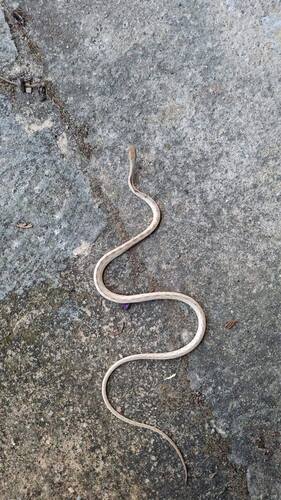
All species (4)
Keep learning
- What Is a Snake? Anatomy and the BasicsA clear overview of what makes a snake a snake: limbless body plan, anatomy, evolution from lizards, species diversity, and why they are ectothermic.
- How Snakes Move, Hunt, and EatHow snakes move without legs, hunt as ambushers or active foragers, kill by constriction or venom, and swallow prey wider than their head.
- What Do Snakes Eat?All snakes are carnivores. Learn what snakes eat, how diet changes with size and age, how often they feed, and how they hunt and swallow prey.
- Venomous vs Nonvenomous: How to Tell the DifferenceThe folk rules for telling venomous snakes apart, where each one fails, and why location-based identification beats guessing by sight.