
Genus · Colubridae
Taeniophallus
2 species make up the genus Taeniophallus. None are considered dangerous to humans.
About forest ground snakes
Taeniophallus are small, secretive South American forest snakes that spend their lives in the leaf litter.
Taeniophallus is a genus of small ground-dwelling snakes in the family Colubridae, placed within the large Neotropical subfamily Dipsadinae. These are the so-called forest ground snakes of Central and South America, slender leaf-litter specialists rather than the big, conspicuous snakes most people picture. Our database holds two species in the genus, including the Short-nosed Groundsnake, and they sit alongside hundreds of other small dipsadine relatives that have radiated across tropical forests. Like most members of this group, they are easy to overlook and rarely seen unless you go looking under fallen leaves and rotting wood.
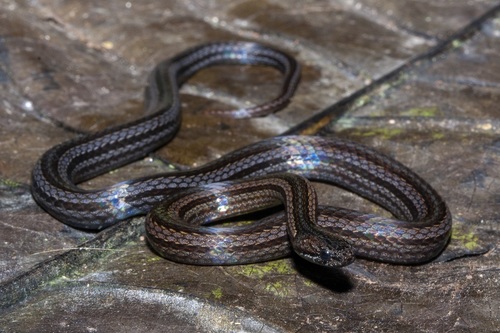
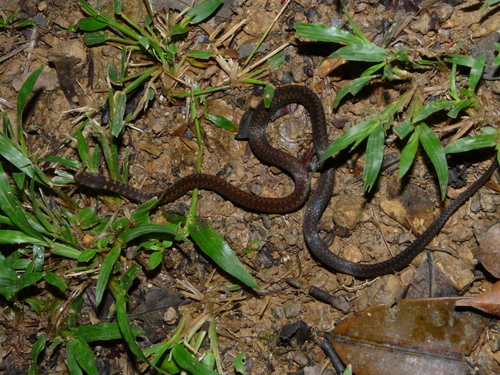
In general terms you recognize a Taeniophallus as a small, slim snake with a modest, often longitudinally striped or lined pattern in browns, grays, and tans that blends into the forest floor. They typically inhabit humid forest, woodland edges, and damp ground litter where they move through the layer of decaying leaves and shallow soil. They are not adapted for climbing, swimming, or burrowing deeply; they are surface foragers of the litter zone. As with many obscure dipsadine genera, the finer points of color and scale counts vary between species and locality, so identification is best confirmed with a regional field guide rather than from memory.
These snakes are harmless to people. Like most colubrids in this subfamily they are non-venomous to humans, small-bodied, and not dangerous, relying on camouflage and quick retreat rather than any meaningful defense. Their diet is built around the small prey of the forest floor, such as frogs, lizards, and invertebrates, and like many small Neotropical colubrids they are egg-layers. Even though they pose no threat, the right move with any wild snake you cannot positively identify is to leave it alone and let it move off; do not handle it, and if anyone is ever bitten by an unidentified snake, contact emergency services or US Poison Control at 1-800-222-1222.
Taeniophallus belongs to the Colubridae family (Colubrids). The largest snake family, and the one most snakes you meet belong to. Typically round pupils, a head only slightly wider than the neck, and no heat-sensing facial pit or rattle. Scales may be smooth and glossy or keeled and matte depending on the species.
Danger: Almost all colubrids are harmless. A small number are rear-fanged with medically significant venom, the boomslang and the twig (vine) snakes of Africa being the dangerous exceptions. Most colubrids will flee or bluff rather than bite.
All species (2)
Keep learning
- What Is a Snake? Anatomy and the BasicsA clear overview of what makes a snake a snake: limbless body plan, anatomy, evolution from lizards, species diversity, and why they are ectothermic.
- How Snakes Move, Hunt, and EatHow snakes move without legs, hunt as ambushers or active foragers, kill by constriction or venom, and swallow prey wider than their head.
- What Do Snakes Eat?All snakes are carnivores. Learn what snakes eat, how diet changes with size and age, how often they feed, and how they hunt and swallow prey.
- Venomous vs Nonvenomous: How to Tell the DifferenceThe folk rules for telling venomous snakes apart, where each one fails, and why location-based identification beats guessing by sight.