
Genus · Colubridae
Types of shadow snakes
9 species make up the genus Synophis, the snakes commonly called shadow snakes. None are considered dangerous to humans.
About fishing snakes
Small, slender Andean forest snakes known as fishing snakes, secretive ground-dwellers that almost no one ever sees.
Synophis is a genus of small, slim snakes in the family Colubridae, the largest and most varied snake family on Earth. Colubrids account for the majority of living snake species and span an enormous range of body plans and habits, so membership in this family tells you a snake is part of a broad, diverse group rather than a tightly uniform one. Within that family, Synophis belongs to the New World snakes of the South American tropics and is treated as part of the dipsadine radiation, a largely harmless-to-people group of small forest and leaf-litter species.
These snakes live in northwestern South America, centered on the Andes and adjacent foothills of Ecuador, Colombia, Peru, and nearby areas. They are creatures of humid montane and cloud forest, where they keep to the damp leaf litter, low vegetation, and the edges of streams. Several of the common names attached to the group, such as fishing snake and shadow snake, point to this preference for moist, shaded, streamside habitat. They are rarely encountered, and much of what is known comes from a relatively small number of specimens.
In general terms, members of Synophis are recognizable as thin, modestly sized snakes with smooth-looking, often dark or shadowed coloration suited to life among wet litter and low cover. Identifying any individual species reliably is a job for specialists using scale counts and locality, because the differences between species are subtle and the genus is still being studied and revised. The honest summary is that these are obscure snakes whose finer details, including the full picture of their biology, remain incompletely documented.
On safety, Synophis are small, non-aggressive snakes that are not considered dangerous to humans and are not known to be a medical threat. Like many colubrids they fall into the broad harmless-to-people category rather than the front-fanged venomous groups such as vipers or elapids. That said, the standard rule for any wild snake applies. Do not handle wild snakes, including small or apparently harmless ones, because field identification can be mistaken and provoking any animal carries risk. If a bite from any snake causes a concerning reaction, contact emergency services or US Poison Control at 1-800-222-1222.
Ecologically these are inconspicuous forest predators. Small Andean leaf-litter snakes of this kind typically feed on small soft-bodied prey such as earthworms, slugs, insects, and small vertebrates, hunting low to the ground and at the margins of water. Like the great majority of colubrids they are understood to be egg-laying, and they are quiet, retiring animals rather than bold or fast-moving ones. Because they are so seldom observed, several specifics of their diet, reproduction, and behavior are still poorly known and remain an active subject of herpetological research.
Synophis belongs to the Colubridae family (Colubrids). The largest snake family, and the one most snakes you meet belong to. Typically round pupils, a head only slightly wider than the neck, and no heat-sensing facial pit or rattle. Scales may be smooth and glossy or keeled and matte depending on the species.
Danger: Almost all colubrids are harmless. A small number are rear-fanged with medically significant venom, the boomslang and the twig (vine) snakes of Africa being the dangerous exceptions. Most colubrids will flee or bluff rather than bite.
All species (9)
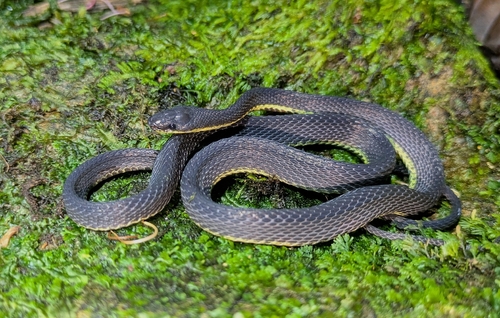 Lasalle's Fishing SnakeSynophis lasalleiHarmless
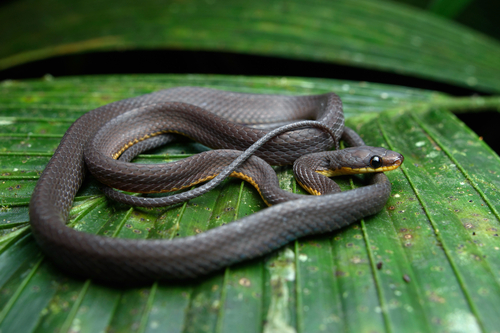 Nicéforo María's Shadow SnakeSynophis niceforomariaeHarmless
 Two-colored Fishing SnakeSynophis bicolorHarmless
 Bogert's Shadow SnakeSynophis bogertiHarmless
 Ecuadorian Fishing SnakeSynophis calamitusHarmless
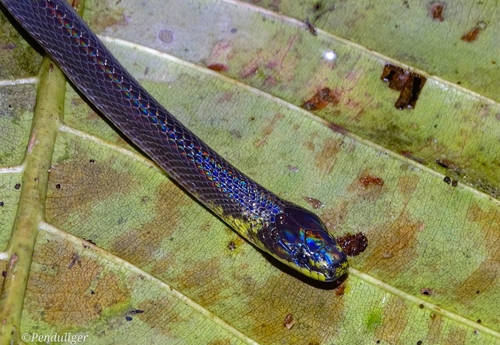 Cauca Fishing SnakeSynophis plectovertebralisHarmless
 Mountain Shadow SnakeSynophis insulomontanusHarmless
 Zaher's Shadow SnakeSynophis zaheriHarmless
 Zamoran Shadow SnakeSynophis zamoraHarmless
Keep learning
- What Is a Snake? Anatomy and the BasicsA clear overview of what makes a snake a snake: limbless body plan, anatomy, evolution from lizards, species diversity, and why they are ectothermic.
- How Snakes Move, Hunt, and EatHow snakes move without legs, hunt as ambushers or active foragers, kill by constriction or venom, and swallow prey wider than their head.
- What Do Snakes Eat?All snakes are carnivores. Learn what snakes eat, how diet changes with size and age, how often they feed, and how they hunt and swallow prey.
- Venomous vs Nonvenomous: How to Tell the DifferenceThe folk rules for telling venomous snakes apart, where each one fails, and why location-based identification beats guessing by sight.