
Genus · Colubridae
Sympholis
The genus Sympholis contains a single species. It is not considered dangerous to humans.
About Mexican short-tailed snake
A burrowing Mexican colubrid known for its blunt, abruptly short tail and ringed body.
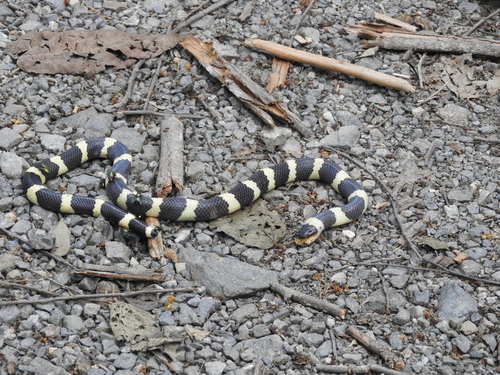
Sympholis is a monotypic genus in the family Colubridae, meaning it contains a single recognized species, Sympholis lippiens, the Mexican short-tailed snake. It belongs to the vast and diverse colubrid family, the largest group of snakes in the world, which holds most of the harmless species people encounter. Sympholis is a fossorial snake, built for life underground and in loose soil rather than in the open, and it is endemic to western and central Mexico along the Pacific slope.
Members are recognized by a stout, cylindrical body, a small head that is barely distinct from the neck, and a notably short, blunt tail that gives the genus its name. The body is typically patterned with alternating bands or rings, often pale yellow or cream against darker brown or black, which along with the burrowing build makes it look superficially like some other small ground-dwelling snakes. Adults are modest in size, generally well under a meter. The smooth scales and reduced eyes are typical adaptations of a snake that spends much of its time below the surface.
This is a secretive, non-venomous, harmless snake to people, with no functional venom delivery and a temperament suited to hiding rather than confrontation. Like most fossorial colubrids it feeds on small prey it encounters underground, and it lays eggs as colubrids generally do. Because it is rarely seen, much of its detailed natural history is poorly documented, which is normal for an obscure burrowing taxon. If you ever need to identify a wild snake or are bitten by any snake you cannot confidently identify, do not handle it and contact local emergency services or US Poison Control at 1-800-222-1222.
Sympholis belongs to the Colubridae family (Colubrids). The largest snake family, and the one most snakes you meet belong to. Typically round pupils, a head only slightly wider than the neck, and no heat-sensing facial pit or rattle. Scales may be smooth and glossy or keeled and matte depending on the species.
Danger: Almost all colubrids are harmless. A small number are rear-fanged with medically significant venom, the boomslang and the twig (vine) snakes of Africa being the dangerous exceptions. Most colubrids will flee or bluff rather than bite.
All species (1)
Keep learning
- What Is a Snake? Anatomy and the BasicsA clear overview of what makes a snake a snake: limbless body plan, anatomy, evolution from lizards, species diversity, and why they are ectothermic.
- How Snakes Move, Hunt, and EatHow snakes move without legs, hunt as ambushers or active foragers, kill by constriction or venom, and swallow prey wider than their head.
- What Do Snakes Eat?All snakes are carnivores. Learn what snakes eat, how diet changes with size and age, how often they feed, and how they hunt and swallow prey.
- Venomous vs Nonvenomous: How to Tell the DifferenceThe folk rules for telling venomous snakes apart, where each one fails, and why location-based identification beats guessing by sight.