
Genus · Xenodermidae
Stoliczkia
The genus Stoliczkia contains a single species. It is not considered dangerous to humans.
About dragon snakes
A tiny genus of rough-scaled, secretive forest snakes from the hill country of South and Southeast Asia.
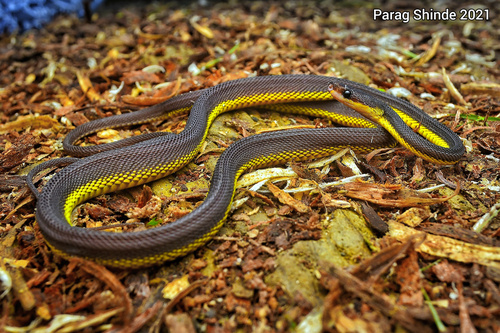
Stoliczkia is a small genus in the family Xenodermidae, the so-called dragon snakes or odd-scaled snakes. The genus is best known from the Lushai Hills Dragon Snake, a rarely seen, ground-dwelling serpent recorded from the forested hills along the borderlands of northeast India, Bangladesh, and Myanmar, with related populations reported elsewhere in the region. Xenodermids are an old, distinct lineage that sits near the base of the advanced snakes, separate from the larger families of colubrids and vipers, which is part of why they look and behave so differently from the snakes most people know.
What sets these snakes apart is their skin. Like other members of Xenodermidae, Stoliczkia tend to have a rough, almost unfinished texture, with strongly keeled or ridged scales and rows of enlarged scales that break up the smooth lines you see on most snakes. They are slender, modest in size rather than large, and dark or muted in color, which suits a life spent in leaf litter, under logs, and in the damp soil of cool, wet montane forest. In general terms you recognize them by that distinctly rough, beaded look combined with a small body and a preference for hidden, moist microhabitats rather than open ground.
These are harmless, non-venomous snakes with no medical importance to people. They are not aggressive and pose no danger; the genus is so seldom encountered that almost all knowledge comes from a handful of preserved specimens, which is exactly why specific claims about diet, breeding, and behavior should be treated cautiously. Based on the family, the reasonable expectation is that they hunt soft-bodied prey such as worms, slugs, and other small invertebrates in the leaf litter, are secretive and most active in cool, humid conditions, and like several xenodermids may lay eggs. As a rule, do not handle wild snakes you cannot confidently identify, and if anyone is bitten by an unknown snake, seek medical care and contact US Poison Control at 1-800-222-1222 or your local emergency services.
Stoliczkia belongs to the Xenodermidae family (Odd-scaled snakes). Forest snakes with strange, knob-like scales. Distinctive bumpy, irregular scalation unlike the smooth or evenly keeled scales of most snakes.
Danger: Harmless.
All species (1)
Keep learning
- What Is a Snake? Anatomy and the BasicsA clear overview of what makes a snake a snake: limbless body plan, anatomy, evolution from lizards, species diversity, and why they are ectothermic.
- How Snakes Move, Hunt, and EatHow snakes move without legs, hunt as ambushers or active foragers, kill by constriction or venom, and swallow prey wider than their head.
- What Do Snakes Eat?All snakes are carnivores. Learn what snakes eat, how diet changes with size and age, how often they feed, and how they hunt and swallow prey.
- Venomous vs Nonvenomous: How to Tell the DifferenceThe folk rules for telling venomous snakes apart, where each one fails, and why location-based identification beats guessing by sight.