
Genus · Colubridae
Types of diadem snakes
5 species make up the genus Spalerosophis, the snakes commonly called diadem snakes. None are considered dangerous to humans.
About diadem and royal snakes
Fast, desert-loving colubrids of North Africa and Asia, marked by the dark, crown-like patch on the head that gives them their name.
Spalerosophis is a genus of slender, agile snakes in the family Colubridae, the largest snake family and one made up overwhelmingly of harmless or only mildly venomous species. The genus is small, with about five recognized species, and its members are commonly called diadem snakes or royal snakes. The names come from the patterned head marking many of them carry, a dark, crown-shaped or diadem-like blotch set against a paler background.
These snakes are creatures of dry country. Their range stretches across North Africa, the Middle East, and into Central and South Asia, including parts of India and Pakistan. They favor arid and semi-arid habitats: rocky deserts, sandy flats, scrubland, dry grassland, and the edges of cultivated fields and human settlements where prey is easy to find. Several species tolerate heat well and are active hunters in open terrain.
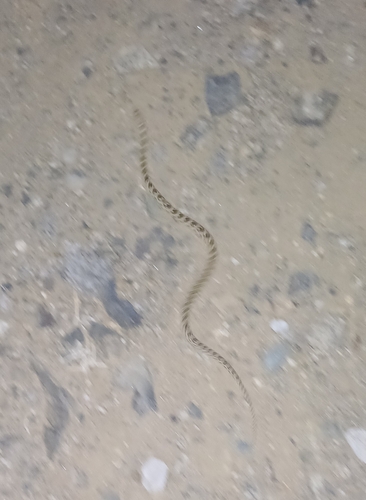
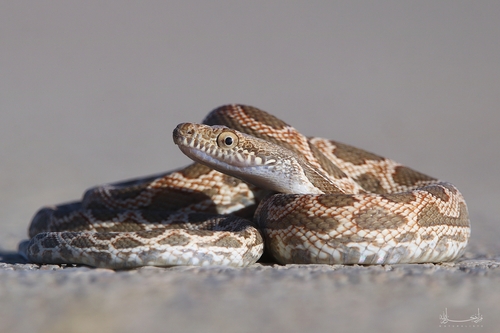
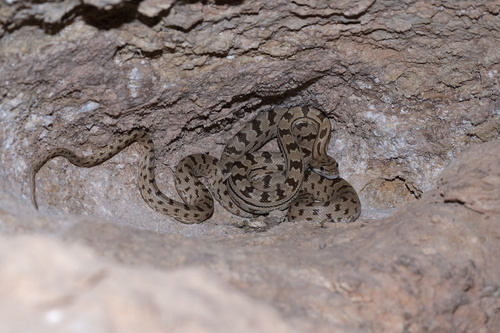
Recognizing a Spalerosophis in general terms means looking for a moderately long, lightly built snake, often pale tan, gray, or reddish to blend with sandy and rocky ground, frequently showing a row of darker saddles or blotches down the back and the characteristic dark head marking. Sizes vary by species, with many adults falling in the roughly 1 to 1.5 meter range. As with many colubrids, exact patterning and color shift with region and individual, so identification is best confirmed by an expert and good photographs rather than a single field trait.
On the question of danger: these are non-venomous to at most very mildly rear-fanged colubrids and are not considered a medical threat to people. They are not front-fanged venomous snakes and are not aggressive by nature, though like any wild snake they may bite if cornered or handled. That does not make any wild snake safe to pick up. Do not handle wild snakes, give them space, and if anyone is bitten by a snake whose identity is uncertain, seek medical care promptly. In the United States contact Poison Control at 1-800-222-1222 or call local emergency services; elsewhere use your local emergency number.
Ecologically, Spalerosophis snakes are active, fast-moving daytime and twilight hunters that prey on small vertebrates such as rodents, lizards, and sometimes birds and their eggs, making them useful natural controllers of rodent populations near farms and villages. Like most colubrids in this group they are egg-laying, with females depositing clutches of eggs that hatch into independent young. Their speed, alertness, and tolerance of dry, human-altered landscapes make them a familiar sight across much of their range.
Spalerosophis belongs to the Colubridae family (Colubrids). The largest snake family, and the one most snakes you meet belong to. Typically round pupils, a head only slightly wider than the neck, and no heat-sensing facial pit or rattle. Scales may be smooth and glossy or keeled and matte depending on the species.
Danger: Almost all colubrids are harmless. A small number are rear-fanged with medically significant venom, the boomslang and the twig (vine) snakes of Africa being the dangerous exceptions. Most colubrids will flee or bluff rather than bite.
All species (5)


Keep learning
- What Is a Snake? Anatomy and the BasicsA clear overview of what makes a snake a snake: limbless body plan, anatomy, evolution from lizards, species diversity, and why they are ectothermic.
- How Snakes Move, Hunt, and EatHow snakes move without legs, hunt as ambushers or active foragers, kill by constriction or venom, and swallow prey wider than their head.
- What Do Snakes Eat?All snakes are carnivores. Learn what snakes eat, how diet changes with size and age, how often they feed, and how they hunt and swallow prey.
- Venomous vs Nonvenomous: How to Tell the DifferenceThe folk rules for telling venomous snakes apart, where each one fails, and why location-based identification beats guessing by sight.