
Genus · Colubridae
Types of night snakes
7 species make up the genus Siphlophis, the snakes commonly called night snakes. None are considered dangerous to humans.
About tropical flat snakes and spotted night snakes
Siphlophis is a small group of slender, mostly nocturnal Neotropical colubrids known for boldly patterned bodies and large eyes.
Siphlophis is a genus in the family Colubridae, the largest and most diverse snake family on Earth. The roughly seven species in our database are sometimes called tropical flat snakes or spotted night snakes, and they live in Central and South America. Like most members of Colubridae, they are slender, agile snakes built for active foraging rather than ambush.
These snakes are tropical and subtropical animals. Their range spans parts of Central America and a broad swath of South America, where they occupy forested and well vegetated habitats. Many members are at home in trees and shrubs, climbing through branches at night, while others move through leaf litter and lower vegetation. The genus name itself refers to the slender, drawn out body shape typical of the group.
In general terms, Siphlophis snakes are recognized by a thin body, a head that is distinct from the neck, and noticeably large eyes with vertical or rounded pupils that suit a nocturnal lifestyle. Coloration tends toward strong patterns of bands, blotches, or spots, often in reds, oranges, browns, and blacks, which is reflected in common names like spotted night snake. Pattern and color vary between species and regions, so identification of an exact species is best confirmed by a herpetologist or regional field guide.
Members of this genus are rear-fanged, meaning they have enlarged grooved teeth toward the back of the upper jaw and a mild venom used to subdue small prey. They are not considered dangerous to people, and bites from rear-fanged colubrids like these are typically minor. Even so, no wild snake should be handled. If a bite occurs and any concerning symptoms develop, do not wait it out. In the United States contact Poison Control at 1-800-222-1222, and anywhere call local emergency services for medical care.
Ecologically, Siphlophis snakes are nocturnal hunters that feed on small vertebrates such as lizards and frogs, with some species also taking small reptile eggs or other prey. As with the vast majority of colubrids, they reproduce by laying eggs. Their behavior is generally secretive and non aggressive; when found they are more likely to flee or hide than to confront a person.
Siphlophis belongs to the Colubridae family (Colubrids). The largest snake family, and the one most snakes you meet belong to. Typically round pupils, a head only slightly wider than the neck, and no heat-sensing facial pit or rattle. Scales may be smooth and glossy or keeled and matte depending on the species.
Danger: Almost all colubrids are harmless. A small number are rear-fanged with medically significant venom, the boomslang and the twig (vine) snakes of Africa being the dangerous exceptions. Most colubrids will flee or bluff rather than bite.
All species (7)
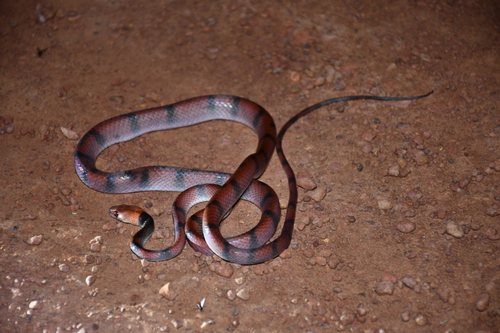 Tropical Flat SnakeSiphlophis compressusHarmless
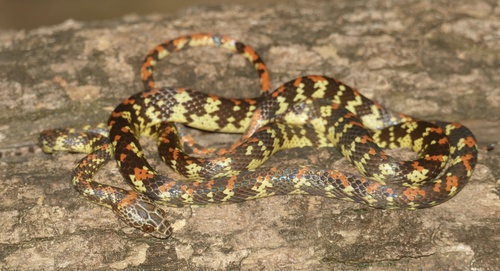 Panama Spotted Night SnakeSiphlophis cervinusHarmless
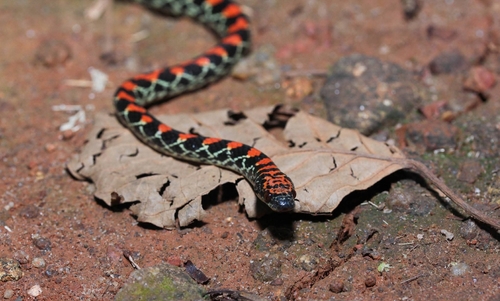 Guanabara Spotted Night SnakeSiphlophis pulcherHarmless
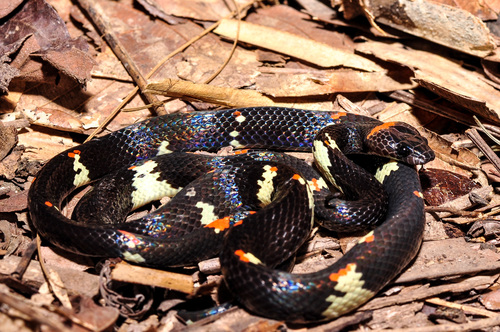 Worontzow's Spotted Night SnakeSiphlophis worontzowiHarmless
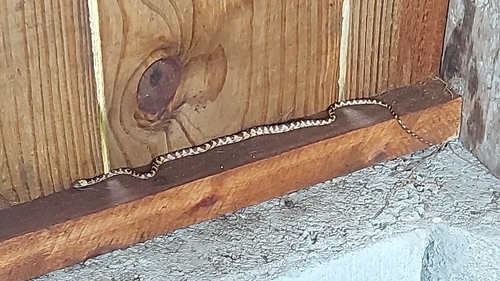 Brazilian Spotted Night SnakeSiphlophis longicaudatusHarmless
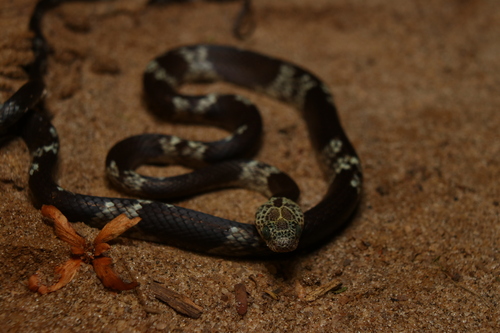 Common Spotted Night SnakeSiphlophis leucocephalusHarmless
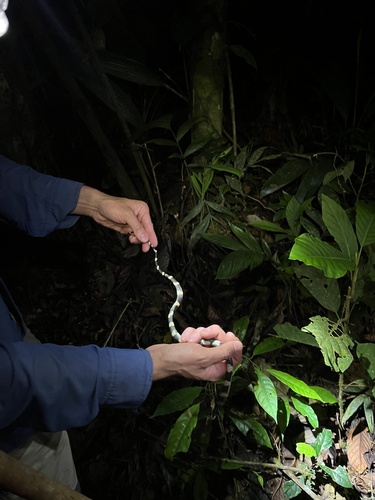 Siphlophis ayaumaHarmless
Keep learning
- What Is a Snake? Anatomy and the BasicsA clear overview of what makes a snake a snake: limbless body plan, anatomy, evolution from lizards, species diversity, and why they are ectothermic.
- How Snakes Move, Hunt, and EatHow snakes move without legs, hunt as ambushers or active foragers, kill by constriction or venom, and swallow prey wider than their head.
- What Do Snakes Eat?All snakes are carnivores. Learn what snakes eat, how diet changes with size and age, how often they feed, and how they hunt and swallow prey.
- Venomous vs Nonvenomous: How to Tell the DifferenceThe folk rules for telling venomous snakes apart, where each one fails, and why location-based identification beats guessing by sight.