
Genus · Elapidae
Types of banded snakes
3 species make up the genus Simoselaps, the snakes commonly called banded snakes. All of them are venomous.
About Australian coral snakes (desert banded snakes)
Small, banded, burrowing elapids of arid Australia that spend most of their lives hidden in sand.
Simoselaps is a genus of small Australian snakes in the family Elapidae, the same front-fanged family that includes cobras, taipans, and sea snakes. Members are often called coral snakes or banded snakes, a reference to their bright crossbands rather than any relationship to the unrelated American coral snakes. The genus belongs to the radiation of terrestrial Australian elapids, a group that dominates the continent's snake fauna and ranges from tiny burrowers like these up to the largest venomous snakes on Earth.
These are burrowing, sand-swimming snakes built for life underground. They are slender and short, typically well under half a meter, with a narrow blunt head that is barely distinct from the neck, smooth glossy scales, and small eyes. A pointed or shovel-like snout helps them push through loose soil. The common pattern is a pale cream, orange, or reddish body crossed by dark bands, sometimes with a dark head shield or nape mark. The three database members, the Southern Desert Banded Snake, the West Coast Banded Snake, and the Northern Desert Banded Snake, fit this template across the dry interior and western parts of the country.
Range and habitat are firmly tied to Australia's arid and semi-arid zones: sandy deserts, spinifex grassland, dry woodland, and coastal dune systems. Simoselaps are fossorial and nocturnal, staying buried by day and moving near the surface at night or after rain. People rarely encounter them in the open. When found, they are usually turned up under logs, leaf litter, or surface debris, or seen crossing roads after dark.
As true elapids, Simoselaps are venomous and front-fanged, not rear-fanged or harmless. In practice they are considered to pose little danger to people: they are small, secretive, reluctant to bite, and carry venom in quantities suited to subduing small reptile prey rather than large mammals. That low risk is not the same as zero risk. Do not handle wild snakes you cannot positively identify, and never assume a small banded snake is safe to pick up. If a bite occurs, treat it as a medical emergency, keep the person calm and still, and seek emergency care immediately. In the United States contact Poison Control at 1-800-222-1222 or call local emergency services; in Australia call 000.
Ecologically these snakes are specialists. Their diet centers heavily on other reptiles, especially small skinks and reptile eggs, which they hunt below the surface. Like most Australian elapids they are egg-laying, producing small clutches. Behavior is shy and defensive rather than aggressive; a cornered individual is more likely to flee, burrow, or display than to strike. Their banded coloring is widely interpreted as a warning or deterrent signal that mimics more dangerous snakes.
Simoselaps belongs to the Elapidae family (Cobras, mambas, coral & sea snakes). Front-fanged venomous snakes, many with potent neurotoxic venom. Usually slender with a head barely wider than the neck and fixed front fangs (not the folding fangs of vipers). Coral snakes are boldly ringed; sea snakes have a flattened, paddle-like tail.
Danger: All elapids are venomous and the family is responsible for a large share of fatal snakebites worldwide. Many are shy, but bites can be life-threatening. Treat any bite as a medical emergency.
All species (3)
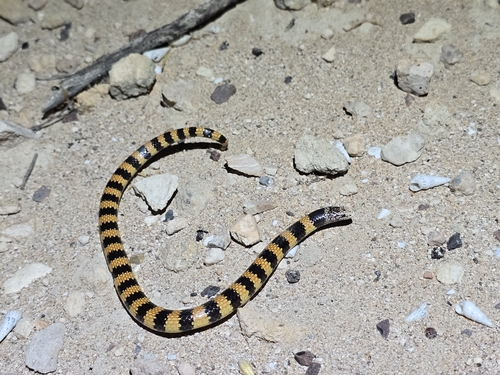
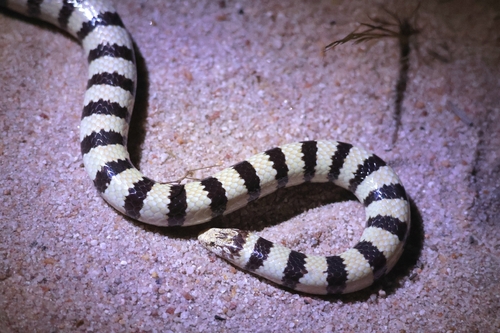
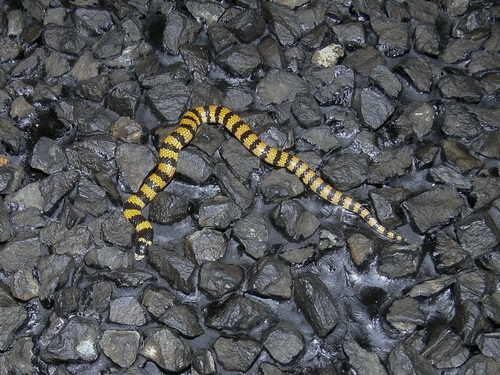
Keep learning
- Venomous vs Nonvenomous: How to Tell the DifferenceThe folk rules for telling venomous snakes apart, where each one fails, and why location-based identification beats guessing by sight.
- Are Snakes Dangerous? The Real Risk, in PerspectiveMost snakes are harmless and avoid people. Here is the honest picture of snakebite risk worldwide and how to lower your own.
- Snake Venom Explained: How It Works and WhyWhat snake venom actually is, why it evolved, the main venom types, fang delivery, how antivenom works, and why ranking the most venomous snake is hard.
- How Snakes Move, Hunt, and EatHow snakes move without legs, hunt as ambushers or active foragers, kill by constriction or venom, and swallow prey wider than their head.