
Genus · Colubridae
Types of neckband snakes
2 species make up the genus Scaphiodontophis, the snakes commonly called neckband snakes. None are considered dangerous to humans.
About neckband snakes
Small, fast Central American forest snakes built like miniature coral snake mimics.
Scaphiodontophis is a small genus of colubrid snakes in the large family Colubridae, the catch-all family that holds most of the world's non-venomous and rear-fanged snakes. The genus is best known by its English name, the neckband snakes, after the dark band or collar that often marks the neck just behind the head. Our database covers two members, the Guatemala Neckband Snake and the Common Neckband Snake, both native to the forests of Mexico and Central America. As colubrids in this group, they sit far from the front-fanged vipers and elapids and pose no meaningful danger to people.
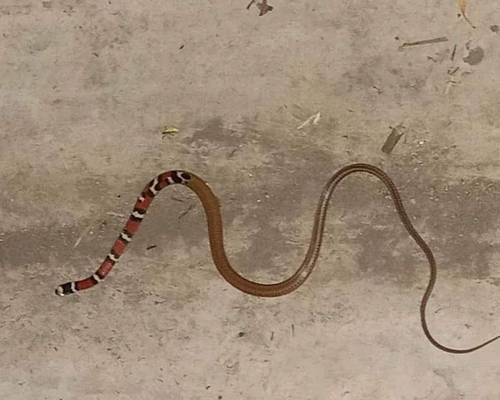
These are slender, fast-moving, mostly ground-dwelling snakes of humid lowland and lower montane forest, where they spend much of their time in leaf litter and along the moist forest floor. Many neckband snakes carry bands of red, black, and pale color along the front of the body that grade into a plainer striped or unmarked tail. The banded front end is widely read as mimicry of the venomous coral snakes that share their range, a defense that can buy a harmless snake a moment of hesitation from a predator. The unusual genus name refers to their distinctive hinged, blade-like teeth, an adaptation tied to their prey.
Neckband snakes are harmless to humans. They are not front-fanged and are not considered dangerous; like many colubrids they may have ungrooved rear teeth and very mild saliva, but they are not a venomous-snake risk to people. They feed largely on small, slick prey such as skinks and other lizards, and their specialized teeth help them grip and swallow these smooth, fast targets. Like most colubrids in the region they lay eggs. As with any wild snake, the right move is to leave it alone and let it move off rather than handle it. In the rare event of any snakebite with uncertain identification, seek medical care and, in the US, contact Poison Control at 1-800-222-1222 or local emergency services.
Scaphiodontophis belongs to the Colubridae family (Colubrids). The largest snake family, and the one most snakes you meet belong to. Typically round pupils, a head only slightly wider than the neck, and no heat-sensing facial pit or rattle. Scales may be smooth and glossy or keeled and matte depending on the species.
Danger: Almost all colubrids are harmless. A small number are rear-fanged with medically significant venom, the boomslang and the twig (vine) snakes of Africa being the dangerous exceptions. Most colubrids will flee or bluff rather than bite.
All species (2)

Keep learning
- What Is a Snake? Anatomy and the BasicsA clear overview of what makes a snake a snake: limbless body plan, anatomy, evolution from lizards, species diversity, and why they are ectothermic.
- How Snakes Move, Hunt, and EatHow snakes move without legs, hunt as ambushers or active foragers, kill by constriction or venom, and swallow prey wider than their head.
- What Do Snakes Eat?All snakes are carnivores. Learn what snakes eat, how diet changes with size and age, how often they feed, and how they hunt and swallow prey.
- Venomous vs Nonvenomous: How to Tell the DifferenceThe folk rules for telling venomous snakes apart, where each one fails, and why location-based identification beats guessing by sight.