
Genus · Colubridae
Types of brown snakes
10+ species make up the genus Rhadinella, the snakes commonly called brown snakes. None are considered dangerous to humans.
About graceful brown snakes
Small, secretive leaf-litter snakes of Central American forests that almost no one ever sees.
Rhadinella is a genus of small terrestrial snakes in the family Colubridae, the largest and most diverse snake family in the world. Within Colubridae these snakes belong to the dipsadine group, a mostly Neotropical assemblage of slender, ground-dwelling colubrids. The common names attached to its members, such as Godman's Graceful Brown Snake, the Striped Litter Snake, the Kinkelin Graceful Brown Snake, and the Monte Cristi Graceful Brown Snake, capture what these animals are: thin, modestly colored snakes that live on and just beneath the forest floor.
The genus is centered on Mexico and Central America, with species ranging through the highlands and montane forests of countries such as Mexico, Guatemala, Honduras, El Salvador, and neighboring areas. Many species are tied to cool, moist cloud forest and mid to high elevation woodland, where they spend their time in leaf litter, under logs, and in the damp layer of soil and debris on the forest floor. Several members are known from only a handful of specimens and small ranges, which makes them some of the more poorly documented snakes in the region.
In general terms, Rhadinella snakes are recognized by their small, slender bodies, smooth scales, and fairly plain coloration in browns, grays, and tans. Some species carry darker longitudinal stripes or a paler line down the side, and many have dark markings around the head or neck. They are easy to overlook and easy to confuse with other small brown litter snakes that share the same habitat, so reliable identification usually comes down to scale counts and locality rather than color alone. As a group they are not large, with most species measuring well under a foot to roughly a foot and a half in total length.
These are harmless snakes to people. Like the great majority of colubrids in this group, they are not front-fanged venomous snakes and pose no danger to humans. Some dipsadine colubrids have enlarged rear teeth and mild saliva used to subdue small prey, but there is no evidence that Rhadinella is medically significant to humans. Even so, the responsible practice with any wild snake is to observe it and leave it alone rather than handle it, since a wild animal can be hard to identify with certainty in the field and may bite defensively.
Ecologically, Rhadinella snakes are quiet predators of the forest floor. They feed on small soft-bodied prey such as insects, insect larvae, earthworms, slugs, and other invertebrates, hunting through litter and soil rather than chasing fast animals. Like many small Neotropical colubrids they are believed to lay eggs, and they are generally shy, ground-bound, and active in cool, humid conditions. Their reliance on intact, moist montane forest makes several species sensitive to habitat loss, which is part of why so little is firmly known about their numbers and behavior.
Rhadinella belongs to the Colubridae family (Colubrids). The largest snake family, and the one most snakes you meet belong to. Typically round pupils, a head only slightly wider than the neck, and no heat-sensing facial pit or rattle. Scales may be smooth and glossy or keeled and matte depending on the species.
Danger: Almost all colubrids are harmless. A small number are rear-fanged with medically significant venom, the boomslang and the twig (vine) snakes of Africa being the dangerous exceptions. Most colubrids will flee or bluff rather than bite.
All species (15)
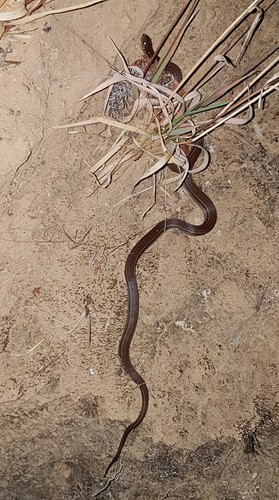 Godman's Graceful Brown SnakeRhadinella godmaniHarmless
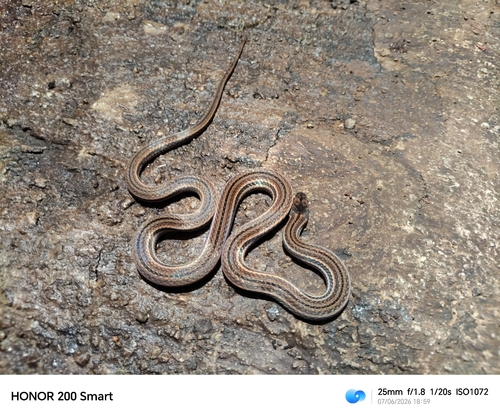 Striped Litter SnakeRhadinella serperasterHarmless
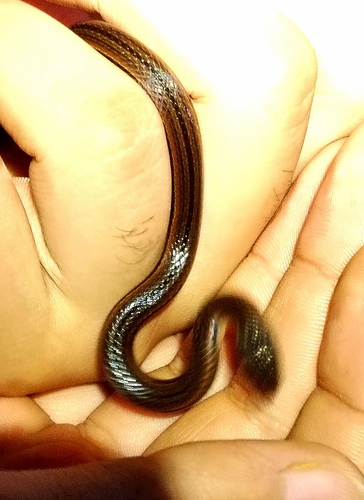 Kinkelin Graceful Brown SnakeRhadinella kinkeliniHarmless
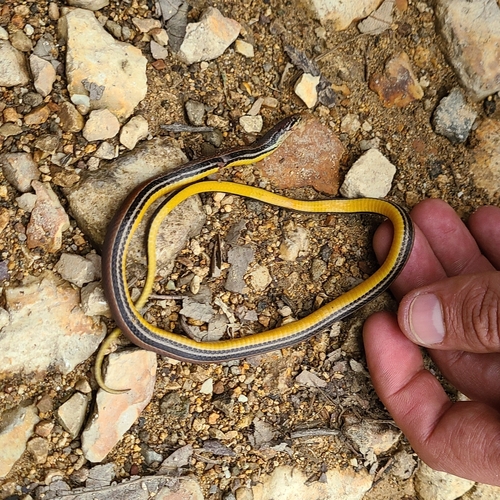 Monte Cristi Graceful Brown SnakeRhadinella montecristiHarmless
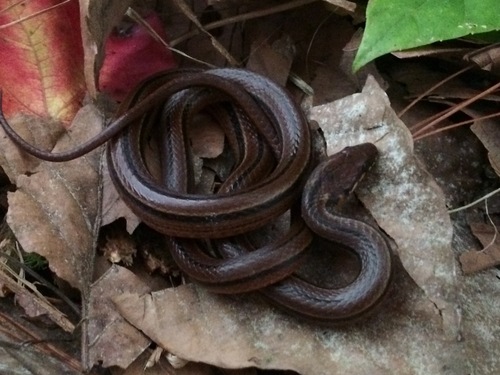 Cusuco Graceful Brown SnakeRhadinella pegosalytaHarmless
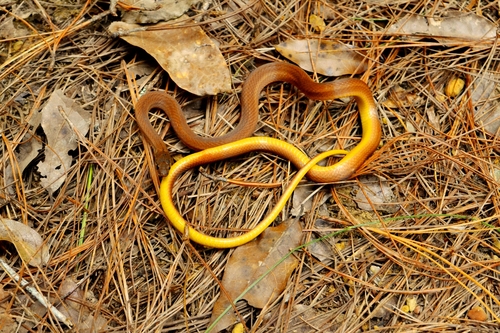 Kanalchutchan Graceful Brown SnakeRhadinella kanalchutchanHarmless
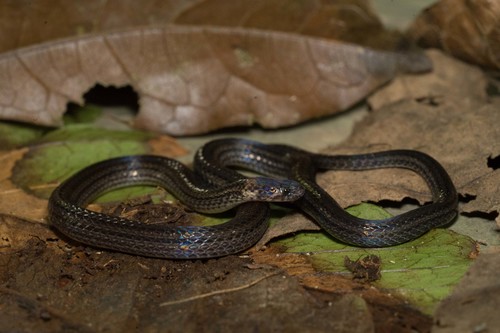 Rhadinella anachoretaHarmless
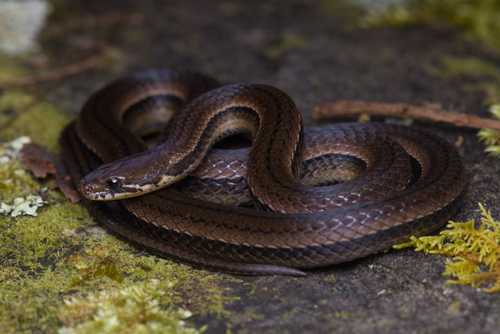 Tearful Pine-Oak SnakeRhadinella lachrymansHarmless
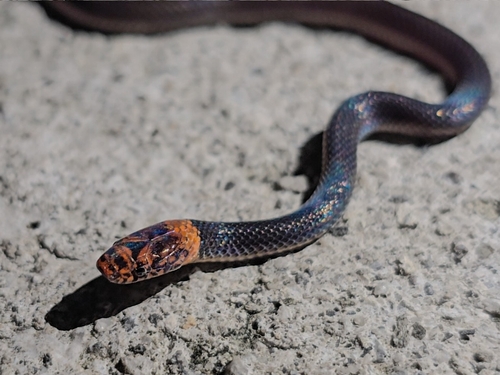 Stuart's Graceful Brown SnakeRhadinella pilonaorumHarmless
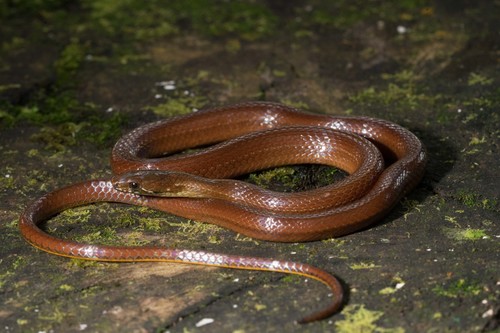 Hempstead's Pine Woods SnakeRhadinella hempsteadaeHarmless
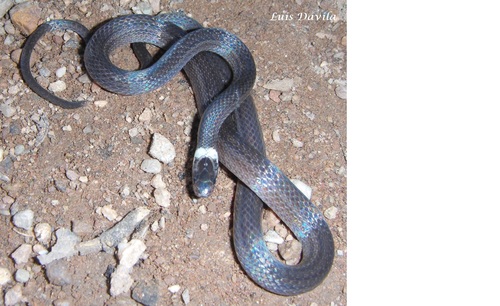 Rhadinella dysmicaHarmless
 Brokencollar Graceful Brown SnakeRhadinella schistosaHarmless
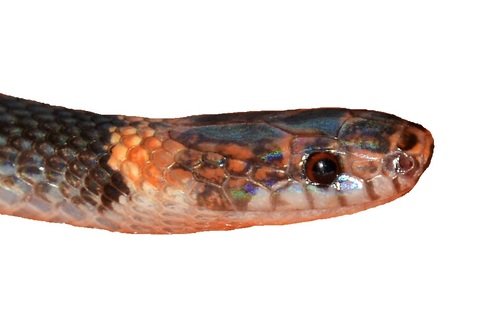 Rhadinella xerophilaHarmless
- No photoRhadinella donajiHarmless
- No photoPosada's Graceful Brown SnakeRhadinella posadasiHarmless
Keep learning
- What Is a Snake? Anatomy and the BasicsA clear overview of what makes a snake a snake: limbless body plan, anatomy, evolution from lizards, species diversity, and why they are ectothermic.
- How Snakes Move, Hunt, and EatHow snakes move without legs, hunt as ambushers or active foragers, kill by constriction or venom, and swallow prey wider than their head.
- What Do Snakes Eat?All snakes are carnivores. Learn what snakes eat, how diet changes with size and age, how often they feed, and how they hunt and swallow prey.
- Venomous vs Nonvenomous: How to Tell the DifferenceThe folk rules for telling venomous snakes apart, where each one fails, and why location-based identification beats guessing by sight.