
Genus · Colubridae
Types of rhabdops
2 species make up the genus Rhabdops, the snakes commonly called rhabdops. None are considered dangerous to humans.
About olive forest snakes
Rhabdops is a tiny genus of secretive, semi-aquatic forest snakes from the hill streams of southern Asia.
Rhabdops is a small genus in the family Colubridae, the largest and most diverse snake family on Earth. It contains only a couple of recognized species, including the Water Rhabdops and the Olive Trapezoid Snake. These are retiring, little-seen snakes tied to the wet, forested hill country of southern Asia, especially the Western Ghats of India and adjacent parts of Southeast Asia. As colubrids they sit among the typical or harmless snakes, the same broad group that holds rat snakes, kukri snakes, and many common ground snakes, rather than among the front-fanged vipers, cobras, or sea snakes.
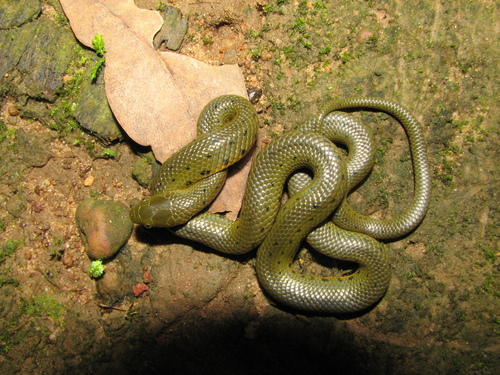
Members of Rhabdops are generally smooth-scaled, moderately slender snakes of modest length, often muddy olive, brown, or dark above with paler undersides. They favor damp microhabitats: stream banks, leaf litter, moist soil, and the edges of forest pools, and they spend much of their lives hidden, which is part of why so little detailed natural history has been documented for them. They are most often encountered during the monsoon, when rain brings them to the surface. As with many such forest colubrids, the diet is thought to center on soft-bodied prey such as earthworms and other small invertebrates, and they are believed to be egg-laying like most of their family, though precise reproductive details for these specific species remain poorly recorded.
From a safety standpoint Rhabdops snakes are regarded as harmless to people. They are not front-fanged and are not known to pose a medical threat, and their small size and secretive habits mean encounters are rare. Even so, the responsible rule with any wild snake is to leave it alone and observe from a distance rather than handle it, both for your safety and for the animal's. Identification of obscure species like these is best left to experts, and if anyone is ever bitten by a snake they cannot confidently identify, treat it as a medical situation and contact emergency services or, in the United States, Poison Control at 1-800-222-1222.
Rhabdops belongs to the Colubridae family (Colubrids). The largest snake family, and the one most snakes you meet belong to. Typically round pupils, a head only slightly wider than the neck, and no heat-sensing facial pit or rattle. Scales may be smooth and glossy or keeled and matte depending on the species.
Danger: Almost all colubrids are harmless. A small number are rear-fanged with medically significant venom, the boomslang and the twig (vine) snakes of Africa being the dangerous exceptions. Most colubrids will flee or bluff rather than bite.
All species (2)

Keep learning
- What Is a Snake? Anatomy and the BasicsA clear overview of what makes a snake a snake: limbless body plan, anatomy, evolution from lizards, species diversity, and why they are ectothermic.
- How Snakes Move, Hunt, and EatHow snakes move without legs, hunt as ambushers or active foragers, kill by constriction or venom, and swallow prey wider than their head.
- What Do Snakes Eat?All snakes are carnivores. Learn what snakes eat, how diet changes with size and age, how often they feed, and how they hunt and swallow prey.
- Venomous vs Nonvenomous: How to Tell the DifferenceThe folk rules for telling venomous snakes apart, where each one fails, and why location-based identification beats guessing by sight.