
Genus · Typhlopidae
Types of blind snakes
5 species make up the genus Ramphotyphlops, the snakes commonly called blind snakes. None are considered dangerous to humans.
About blind snakes
Ramphotyphlops are small, burrowing blind snakes that spend almost their whole lives underground hunting ants and termites.
Ramphotyphlops is a genus in the family Typhlopidae, the typical blind snakes. Like all members of this family, they are part of an ancient lineage of fossorial snakes adapted for life beneath the surface. They are easy to confuse with earthworms at a glance, and many people who encounter one assume they have found a worm rather than a snake. The genus has been revised heavily over the years, with many species once placed here now moved to related genera, so the membership and exact count can shift as taxonomy is refined.
These snakes live in soil, leaf litter, rotting logs, ant and termite nests, and under rocks and debris. Typhlopid blind snakes as a group are widely distributed across warmer regions of the world, with strong representation across the Australasian and Indo-Pacific region where many Ramphotyphlops species occur. They favor moist, loose ground that is easy to tunnel through and that holds the insect colonies they feed on.
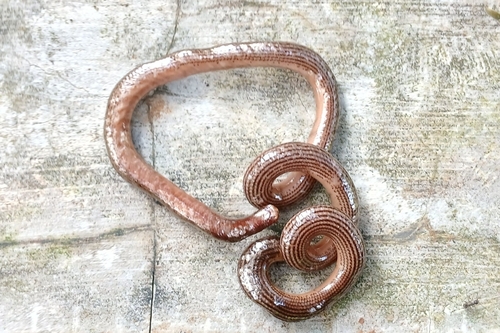
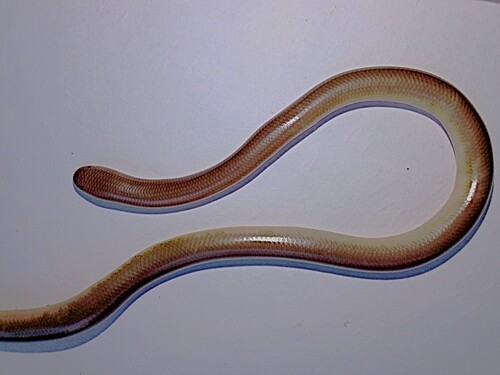
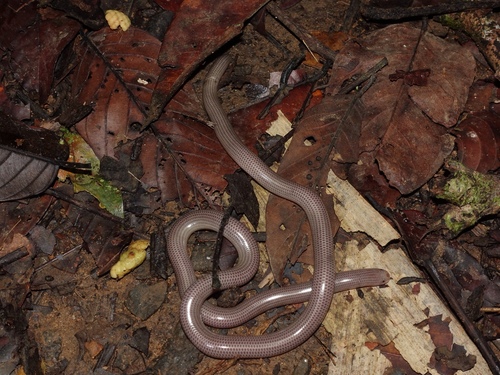
Recognizing a blind snake comes down to a few shared traits rather than bold markings. They are small and slender with a smooth, cylindrical body of nearly uniform width from head to tail, tight glossy scales, and a short blunt tail that often ends in a tiny spine. The eyes are reduced to dark spots under the head scales and detect little more than light and dark, which is the source of the common name. The head and tail can look similar at first glance, another reason they are mistaken for worms.
Blind snakes are harmless to people. They are not venomous, they are not rear-fanged, and their mouths are tiny and adapted for swallowing soft insect prey, not for biting humans. If handled they may wriggle, press the tail spine against the skin, or release a musky fluid, but none of this is dangerous. There is no medical concern from these snakes. As with any wild animal, the kind choice is to leave it be and let it return to the soil.
Ecologically they are specialist feeders, eating ants and termites along with the eggs, larvae, and pupae found inside the colonies they raid. They are active mostly at night or after rain and stay hidden the rest of the time. Many typhlopid blind snakes lay eggs, and some lineages in this family are known for all-female reproduction by parthenogenesis, though reproductive details vary by species and are not established for every member of the genus.
Ramphotyphlops belongs to the Typhlopidae family (Blindsnakes). Tiny, worm-like burrowing snakes that raid ant and termite nests. Looks like a small, glossy earthworm with smooth scales and no obvious neck, eyes, or pattern.
Danger: Harmless. They do not bite people and have no venom.
All species (5)
Keep learning
- What Is a Snake? Anatomy and the BasicsA clear overview of what makes a snake a snake: limbless body plan, anatomy, evolution from lizards, species diversity, and why they are ectothermic.
- How Snakes Move, Hunt, and EatHow snakes move without legs, hunt as ambushers or active foragers, kill by constriction or venom, and swallow prey wider than their head.
- What Do Snakes Eat?All snakes are carnivores. Learn what snakes eat, how diet changes with size and age, how often they feed, and how they hunt and swallow prey.
- Venomous vs Nonvenomous: How to Tell the DifferenceThe folk rules for telling venomous snakes apart, where each one fails, and why location-based identification beats guessing by sight.