
Genus · Colubridae
Rabdion
The genus Rabdion contains a single species. It is not considered dangerous to humans.
About Forsten's pointed snakes
A tiny, secretive burrowing colubrid from the islands of Southeast Asia, built for a life spent under leaf litter and soil.
Rabdion is a small genus in the family Colubridae, the largest snake family in the world and the one that holds most of the planet's harmless or near-harmless species. The genus is best known for Forsten's pointed snake, a slender, secretive burrowing snake native to Sulawesi and nearby islands in Indonesia. Like many colubrids, it sits in the broad group of typical snakes rather than among the front-fanged venomous families such as vipers and elapids.
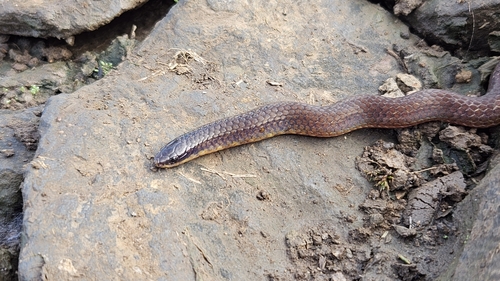
Members of Rabdion are fossorial, meaning they live in and under the soil and leaf litter of forested and humid habitats. The pointed, reinforced snout that gives the group its common name is a digging and probing tool, and the body is built low and smooth for moving through tight underground spaces. Because these snakes spend most of their lives hidden, they are rarely seen, and many details of their natural history remain poorly documented. In general terms you would recognize one as a small, slim, dark snake with a narrow head, reduced eyes, and a tapered snout, encountered in soil, under logs, or in leaf litter rather than out in the open.
Rabdion is not considered dangerous to people. It is a small, secretive colubrid with no medically significant venom and no history of harmful bites, and its diet is thought to consist of small soil-dwelling invertebrates and similar prey suited to a burrowing lifestyle. As with any wild snake, the responsible approach is to observe it without handling, give it space, and let it move on. If anyone is ever bitten by a snake they cannot confidently identify, treat it as a medical matter rather than guessing: contact emergency services or, in the United States, Poison Control at 1-800-222-1222.
Rabdion belongs to the Colubridae family (Colubrids). The largest snake family, and the one most snakes you meet belong to. Typically round pupils, a head only slightly wider than the neck, and no heat-sensing facial pit or rattle. Scales may be smooth and glossy or keeled and matte depending on the species.
Danger: Almost all colubrids are harmless. A small number are rear-fanged with medically significant venom, the boomslang and the twig (vine) snakes of Africa being the dangerous exceptions. Most colubrids will flee or bluff rather than bite.
All species (1)
Keep learning
- What Is a Snake? Anatomy and the BasicsA clear overview of what makes a snake a snake: limbless body plan, anatomy, evolution from lizards, species diversity, and why they are ectothermic.
- How Snakes Move, Hunt, and EatHow snakes move without legs, hunt as ambushers or active foragers, kill by constriction or venom, and swallow prey wider than their head.
- What Do Snakes Eat?All snakes are carnivores. Learn what snakes eat, how diet changes with size and age, how often they feed, and how they hunt and swallow prey.
- Venomous vs Nonvenomous: How to Tell the DifferenceThe folk rules for telling venomous snakes apart, where each one fails, and why location-based identification beats guessing by sight.