
Genus · Colubridae
Types of reed snakes
6 species make up the genus Pseudorabdion, the snakes commonly called reed snakes. None are considered dangerous to humans.
About reed snakes (dwarf burrowing snakes)
Tiny, secretive burrowers of the Southeast Asian forest floor that almost no one ever sees above ground.
Pseudorabdion is a genus of small, slender, fossorial snakes in the large family Colubridae. The genus belongs to a group of Asian burrowing colubrids often called reed snakes, and its members spend almost all of their lives underground or hidden in leaf litter, loose soil, rotting logs, and the root zone of forest plants. Because they live out of sight, several species are known from only a handful of specimens, and the genus as a whole is poorly studied compared with larger, more visible snakes.
Geographically the genus is centered on Southeast Asia. Members occur across the region including the Malay Peninsula, the Greater Sunda Islands, the Philippines, and nearby areas, typically in lowland and hill forest. They favor moist, shaded habitat where the soil stays damp, which suits a burrowing lifestyle. Some species also turn up in disturbed ground, plantations, and gardens near forest, usually only when soil is overturned or after heavy rain pushes them to the surface.
In general terms these are short snakes, most no more than roughly 20 to 30 centimeters long, with a cylindrical body, smooth scales, small eyes, and a short blunt or slightly pointed head suited to pushing through soil. Coloration tends toward plain browns, grays, and blackish tones, sometimes with a pale collar, band, or light stripe near the neck or along the body. Several common names reference this collar pattern, such as the collared and white-collared forms. Because the differences between species are subtle and several look alike, reliable identification usually depends on scale counts and locality rather than color alone.
On safety, members of Pseudorabdion are not considered dangerous to people. As small fossorial colubrids they are regarded as harmless to humans, and there is no evidence they pose a medical threat. They are reclusive and far more likely to burrow away than to confront anything. As with any wild snake, the responsible approach is to observe rather than handle, since handling stresses the animal and field identification can be uncertain. If a bite from any unidentified snake ever causes concerning symptoms, contact emergency services or, in the United States, Poison Control at 1-800-222-1222.
Ecologically these snakes fit the typical mold of small burrowing colubrids. They feed on small soil and litter invertebrates, with earthworms and soft-bodied prey being the expected diet for snakes of this size and lifestyle. Like many colubrids they are believed to be egg-laying, producing small clutches, though detailed reproductive data is lacking for most species. Their behavior is shy and largely nocturnal or hidden, and their main defense is simply staying buried and out of reach.
Pseudorabdion belongs to the Colubridae family (Colubrids). The largest snake family, and the one most snakes you meet belong to. Typically round pupils, a head only slightly wider than the neck, and no heat-sensing facial pit or rattle. Scales may be smooth and glossy or keeled and matte depending on the species.
Danger: Almost all colubrids are harmless. A small number are rear-fanged with medically significant venom, the boomslang and the twig (vine) snakes of Africa being the dangerous exceptions. Most colubrids will flee or bluff rather than bite.
All species (6)
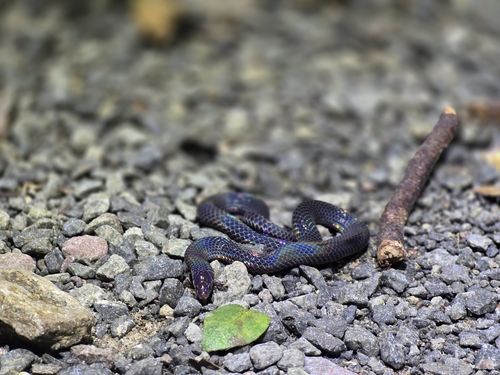 Cantor's Dwarf Reed SnakePseudorabdion longicepsHarmless
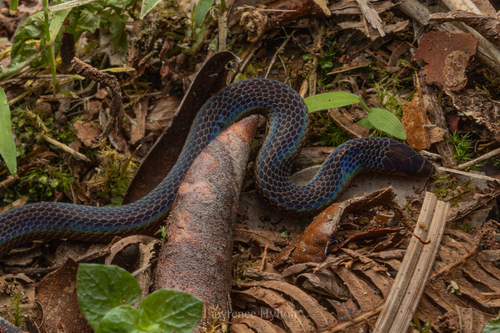 Common Collared SnakePseudorabdion collarisHarmless
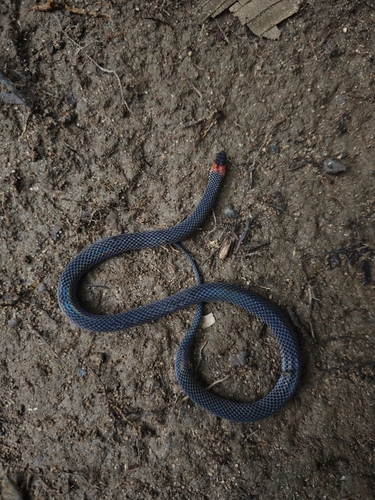 White-collared Reed SnakePseudorabdion albonuchalisHarmless
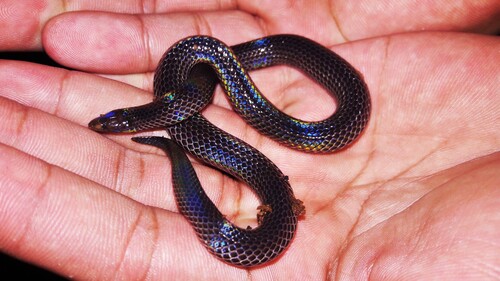 Negros Light-scaled Burrowing SnakePseudorabdion oxycephalumHarmless
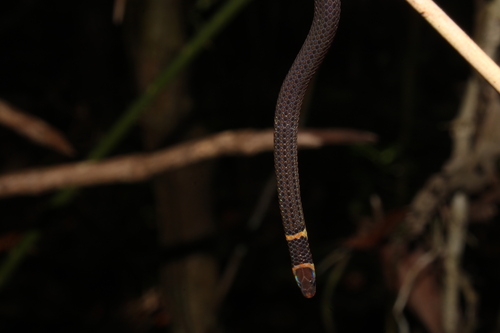 Zamboanga Burrowing SnakePseudorabdion aterHarmless
- No photoPseudorabdion saravacenseHarmless
Keep learning
- What Is a Snake? Anatomy and the BasicsA clear overview of what makes a snake a snake: limbless body plan, anatomy, evolution from lizards, species diversity, and why they are ectothermic.
- How Snakes Move, Hunt, and EatHow snakes move without legs, hunt as ambushers or active foragers, kill by constriction or venom, and swallow prey wider than their head.
- What Do Snakes Eat?All snakes are carnivores. Learn what snakes eat, how diet changes with size and age, how often they feed, and how they hunt and swallow prey.
- Venomous vs Nonvenomous: How to Tell the DifferenceThe folk rules for telling venomous snakes apart, where each one fails, and why location-based identification beats guessing by sight.