
Genus · Viperidae
Types of vipers
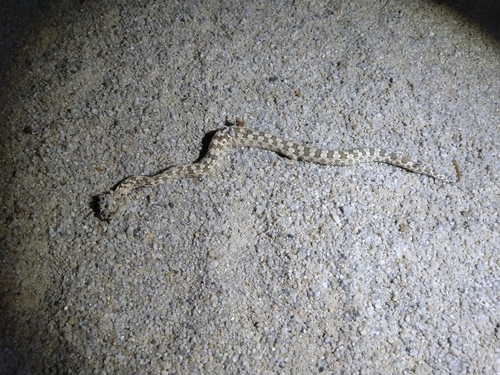
3 species make up the genus Pseudocerastes, the snakes commonly called vipers. All of them are venomous.
About false horned vipers
A small group of Middle Eastern desert vipers famous for the soft horns over their eyes and, in one species, a tail tipped to look like a spider.
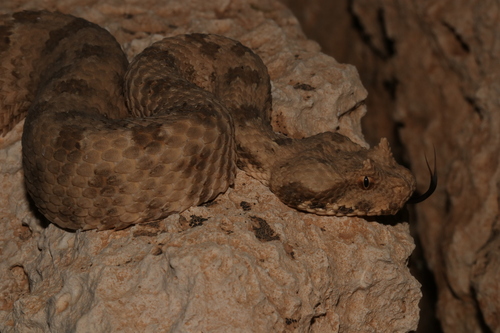
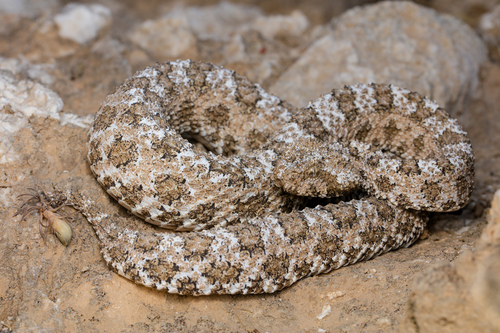
Pseudocerastes is a genus of true vipers in the family Viperidae, the group that also contains rattlesnakes, adders, and pit vipers. The name means false horned viper, distinguishing it from the true horned vipers of the genus Cerastes. Members are sometimes called false horned vipers or simply horned vipers, and the genus holds three recognized species: the Persian horned viper, Field's horned viper, and the spider-tailed horned viper.
These snakes live across arid and semi-arid parts of the Middle East and Central Asia, including ranges in Iran, Iraq, the Arabian Peninsula, and neighboring regions. They favor rocky deserts, gravel plains, scrubby slopes, and dry foothills. Like many desert vipers they are well camouflaged in sandy and stony tones, and they tend to shelter in crevices, under rocks, or in rodent burrows during the heat of the day.
In general terms, Pseudocerastes are stout-bodied, slow-moving snakes with the broad triangular head typical of vipers and vertical pupils. The most recognizable feature is a pair of raised, soft, scale-covered horns above the eyes, formed from clusters of small scales rather than a single hard spike. The spider-tailed horned viper carries an additional oddity: a tail tip modified into a bulb and elongated scales that the snake wiggles to mimic a moving spider or insect, luring birds within striking range.
As members of Viperidae, these are venomous, front-fanged snakes with hinged fangs that fold against the roof of the mouth. They are not rear-fanged and they are not harmless. A bite from a viper of this family can cause serious tissue damage and systemic effects and is a medical emergency. Never handle a wild venomous snake and never assume one is safe to approach. If a bite occurs, keep the person calm and still, remove tight items near the bite, and get to emergency care immediately. In the United States contact Poison Control at 1-800-222-1222, or call local emergency services where you are.
Ecologically, Pseudocerastes are ambush predators. They feed largely on small mammals, lizards, and birds, with the spider-tailed species relying heavily on its tail lure to draw in birds. Reproduction in the genus is egg-laying, which is somewhat unusual among vipers since many relatives give live birth. They are generally sedentary and rely on camouflage and stillness rather than speed, becoming more active around dusk and at night to avoid the heat.
Pseudocerastes belongs to the Viperidae family (Vipers & pit vipers). Heavy-bodied venomous snakes with long, hinged, hollow fangs. Broad, triangular head distinct from a narrow neck, heavy body, and (usually) vertical, cat-like pupils. Pit vipers also have a heat-sensing pit; true vipers do not.
Danger: Every viper is venomous, and the family includes some of the world's most medically important snakes. Venom is typically hemotoxic, causing pain, swelling, tissue damage, and bleeding. Treat any viper bite as a medical emergency.
All species (3)
Keep learning
- Venomous vs Nonvenomous: How to Tell the DifferenceThe folk rules for telling venomous snakes apart, where each one fails, and why location-based identification beats guessing by sight.
- Are Snakes Dangerous? The Real Risk, in PerspectiveMost snakes are harmless and avoid people. Here is the honest picture of snakebite risk worldwide and how to lower your own.
- Snake Venom Explained: How It Works and WhyWhat snake venom actually is, why it evolved, the main venom types, fang delivery, how antivenom works, and why ranking the most venomous snake is hard.
- How Snakes Move, Hunt, and EatHow snakes move without legs, hunt as ambushers or active foragers, kill by constriction or venom, and swallow prey wider than their head.