
Genus · Colubridae
Types of rat snakes
2 species make up the genus Pseudelaphe, the snakes commonly called rat snakes. None are considered dangerous to humans.
About Middle American rat snakes
Slender, large-eyed climbing rat snakes from Mexico and Central America that were split off from the true rat snakes.
Pseudelaphe is a small genus in the family Colubridae, the largest snake family and the group that holds most of the world's harmless egg-laying snakes. The genus was carved out of the broad old concept of Elaphe to hold New World rat snakes that did not belong with their Old World relatives, and the name itself signals this: it means roughly false Elaphe. Two species sit here in our database, the Yucatan rat snake and the yellow-red rat snake, both Middle American climbers. As colubrids, they are constrictors with smooth to weakly keeled scales, round pupils, and the slender, agile build typical of rat snakes that spend time off the ground.
These are snakes of Mexico and Central America, ranging across lowland and foothill country including the Yucatan Peninsula and adjacent regions. Typical habitat is warm, often forested or scrubby terrain, and like other rat snakes they are comfortable both on the ground and up in trees, rock piles, and around structures. You recognize the group in general terms by the classic rat snake look: a long, somewhat laterally compressed body, a head that is distinct from the neck, large eyes, and patterning that often runs to blotches or bands over a paler ground color. Precise scale counts and markings separate the individual species, and field identification in their range is best confirmed against a regional guide.
Pseudelaphe rat snakes are non-venomous and harmless to people. They kill prey by constriction, feeding mainly on rodents, birds, and eggs, which makes them useful natural rodent control around farms and settlements. Like nearly all colubrids in this lineage they reproduce by laying eggs. A cornered individual may hiss, flatten its body, or bite defensively, and any wild snake bite should be cleaned and watched, but there is no venom risk here. As always, do not handle wild snakes you cannot positively identify, and if a bite from an unknown snake causes spreading pain, swelling, or other symptoms, seek emergency care or contact US Poison Control at 1-800-222-1222 or your local emergency services.
Pseudelaphe belongs to the Colubridae family (Colubrids). The largest snake family, and the one most snakes you meet belong to. Typically round pupils, a head only slightly wider than the neck, and no heat-sensing facial pit or rattle. Scales may be smooth and glossy or keeled and matte depending on the species.
Danger: Almost all colubrids are harmless. A small number are rear-fanged with medically significant venom, the boomslang and the twig (vine) snakes of Africa being the dangerous exceptions. Most colubrids will flee or bluff rather than bite.
All species (2)
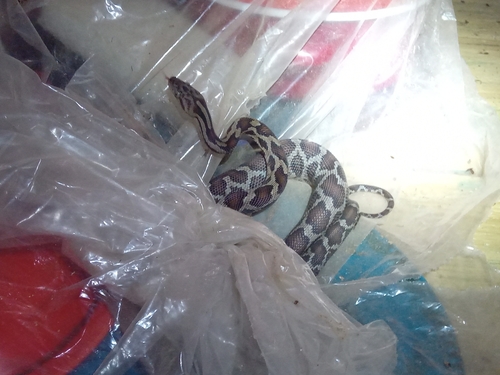
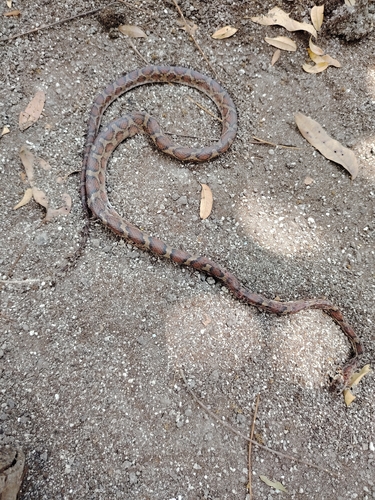
Keep learning
- What Is a Snake? Anatomy and the BasicsA clear overview of what makes a snake a snake: limbless body plan, anatomy, evolution from lizards, species diversity, and why they are ectothermic.
- How Snakes Move, Hunt, and EatHow snakes move without legs, hunt as ambushers or active foragers, kill by constriction or venom, and swallow prey wider than their head.
- What Do Snakes Eat?All snakes are carnivores. Learn what snakes eat, how diet changes with size and age, how often they feed, and how they hunt and swallow prey.
- Venomous vs Nonvenomous: How to Tell the DifferenceThe folk rules for telling venomous snakes apart, where each one fails, and why location-based identification beats guessing by sight.