
Genus · Colubridae
Types of pampas snakes
3 species make up the genus Phimophis, the snakes commonly called pampas snakes. None are considered dangerous to humans.
About pampas snakes
Phimophis are burrowing South American colubrids built for pushing through loose soil, with a hardened, shovel-like snout.
Phimophis is a small genus of New World snakes in the family Colubridae, the largest and most diverse snake family. Like most colubrids, these are slender, agile snakes rather than the heavy-bodied vipers people often fear. The genus is best known by the common name pampas snakes, a nod to the open grassland regions of southern South America where several members live.
The defining feature of Phimophis is the head. These snakes have a reinforced, projecting rostral scale that forms a hard, somewhat upturned or shovel-shaped snout. That structure is an adaptation for a semi-fossorial life: the snout helps them wedge into and move through sandy or loose soils. The body is typically slim and cylindrical, the eyes are relatively small, and the tail tapers to a point, all consistent with a snake that spends much of its time at or below the surface.
Their range covers parts of South America, with members found across grassland, savanna, and dry open habitats including the pampas of Argentina and surrounding regions. As with many ground-dwelling colubrids, they favor environments where they can burrow, shelter under cover, and hunt small prey out of sight.
Phimophis are rear-fanged colubrids. Many colubrids in this group carry enlarged grooved teeth toward the back of the upper jaw paired with a Duvernoy's gland that produces a mild secretion used to subdue small prey. For the great majority of such snakes the secretion poses little to no medical threat to humans, and Phimophis are not considered dangerous. Even so, no wild snake should be handled. A defensive bite can cause local pain, bleeding, or swelling, and a snake can be misidentified in the field. If anyone is bitten by an unknown snake, stay calm, keep the limb still, and seek medical care immediately. In the US contact Poison Control at 1-800-222-1222, and elsewhere call local emergency services.
Ecologically these snakes fit the typical colubrid mold for a burrowing predator. Their diet centers on small vertebrates available in their habitat, and like most colubrids in their region they are egg-laying (oviparous). They are secretive and generally not aggressive, relying on concealment and quick retreat rather than confrontation, which is why encounters with people are uncommon.
Phimophis belongs to the Colubridae family (Colubrids). The largest snake family, and the one most snakes you meet belong to. Typically round pupils, a head only slightly wider than the neck, and no heat-sensing facial pit or rattle. Scales may be smooth and glossy or keeled and matte depending on the species.
Danger: Almost all colubrids are harmless. A small number are rear-fanged with medically significant venom, the boomslang and the twig (vine) snakes of Africa being the dangerous exceptions. Most colubrids will flee or bluff rather than bite.
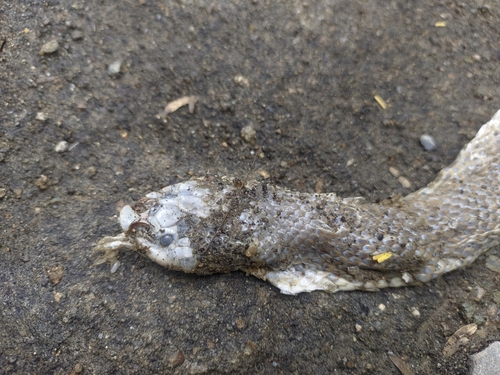
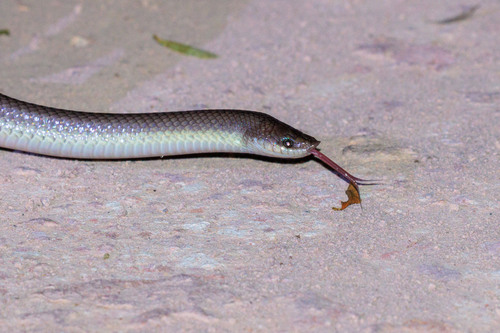
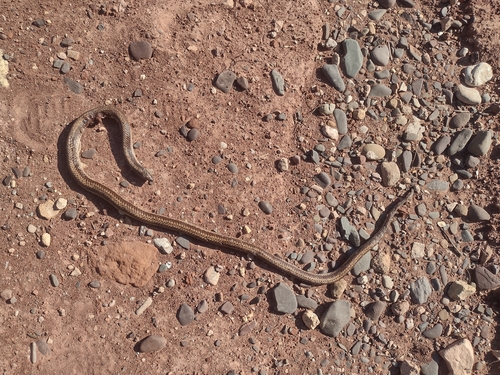
All species (3)
Keep learning
- What Is a Snake? Anatomy and the BasicsA clear overview of what makes a snake a snake: limbless body plan, anatomy, evolution from lizards, species diversity, and why they are ectothermic.
- How Snakes Move, Hunt, and EatHow snakes move without legs, hunt as ambushers or active foragers, kill by constriction or venom, and swallow prey wider than their head.
- What Do Snakes Eat?All snakes are carnivores. Learn what snakes eat, how diet changes with size and age, how often they feed, and how they hunt and swallow prey.
- Venomous vs Nonvenomous: How to Tell the DifferenceThe folk rules for telling venomous snakes apart, where each one fails, and why location-based identification beats guessing by sight.