
Genus · Viperidae
Types of pitvipers
3 species make up the genus Ophryacus, the snakes commonly called pitvipers. All of them are venomous.
About Mexican horned pitvipers
A small group of high-altitude Mexican pitvipers known for the raised, horn-like scales above their eyes that give the genus its name.
Ophryacus is a genus of pitvipers in the family Viperidae, the same broad family as rattlesnakes, copperheads, lanceheads and Old World vipers. Within Viperidae they belong to the pit viper group, the subfamily Crotalinae, which is defined by a heat-sensing pit located between the eye and the nostril on each side of the head. That paired organ detects the body heat of prey and lets these snakes strike accurately in darkness. Our database lists 3 species in the genus, including the Mexican Horned Pit Viper, the Emerald Horned Pitviper and the Broad-horned Pitviper.
The genus is endemic to Mexico, meaning it is found there and nowhere else. Its members live in the highlands of the country, in cool, humid montane forests and cloud forest of the southern and central mountain ranges. These are not lowland or desert snakes; they are tied to forested mountain habitats where moisture and tree cover stay high. Because that habitat is patchy and limited, the genus has a naturally restricted distribution.
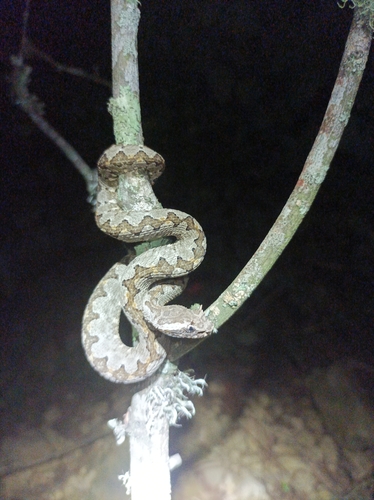
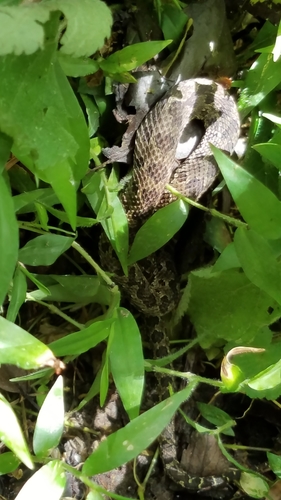
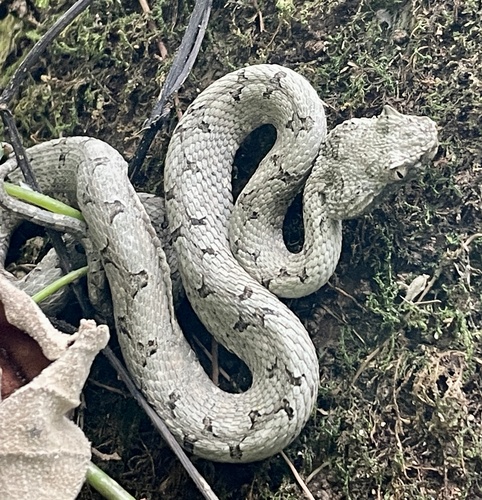
The feature that names the genus is the cluster of enlarged, upturned scales above each eye, which can form a small horn or raised brow. Beyond that, members show the general pitviper build: a relatively stout body, a broad triangular head clearly set off from a narrow neck, keeled scales that give a rough texture, and vertical, cat-like pupils. Color varies by species and includes patterned grays and browns as well as vivid green forms. The combination of the horned brow, the facial pit and the montane Mexican locality is the most reliable way to place a snake in this group rather than relying on color alone.
These are venomous snakes and should be treated as dangerous. As true pit vipers, they deliver venom through long, hinged front fangs, and viper venoms in general can damage tissue and affect blood clotting. Detailed clinical data on Ophryacus bites is limited because the snakes are uncommon, secretive and live in remote terrain, so any bite should be assumed serious. No wild venomous snake is safe to handle. A bite is a medical emergency: do not attempt field first aid or wait it out, and instead get the person to professional emergency care as fast as possible. In the United States you can also reach Poison Control at 1-800-222-1222; in Mexico or elsewhere, contact local emergency services.
Ecologically these are ambush predators of the forest. Like other arboreal and montane pitvipers, they are believed to feed on small vertebrates such as lizards, small mammals and frogs, using the heat-sensing pits to target warm prey and striking from concealment rather than actively chasing. They tend to be secretive and are often associated with vegetation and ground cover in their humid forest homes. As is typical of many New World pitvipers, members of the genus give birth to live young rather than laying eggs. Their restricted range and dependence on intact montane forest make habitat protection central to their long-term survival.
Ophryacus belongs to the Viperidae family (Vipers & pit vipers). Heavy-bodied venomous snakes with long, hinged, hollow fangs. Broad, triangular head distinct from a narrow neck, heavy body, and (usually) vertical, cat-like pupils. Pit vipers also have a heat-sensing pit; true vipers do not.
Danger: Every viper is venomous, and the family includes some of the world's most medically important snakes. Venom is typically hemotoxic, causing pain, swelling, tissue damage, and bleeding. Treat any viper bite as a medical emergency.
All species (3)
Keep learning
- Venomous vs Nonvenomous: How to Tell the DifferenceThe folk rules for telling venomous snakes apart, where each one fails, and why location-based identification beats guessing by sight.
- Are Snakes Dangerous? The Real Risk, in PerspectiveMost snakes are harmless and avoid people. Here is the honest picture of snakebite risk worldwide and how to lower your own.
- Snake Venom Explained: How It Works and WhyWhat snake venom actually is, why it evolved, the main venom types, fang delivery, how antivenom works, and why ranking the most venomous snake is hard.
- How Snakes Move, Hunt, and EatHow snakes move without legs, hunt as ambushers or active foragers, kill by constriction or venom, and swallow prey wider than their head.