
Genus · Colubridae
Nothopsis
The genus Nothopsis contains a single species. It is not considered dangerous to humans.
About rough coffee snakes
A small, secretive Central American snake known for its rough, granular scales and forest-floor habits.
Nothopsis is a tiny genus within the large family Colubridae, the so-called typical snakes that account for most snake species worldwide. The genus is best known from a single recognized species, the Rough Coffee Snake (Nothopsis rugosus), found in the humid lowland forests of Central America and into northwestern South America, across parts of Panama, Costa Rica, Nicaragua, and adjacent regions. Its odd, slightly out of place look has long made it a subject of taxonomic discussion, and it is sometimes treated apart from more familiar colubrids because of its unusual scalation.
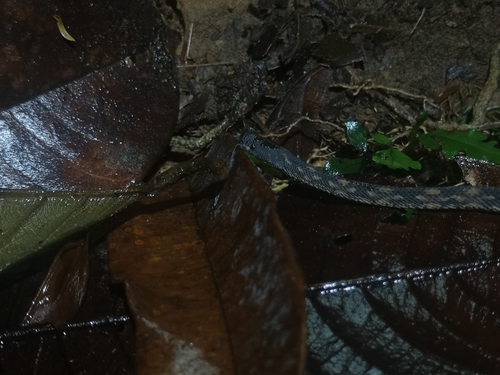
Members are small, ground dwelling snakes adapted to leaf litter and the damp floor of tropical rainforest. The standout recognition feature is the skin itself: rather than the smooth, neatly overlapping scales of many colubrids, Nothopsis has small, rough, granular scales that give the body a matte, bumpy texture, paired with a relatively flattened head and small eyes suited to a life spent hidden in moist debris. Coloration is generally dull and earthy, brown to grayish with darker mottling, which keeps the snake camouflaged against soil and decaying leaves.
This is a harmless snake to people. It is non venomous, secretive, and poses no danger; it relies on hiding rather than defense, and there are no medically significant bites associated with it. Like many small leaf litter colubrids, it is thought to feed on small soft bodied prey such as amphibians and invertebrates and to lay eggs, though its retiring habits mean detailed natural history is still poorly documented. As a general rule with any wild snake, the right approach is to observe and leave it undisturbed rather than handle it.
Nothopsis belongs to the Colubridae family (Colubrids). The largest snake family, and the one most snakes you meet belong to. Typically round pupils, a head only slightly wider than the neck, and no heat-sensing facial pit or rattle. Scales may be smooth and glossy or keeled and matte depending on the species.
Danger: Almost all colubrids are harmless. A small number are rear-fanged with medically significant venom, the boomslang and the twig (vine) snakes of Africa being the dangerous exceptions. Most colubrids will flee or bluff rather than bite.
All species (1)
Keep learning
- What Is a Snake? Anatomy and the BasicsA clear overview of what makes a snake a snake: limbless body plan, anatomy, evolution from lizards, species diversity, and why they are ectothermic.
- How Snakes Move, Hunt, and EatHow snakes move without legs, hunt as ambushers or active foragers, kill by constriction or venom, and swallow prey wider than their head.
- What Do Snakes Eat?All snakes are carnivores. Learn what snakes eat, how diet changes with size and age, how often they feed, and how they hunt and swallow prey.
- Venomous vs Nonvenomous: How to Tell the DifferenceThe folk rules for telling venomous snakes apart, where each one fails, and why location-based identification beats guessing by sight.