
Genus · Leptotyphlopidae
Types of blind snakes
10+ species make up the genus Myriopholis, the snakes commonly called blind snakes. None are considered dangerous to humans.
About thread snakes
Myriopholis are tiny, worm-like burrowing snakes so slender and smooth that most people who see one mistake it for an earthworm rather than a snake.
Myriopholis belongs to the family Leptotyphlopidae, the slender blind snakes or thread snakes. This is one of the families of fossorial, or burrowing, snakes that spend almost their entire lives underground. Members of the family are among the smallest snakes on Earth, with bodies that are extremely thin, cylindrical, and covered in tightly fitted, glossy scales that let them slide easily through soil. Our database lists 10+ species in the genus, including the Hook-snouted Worm Snake, the Long-tailed Thread Snake, the Gambia Blind Snake, and Nurse's Blind Snake.
These snakes are native to the Old World, with the genus centered on Africa and extending into the Middle East and parts of southwestern Asia. They live in soil, sand, leaf litter, and under rocks, logs, and other ground cover, favoring warm regions including dry savanna, scrub, and semi-arid country. Because they stay buried for so much of their lives, they are seldom seen except when heavy rain, plowing, or turned-over debris brings them briefly to the surface.
Recognizing a Myriopholis comes down to family-level traits rather than bold markings. They are very small and pencil-thin, often only a few inches long, with a blunt, rounded head that is barely distinct from the neck and a short tail that may end in a tiny spine. The eyes are reduced to dark spots beneath the head scales, which is the source of the 'blind snake' name, since vision is of little use underground. The body is uniform and shiny, usually pink, brown, grey, or purplish, and the smooth scales give the whole animal a polished, worm-like look. Distinguishing one thread snake species from another is a job for close examination of scale counts, not field color.
Thread snakes are completely harmless to people. They are non-venomous, they are not rear-fanged, and their mouths are so small that they cannot meaningfully bite a human. They have no venom delivery system and pose no medical danger. The sensible response to finding one is simply to leave it alone or gently move it back to cover, both for the animal's sake and because small burrowing snakes are easy to misidentify. If any wild snake bites a person and the species is uncertain, contact local emergency services or US Poison Control at 1-800-222-1222.
Ecologically, Myriopholis are specialist predators of ants and termites and their larvae and eggs, hunting them inside nests and tunnels. Their smooth scales, blunt head, and small size are all adaptations for moving through tight underground spaces and resisting the bites of the social insects they raid. Like other leptotyphlopids, they reproduce by laying eggs, and they are most active when conditions are warm and moist. As quiet, soil-dwelling insect hunters, they play a useful role in controlling ant and termite populations.
Myriopholis belongs to the Leptotyphlopidae family (Slender blindsnakes (threadsnakes)). Among the smallest snakes in the world, thin as a thread. Extremely thin and worm-like, uniformly colored, with vestigial eyes. Resembles a shiny piece of string.
Danger: Harmless. No venom and far too small to harm a person.
All species (12)
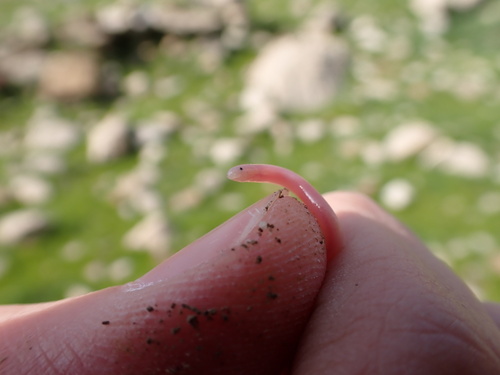 Hook-snouted worm snakeMyriopholis macrorhynchaHarmless
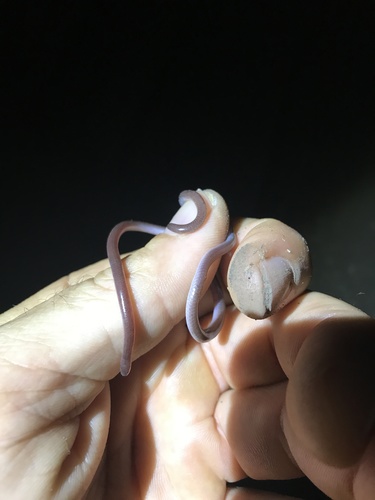 Long-tailed Thread SnakeMyriopholis longicaudaHarmless
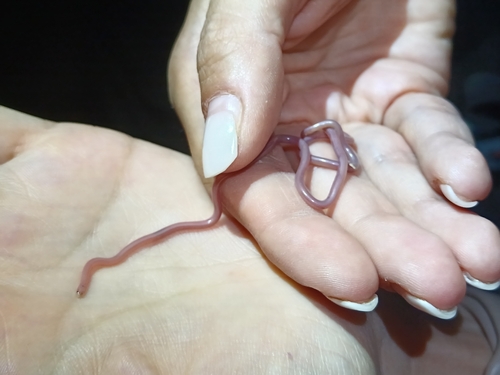 Gambia Blind SnakeMyriopholis algeriensisHarmless
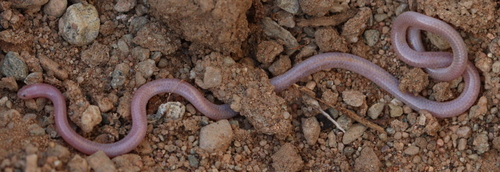 Nurse's Blind SnakeMyriopholis nursiiHarmless
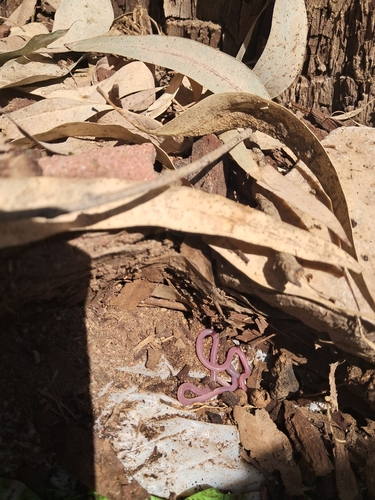 Cairo Blind SnakeMyriopholis cairiHarmless
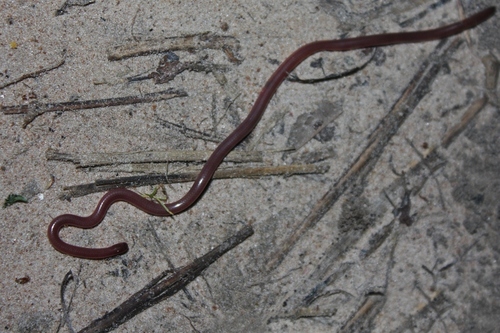 Sahel Thread SnakeMyriopholis narirostrisHarmless
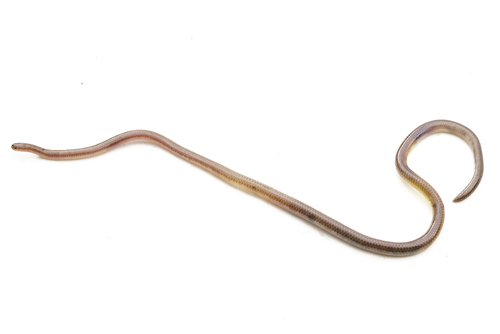 Ionides’ worm snakeMyriopholis ionidesiHarmless
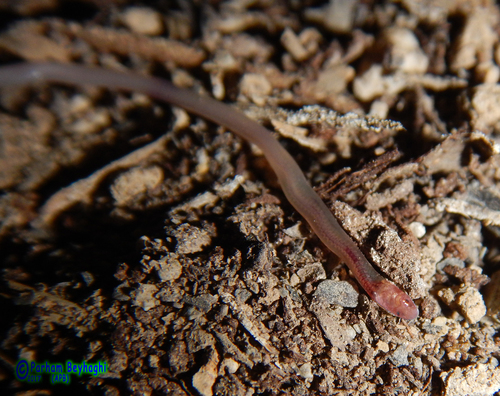 Sindh Thread SnakeMyriopholis blanfordiHarmless
 Boulenger's Blind SnakeMyriopholis macruraHarmless
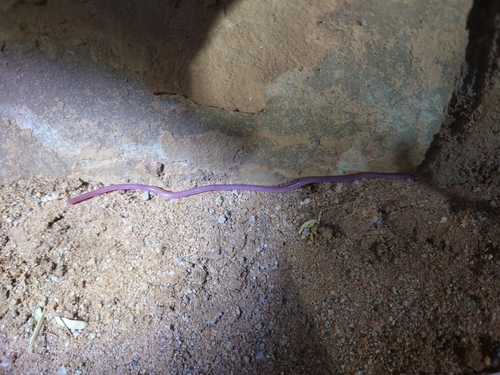 Parker’s worm snakeMyriopholis parkeriHarmless
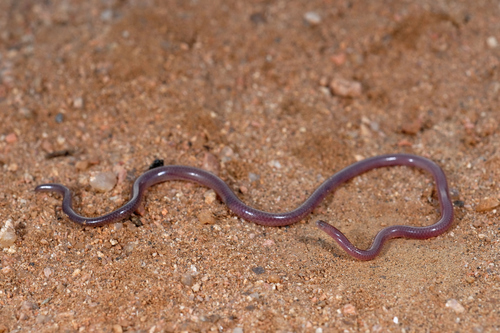 Wilson's Blind SnakeMyriopholis wilsoniHarmless
- No photoRoux-Estève’s Worm SnakeMyriopholis rouxestevaeHarmless
Keep learning
- What Is a Snake? Anatomy and the BasicsA clear overview of what makes a snake a snake: limbless body plan, anatomy, evolution from lizards, species diversity, and why they are ectothermic.
- How Snakes Move, Hunt, and EatHow snakes move without legs, hunt as ambushers or active foragers, kill by constriction or venom, and swallow prey wider than their head.
- What Do Snakes Eat?All snakes are carnivores. Learn what snakes eat, how diet changes with size and age, how often they feed, and how they hunt and swallow prey.
- Venomous vs Nonvenomous: How to Tell the DifferenceThe folk rules for telling venomous snakes apart, where each one fails, and why location-based identification beats guessing by sight.