
Genus · Elapidae
Micruroides
The genus Micruroides contains a single species. It is venomous.
About Western coralsnakes
Micruroides is the small New World coralsnake genus of the arid Southwest, holding the Sonoran coralsnake.
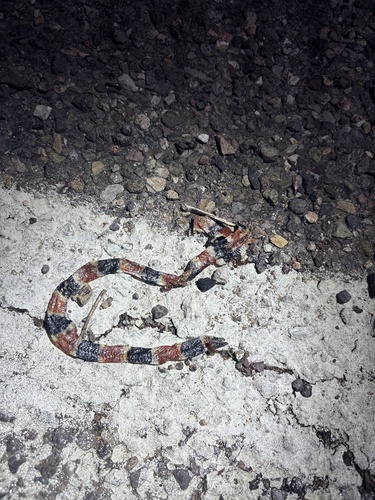
Micruroides is a genus in the family Elapidae, the same front-fanged family that includes cobras, mambas, sea snakes, and the more diverse New World coralsnakes of the genus Micrurus. Our database holds one species, the Sonoran coralsnake (Micruroides euryxanthus). It is a true coralsnake: small, slender, smooth-scaled, and ringed in red, black, and pale yellow or white. Micruroides is distinguished from its close relative Micrurus largely by range and by fine details of head and scale anatomy, but for the casual observer the two look much alike. This genus represents the western, desert-adapted branch of North American coralsnakes.
The Sonoran coralsnake occurs in the Sonoran Desert region of the southwestern United States, mainly Arizona and into southwestern New Mexico, and south into northwestern Mexico. It favors arid and semiarid habitats: rocky desert, thornscrub, grassland, and the lower slopes of mountains, often near rock crevices, leaf litter, or loose soil where it can burrow and hide. It is secretive and largely fossorial, spending most of its time underground or under cover and emerging at night or after rain. Because of these habits it is encountered far less often than its bright warning colors might suggest. Members are recognized by a small head barely distinct from the neck, a blunt blackish snout, and complete body rings of red, black, and light yellow that encircle the body. In this genus the red and yellow rings touch, the basis for the old North American rhyme, though color rules vary worldwide and should never be trusted as a safety test.
This is a venomous elapid. The Sonoran coralsnake produces a neurotoxic venom, and while it is a small snake with a small mouth and a reserved temperament, it should never be handled. Do not pick up, restrain, or attempt to identify a wild coralsnake by handling it. If anyone is bitten, treat it as a medical emergency: keep the person calm and still, remove rings or tight clothing near the bite, do not cut, suck, or apply a tourniquet, and seek emergency care immediately. In the United States contact Poison Control at 1-800-222-1222 or call local emergency services. Ecologically, Sonoran coralsnakes feed mainly on other small snakes and lizards, are egg-laying, and are most active in warm, humid conditions of the monsoon season. They are an important, low-profile part of the desert food web and are best appreciated from a respectful distance.
Micruroides belongs to the Elapidae family (Cobras, mambas, coral & sea snakes). Front-fanged venomous snakes, many with potent neurotoxic venom. Usually slender with a head barely wider than the neck and fixed front fangs (not the folding fangs of vipers). Coral snakes are boldly ringed; sea snakes have a flattened, paddle-like tail.
Danger: All elapids are venomous and the family is responsible for a large share of fatal snakebites worldwide. Many are shy, but bites can be life-threatening. Treat any bite as a medical emergency.
All species (1)
Keep learning
- Venomous vs Nonvenomous: How to Tell the DifferenceThe folk rules for telling venomous snakes apart, where each one fails, and why location-based identification beats guessing by sight.
- Are Snakes Dangerous? The Real Risk, in PerspectiveMost snakes are harmless and avoid people. Here is the honest picture of snakebite risk worldwide and how to lower your own.
- Snake Venom Explained: How It Works and WhyWhat snake venom actually is, why it evolved, the main venom types, fang delivery, how antivenom works, and why ranking the most venomous snake is hard.
- How Snakes Move, Hunt, and EatHow snakes move without legs, hunt as ambushers or active foragers, kill by constriction or venom, and swallow prey wider than their head.