
Genus · Elapidae
Loveridgelaps
The genus Loveridgelaps contains a single species. It is venomous.
About Solomons small-eyed snake
A single venomous elapid found only in the Solomon Islands, related to the cobras and sea snakes.
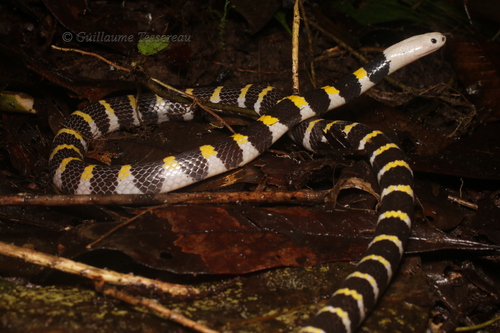
Loveridgelaps is a genus in the family Elapidae, the group that holds cobras, mambas, coral snakes, and the venomous land and sea snakes of the Australasian region. The genus contains a single recognized species, Loveridgelaps elapoides, commonly called the Solomons small-eyed snake. It belongs to the Australasian elapid radiation, the same broad lineage that produced the terrestrial elapids of New Guinea and Australia, and it is found only in the Solomon Islands, a restricted island range that makes it one of the more localized snakes in the family.
As an island endemic, Loveridgelaps lives in tropical lowland and forest habitats typical of the Solomons, where it is associated with moist ground cover, leaf litter, and the margins of streams and wet areas. In general terms it is a slender to moderately built snake with the smooth scales and short, fixed front fangs that define elapids. Members of this genus carry the boldly banded pattern that is common among Pacific and Australasian elapids, and the common name points to the relatively small eyes. Because the genus is poorly studied and limited to one obscure species, broad family-level traits are a more reliable guide than precise measurements.
Loveridgelaps is venomous, like all elapids, delivering venom through fixed front fangs. The specific toxicity and medical significance to humans are not well documented for this rarely encountered snake, so it should be treated with the caution due any front-fanged elapid. Do not handle a wild venomous snake and do not assume it is harmless. If a bite occurs, treat it as a medical emergency and seek care immediately by contacting US Poison Control at 1-800-222-1222 or local emergency services. Like related Australasian elapids, it is expected to be an active hunter that feeds on small vertebrates such as other reptiles, amphibians, and small prey, and elapids in this group reproduce by laying eggs or, in some lineages, giving live birth; the exact biology of this species remains incompletely known.
Loveridgelaps belongs to the Elapidae family (Cobras, mambas, coral & sea snakes). Front-fanged venomous snakes, many with potent neurotoxic venom. Usually slender with a head barely wider than the neck and fixed front fangs (not the folding fangs of vipers). Coral snakes are boldly ringed; sea snakes have a flattened, paddle-like tail.
Danger: All elapids are venomous and the family is responsible for a large share of fatal snakebites worldwide. Many are shy, but bites can be life-threatening. Treat any bite as a medical emergency.
All species (1)
Keep learning
- Venomous vs Nonvenomous: How to Tell the DifferenceThe folk rules for telling venomous snakes apart, where each one fails, and why location-based identification beats guessing by sight.
- Are Snakes Dangerous? The Real Risk, in PerspectiveMost snakes are harmless and avoid people. Here is the honest picture of snakebite risk worldwide and how to lower your own.
- Snake Venom Explained: How It Works and WhyWhat snake venom actually is, why it evolved, the main venom types, fang delivery, how antivenom works, and why ranking the most venomous snake is hard.
- How Snakes Move, Hunt, and EatHow snakes move without legs, hunt as ambushers or active foragers, kill by constriction or venom, and swallow prey wider than their head.