
Genus · Colubridae
Isanophis
The genus Isanophis contains a single species. It is not considered dangerous to humans.
About Boonsong's keelback
A little-known Southeast Asian keelback known from a single described species in the colubrid family.
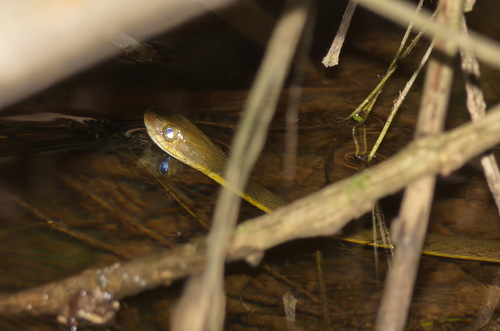
Isanophis is a genus in the family Colubridae, the largest and most diverse family of snakes worldwide. It holds a single described species, Isanophis boonsongi, often called Boonsong's keelback, named for the region of Isan in northeastern Thailand. Keelbacks are a broad informal grouping of semiaquatic and ground-dwelling colubrids that share keeled scales, the raised ridge running down each dorsal scale that gives the group its name and a roughened look. As a recently recognized and rarely encountered taxon, much of what can be said about Isanophis is best understood through this wider keelback and colubrid context rather than from a long published record.
Members live in mainland Southeast Asia, where keelbacks generally favor moist habitats: forested streams, marshes, rice paddies, ditches, and the damp margins of ponds and slow rivers. In general terms a keelback is a slender to moderately built snake with strongly keeled body scales, round pupils, and a patterned dorsum that helps it blend into leaf litter and waterside vegetation. Identifying an obscure species like this in the field is difficult, and confident identification of any small Asian colubrid should rely on local herpetological expertise rather than appearance alone.
Most keelbacks in the family Colubridae are non-aggressive and pose little threat to people, though some Asian keelback genera are rear-fanged and mildly venomous, and a few unrelated keelbacks have caused serious bites, so the group should not be assumed uniformly harmless. The specifics of venom for this rarely studied genus are not well established, so the honest approach is caution: do not handle any wild snake you cannot positively and safely identify, and never assume a snake is safe to pick up. Like other keelbacks, members are expected to feed on small aquatic and terrestrial prey such as frogs, tadpoles, fish, and invertebrates, and to be egg-layers, though detailed life-history data for Isanophis remain limited. If a bite occurs, treat it as a medical matter and seek care promptly through local emergency services or, in the US, Poison Control at 1-800-222-1222.
Isanophis belongs to the Colubridae family (Colubrids). The largest snake family, and the one most snakes you meet belong to. Typically round pupils, a head only slightly wider than the neck, and no heat-sensing facial pit or rattle. Scales may be smooth and glossy or keeled and matte depending on the species.
Danger: Almost all colubrids are harmless. A small number are rear-fanged with medically significant venom, the boomslang and the twig (vine) snakes of Africa being the dangerous exceptions. Most colubrids will flee or bluff rather than bite.
All species (1)
Keep learning
- What Is a Snake? Anatomy and the BasicsA clear overview of what makes a snake a snake: limbless body plan, anatomy, evolution from lizards, species diversity, and why they are ectothermic.
- How Snakes Move, Hunt, and EatHow snakes move without legs, hunt as ambushers or active foragers, kill by constriction or venom, and swallow prey wider than their head.
- What Do Snakes Eat?All snakes are carnivores. Learn what snakes eat, how diet changes with size and age, how often they feed, and how they hunt and swallow prey.
- Venomous vs Nonvenomous: How to Tell the DifferenceThe folk rules for telling venomous snakes apart, where each one fails, and why location-based identification beats guessing by sight.