
Genus · Colubridae
Hydraethiops
The genus Hydraethiops contains a single species. It is not considered dangerous to humans.
About African water snakes
Secretive African water snakes built for a life in and around forest streams and swamps.
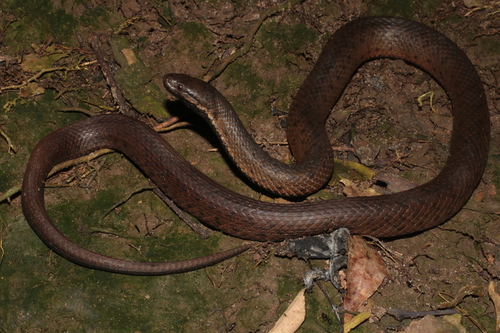
Hydraethiops is a small genus in the family Colubridae, the largest and most diverse snake family. It is a group of semi-aquatic African colubrids found in the rainforest zones of west and central Africa, where the climate is wet and water is never far away. The best known member is the Blackbelly Snake (Hydraethiops melanogaster), named for its dark underside. These snakes sit among the African aquatic and semi-aquatic colubrids, filling the same kind of ecological role that true water snakes and keelbacks fill on other continents.
In general terms, members are slender to moderately stout water snakes tied to streams, swamps, and the damp margins of forest pools. They tend to be dark above with a markedly darker belly in the case of the Blackbelly Snake, and their overall form and habitat say more than any single marking. Look-alike aquatic snakes share the same wet forests, so a confident identification should come from a regional herpetology reference or a local expert rather than a quick glance. Like most colubrids, these are non-front-fanged snakes. They are not considered dangerous to people and have no medically significant venom, but the sensible practice with any wild snake is to observe from a distance and not handle it. If a bite from any wild snake breaks the skin, wash the area and seek medical guidance, and contact emergency services or US Poison Control at 1-800-222-1222 if you are unsure.
Ecologically these snakes forage in and around water and feed largely on aquatic and amphibious prey such as fish and frogs, which is typical of semi-aquatic colubrids. Detailed records of reproduction and behavior for this obscure genus are limited, but the lifestyle matches the broader pattern of water-associated forest colubrids: active near cover, quick to slip into water when disturbed, and dependent on healthy freshwater habitat. For most people the key facts are simple. These are harmless, secretive African water snakes, best appreciated where they live rather than picked up.
Hydraethiops belongs to the Colubridae family (Colubrids). The largest snake family, and the one most snakes you meet belong to. Typically round pupils, a head only slightly wider than the neck, and no heat-sensing facial pit or rattle. Scales may be smooth and glossy or keeled and matte depending on the species.
Danger: Almost all colubrids are harmless. A small number are rear-fanged with medically significant venom, the boomslang and the twig (vine) snakes of Africa being the dangerous exceptions. Most colubrids will flee or bluff rather than bite.
All species (1)
Keep learning
- What Is a Snake? Anatomy and the BasicsA clear overview of what makes a snake a snake: limbless body plan, anatomy, evolution from lizards, species diversity, and why they are ectothermic.
- How Snakes Move, Hunt, and EatHow snakes move without legs, hunt as ambushers or active foragers, kill by constriction or venom, and swallow prey wider than their head.
- What Do Snakes Eat?All snakes are carnivores. Learn what snakes eat, how diet changes with size and age, how often they feed, and how they hunt and swallow prey.
- Venomous vs Nonvenomous: How to Tell the DifferenceThe folk rules for telling venomous snakes apart, where each one fails, and why location-based identification beats guessing by sight.