
Genus · Colubridae
Hydrablabes
The genus Hydrablabes contains a single species. It is not considered dangerous to humans.
About small-eyed water snakes
A tiny genus of secretive, semi-aquatic colubrid snakes from the streams and damp forests of Borneo and the Greater Sunda region.
Hydrablabes is a small genus in the family Colubridae, the largest and most varied family of snakes in the world. It holds only a couple of recognized species, the best known being the Olive Small-eyed Snake (Hydrablabes periops). These are modest, ground-and-water dwelling snakes of Southeast Asia, tied to the wet forests, stream margins, and damp leaf litter of Borneo and nearby parts of the Greater Sunda region. Like many obscure Asian colubrids, they sit on the natricine and allied branches of the colubrid tree, the broad grouping that also contains keelbacks and other water-associated snakes, and they are far more often passed over than seen.
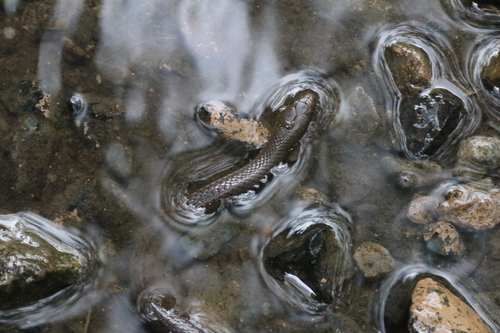
In general terms, members of Hydrablabes are small to medium snakes with smooth, even scales, a slender body, and the small eyes that give the group its common name. The reduced eye size is a typical signal of a snake that spends much of its life low to the ground, in dim forest understory, or partly in water, where keen daylight vision matters less than it does for a fast diurnal hunter. Coloration tends toward plain olive, brown, or grayish tones that blend with mud, wet leaves, and stream banks. Because the genus is poorly studied, the surest way to identify one is by region and habitat combined with a herpetologist's examination of scale counts, not by a single field mark.
These are not snakes of medical concern to people. They are non-venomous to humans, with no apparatus capable of delivering a dangerous bite, and they are reclusive rather than aggressive. Their ecology follows the pattern of small semi-aquatic forest colubrids: they hunt small soft-bodied prey near water, such as worms, amphibians, and other small animals, and they reproduce by laying eggs as is typical for most colubrids. The honest summary is that Hydrablabes is a genus defined more by what we still do not know than by dramatic traits. As with any wild snake, the right approach is to observe and leave it undisturbed, and if anyone is ever bitten by a snake they cannot confidently identify, treat it as a medical situation and contact emergency services or US Poison Control at 1-800-222-1222.
Hydrablabes belongs to the Colubridae family (Colubrids). The largest snake family, and the one most snakes you meet belong to. Typically round pupils, a head only slightly wider than the neck, and no heat-sensing facial pit or rattle. Scales may be smooth and glossy or keeled and matte depending on the species.
Danger: Almost all colubrids are harmless. A small number are rear-fanged with medically significant venom, the boomslang and the twig (vine) snakes of Africa being the dangerous exceptions. Most colubrids will flee or bluff rather than bite.
All species (1)
Keep learning
- What Is a Snake? Anatomy and the BasicsA clear overview of what makes a snake a snake: limbless body plan, anatomy, evolution from lizards, species diversity, and why they are ectothermic.
- How Snakes Move, Hunt, and EatHow snakes move without legs, hunt as ambushers or active foragers, kill by constriction or venom, and swallow prey wider than their head.
- What Do Snakes Eat?All snakes are carnivores. Learn what snakes eat, how diet changes with size and age, how often they feed, and how they hunt and swallow prey.
- Venomous vs Nonvenomous: How to Tell the DifferenceThe folk rules for telling venomous snakes apart, where each one fails, and why location-based identification beats guessing by sight.