
Genus · Pseudoxyrhophiidae
Types of dwarf snakes
2 species make up the genus Heteroliodon, the snakes commonly called dwarf snakes. None are considered dangerous to humans.
About Madagascar dwarf snakes
A tiny genus of small, secretive burrowing snakes found only on Madagascar.
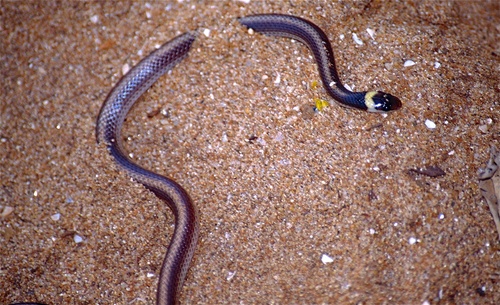
Heteroliodon is a small genus of snakes endemic to Madagascar, placed in the family Pseudoxyrhophiidae. That family is the dominant group of snakes on the island, a single evolutionary radiation that diversified into dozens of forms after colonizing Madagascar. Within that radiation, Heteroliodon represents the small, slender, ground-dwelling end of the spectrum. The two species recognized here are the Light-banded Dwarf Snake and the Ankarana Dwarf Snake, both modest in size and rarely encountered.
These are diminutive snakes adapted to life in and under leaf litter, loose soil, and sandy or rocky ground in dry and transitional forest habitats of western and northern Madagascar. In general terms, members are small and cylindrical with smooth scales, a head that is barely distinct from the neck, and patterning that ranges from plain to faintly banded, which suits a fossorial and semi-fossorial lifestyle. Because the genus is so species-poor and seldom studied, fine details vary, and field identification often comes down to locality, size, and head and scale features rather than any single bold mark.
Like most pseudoxyrhophiids, these snakes are not dangerous to people. Many members of the family are rear-fanged with mild venom used to subdue small prey such as lizards and invertebrates, and Heteroliodon fits that harmless, non-threatening profile for humans. As a rule, leave any wild snake alone and do not handle it. If a bite from any snake causes unexpected swelling, pain, or other symptoms, treat it as a medical matter and contact emergency services or US Poison Control at 1-800-222-1222 rather than self-treating. These small Malagasy snakes are best appreciated as a quiet, specialized branch of one of the world's most remarkable island snake radiations.
Heteroliodon belongs to the Pseudoxyrhophiidae family (Malagasy snakes). A spectacular radiation of mostly harmless snakes centered on Madagascar. Highly variable; identification is usually by region and genus rather than a single family trait.
Danger: Considered harmless to humans. Some are mildly venomous (rear-fanged) but not medically significant.
All species (2)
Keep learning
- What Is a Snake? Anatomy and the BasicsA clear overview of what makes a snake a snake: limbless body plan, anatomy, evolution from lizards, species diversity, and why they are ectothermic.
- How Snakes Move, Hunt, and EatHow snakes move without legs, hunt as ambushers or active foragers, kill by constriction or venom, and swallow prey wider than their head.
- What Do Snakes Eat?All snakes are carnivores. Learn what snakes eat, how diet changes with size and age, how often they feed, and how they hunt and swallow prey.
- Venomous vs Nonvenomous: How to Tell the DifferenceThe folk rules for telling venomous snakes apart, where each one fails, and why location-based identification beats guessing by sight.