
Genus · Psammophiidae
Types of bark snakes
4 species make up the genus Hemirhagerrhis, the snakes commonly called bark snakes. None are considered dangerous to humans.
About bark snakes
Small, slender, tree-and-rock African snakes that are rear-fanged and mildly venomous, but not considered dangerous to people.
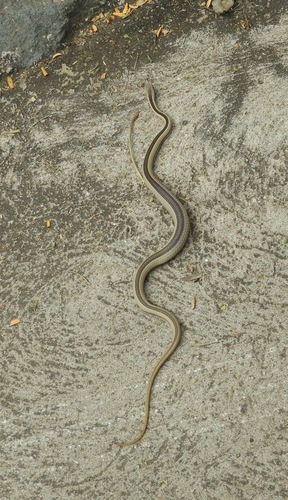
Hemirhagerrhis is a genus of small, slim African snakes in the family Psammophiidae, the same group that holds the sand snakes, whip snakes, and beaked snakes. They are usually called bark snakes because of their tree-and-rock habits and their cryptic, bark-like patterning. Our database lists 4 species, including the Mopane Snake, the Kenyan Bark Snake, the Western Bark Snake, and Keller's Bark Snake.
The genus is found in sub-Saharan Africa, with members spread across parts of eastern, southern, and western Africa. Typical habitat is warm and rocky or wooded, including savanna, dry bushland, rocky outcrops, and the trunks and branches of trees such as mopane. These are agile climbers that move easily over bark and stone, and they tend to shelter in crevices, under bark, and in tight cracks where their flattened bodies and camouflage keep them hidden.
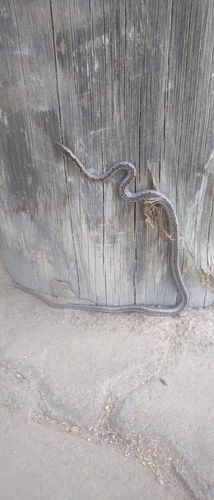
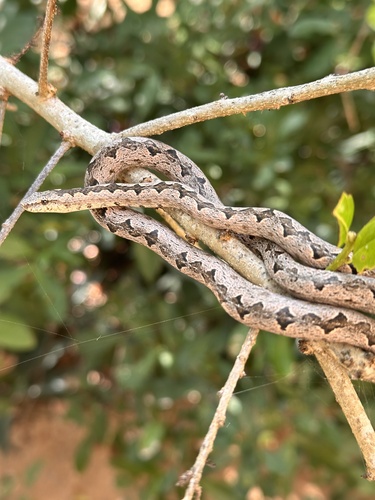
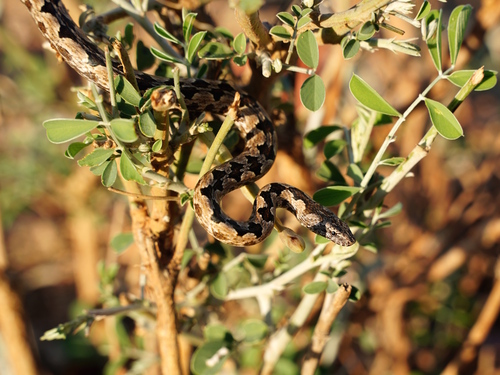
In general terms, bark snakes are recognizable as small and very slender snakes with a narrow head only slightly set off from the neck and a body marked with mottled, blotched, or barred patterns in grays, browns, and tans. That patterning breaks up their outline against bark and rock, which is the main way to recognize the group: a thin, well-camouflaged snake clinging to a trunk or a rocky face rather than a boldly colored or thick-bodied animal. They are modest in size, well under the length of the larger psammophiid racers.
Bark snakes are rear-fanged and mildly venomous, with enlarged grooved teeth set toward the back of the upper jaw and a venom suited to subduing small prey. They are not considered dangerous to humans, and their small size and shy nature make bites rare. That said, no wild venomous snake is safe to handle. Do not pick one up. If a bite occurs, or if there is any swelling, unusual pain, or other symptoms, treat it as a medical matter, keep the person calm, and contact emergency care. In the United States call Poison Control at 1-800-222-1222, and elsewhere contact local emergency services.
Ecologically, Hemirhagerrhis are small predators that specialize on little prey suited to their slim build. They commonly take lizards, especially geckos, along with other small vertebrates and their eggs, using mild venom to subdue what they catch among bark and rocks. Like other members of their family, they are egg-layers rather than live-bearers. Their combination of small size, strong camouflage, and a climbing, crevice-dwelling lifestyle makes them quiet specialists of Africa's rocky and wooded country, far more often overlooked than encountered.
Hemirhagerrhis belongs to the Psammophiidae family (Sand & grass snakes). Fast, slender, day-active snakes of open country. Long, slim, and fast, with large eyes and a streamlined head, often striped lengthwise.
Danger: Rear-fanged and mildly venomous; bites can cause local swelling but are not considered dangerous to people.
All species (4)
Keep learning
- What Is a Snake? Anatomy and the BasicsA clear overview of what makes a snake a snake: limbless body plan, anatomy, evolution from lizards, species diversity, and why they are ectothermic.
- How Snakes Move, Hunt, and EatHow snakes move without legs, hunt as ambushers or active foragers, kill by constriction or venom, and swallow prey wider than their head.
- What Do Snakes Eat?All snakes are carnivores. Learn what snakes eat, how diet changes with size and age, how often they feed, and how they hunt and swallow prey.
- Venomous vs Nonvenomous: How to Tell the DifferenceThe folk rules for telling venomous snakes apart, where each one fails, and why location-based identification beats guessing by sight.