
Genus · Colubridae
Hemerophis
The genus Hemerophis contains a single species. It is not considered dangerous to humans.
About Socotran racer
A single slender island racer found only on Socotra, part of the vast harmless colubrid family.
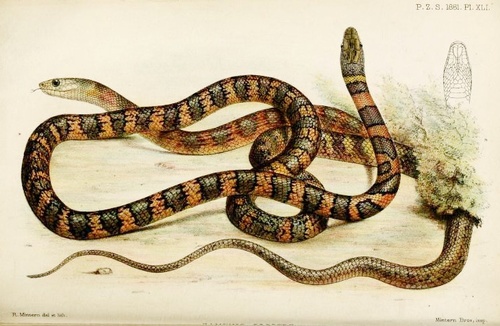
Hemerophis is a small genus in the family Colubridae, the largest and most diverse snake family on Earth. As currently recognized it holds essentially one species, the Socotran Racer (Hemerophis socotrae), which is endemic to the Socotra Archipelago off the Horn of Africa in the Arabian Sea. Like most racers across the colubrid family, it is a slim, fast, alert, ground-active snake. It was historically grouped with the Old World racers near the genus Coluber and related forms, and modern work has set it apart as its own lineage native to this isolated island system.
Its range is one of the narrowest of any snake genus, restricted to Socotra and its smaller neighboring islands. Socotra is a dry, rugged landscape of limestone plateaus, coastal plains, and arid scrub, and the racer occupies these terrestrial habitats rather than wetlands or dense forest. In general terms, members of racer lineages like this are recognized by a slender build, a long tapering tail, large eyes suited to active daytime hunting, and smooth or weakly keeled scales over a streamlined body. Coloration in island colubrids tends toward muted browns and grays that match rock and dry ground.
The Socotran Racer is a non-venomous, harmless colubrid that poses no medical danger to people. It is not a front-fanged snake and is not aggressive toward humans; like other small racers it relies on speed and concealment to avoid threats. As a typical colubrid racer it feeds on small prey such as lizards and invertebrates, hunts actively by day, and is presumed to reproduce by laying eggs as the great majority of colubrids do. Wild snakes should still be observed and not handled, and any genuine snakebite emergency should be directed to local emergency services or, in the US, Poison Control at 1-800-222-1222.
Hemerophis belongs to the Colubridae family (Colubrids). The largest snake family, and the one most snakes you meet belong to. Typically round pupils, a head only slightly wider than the neck, and no heat-sensing facial pit or rattle. Scales may be smooth and glossy or keeled and matte depending on the species.
Danger: Almost all colubrids are harmless. A small number are rear-fanged with medically significant venom, the boomslang and the twig (vine) snakes of Africa being the dangerous exceptions. Most colubrids will flee or bluff rather than bite.
All species (1)
Keep learning
- What Is a Snake? Anatomy and the BasicsA clear overview of what makes a snake a snake: limbless body plan, anatomy, evolution from lizards, species diversity, and why they are ectothermic.
- How Snakes Move, Hunt, and EatHow snakes move without legs, hunt as ambushers or active foragers, kill by constriction or venom, and swallow prey wider than their head.
- What Do Snakes Eat?All snakes are carnivores. Learn what snakes eat, how diet changes with size and age, how often they feed, and how they hunt and swallow prey.
- Venomous vs Nonvenomous: How to Tell the DifferenceThe folk rules for telling venomous snakes apart, where each one fails, and why location-based identification beats guessing by sight.