
Genus · Colubridae
Types of green snakes
3 species make up the genus Hapsidophrys, the snakes commonly called green snakes. None are considered dangerous to humans.
About African green tree snakes
Slender, vividly green African colubrids built for life in the trees of equatorial forests.
Hapsidophrys is a small genus of slim, agile snakes in the family Colubridae, the largest and most varied snake family on Earth. These are classic forest tree snakes: long-bodied, light, and quick, with the kind of build that lets them move easily through branches and foliage. The genus is part of the broader radiation of African colubrids and is closely associated with the green-snake group found across the continent's wetter regions.
The genus is native to sub-Saharan Africa, centered on the tropical forests of West and Central Africa. Members range across the Guineo-Congolian forest belt and reach the offshore islands of the Gulf of Guinea, where the Principe Green Snake is found. Typical habitat is humid lowland and gallery forest, forest edges, and well-vegetated areas where the snakes can climb and hunt above the ground. They are strongly arboreal and diurnal, active by day in the canopy and understory.
Recognizing a member of Hapsidophrys comes down to general impression rather than one single mark. Expect a thin, elongated snake with a fairly distinct head, large eyes suited to daytime hunting, and bright green coloration, sometimes with darker lines or a metallic sheen along the body. The Black-lined Green Snake, for example, carries dark stripes down its length, while others are more uniformly green. Because several harmless and mildly venomous green snakes share this look across Africa, exact identification from color alone is unreliable, and local field guides are the best reference.
These snakes are not considered dangerous to people. Like many colubrids they are best described as harmless to humans in terms of medically significant venom, though some forest colubrids possess mild rear-fanged secretions used to subdue small prey rather than to threaten anything large. A wild snake of any kind can bite if cornered or grabbed. Do not handle wild snakes you cannot positively identify. If a bite happens and you are unsure of the species, or symptoms develop, seek medical care: in the US contact Poison Control at 1-800-222-1222, and elsewhere call local emergency services.
Ecologically, Hapsidophrys snakes are active visual hunters of small arboreal prey such as frogs, lizards, and insects, which fits their slim build, good eyesight, and fast, exploratory movement through vegetation. Like the great majority of colubrids they are egg-laying. Their day-active, tree-dwelling lifestyle makes them a familiar part of healthy African forest ecosystems, where they help control populations of the small animals they eat.
Hapsidophrys belongs to the Colubridae family (Colubrids). The largest snake family, and the one most snakes you meet belong to. Typically round pupils, a head only slightly wider than the neck, and no heat-sensing facial pit or rattle. Scales may be smooth and glossy or keeled and matte depending on the species.
Danger: Almost all colubrids are harmless. A small number are rear-fanged with medically significant venom, the boomslang and the twig (vine) snakes of Africa being the dangerous exceptions. Most colubrids will flee or bluff rather than bite.
All species (3)
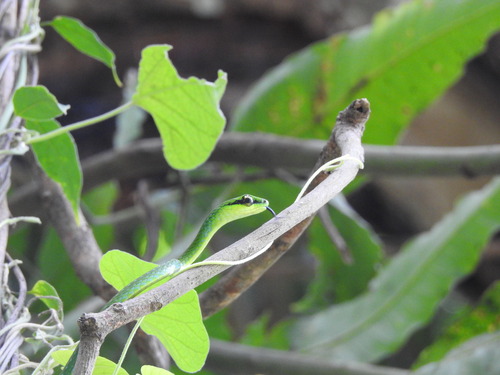
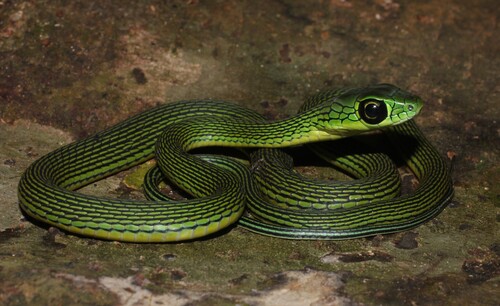
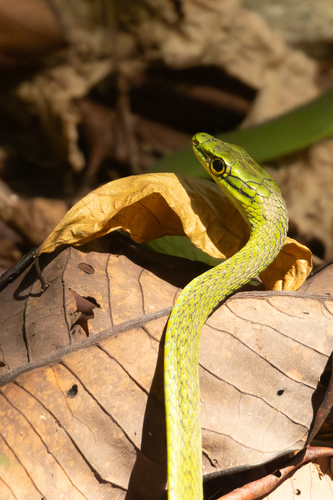
Keep learning
- What Is a Snake? Anatomy and the BasicsA clear overview of what makes a snake a snake: limbless body plan, anatomy, evolution from lizards, species diversity, and why they are ectothermic.
- How Snakes Move, Hunt, and EatHow snakes move without legs, hunt as ambushers or active foragers, kill by constriction or venom, and swallow prey wider than their head.
- What Do Snakes Eat?All snakes are carnivores. Learn what snakes eat, how diet changes with size and age, how often they feed, and how they hunt and swallow prey.
- Venomous vs Nonvenomous: How to Tell the DifferenceThe folk rules for telling venomous snakes apart, where each one fails, and why location-based identification beats guessing by sight.