
Genus · Typhlopidae
Grypotyphlops
The genus Grypotyphlops contains a single species. It is not considered dangerous to humans.
About blind snakes
A worm-like burrowing blind snake from India and Sri Lanka, harmless and almost never seen above ground.
Grypotyphlops is a small genus in the family Typhlopidae, the typical blind snakes. It contains the Beaked Blind Snake (Grypotyphlops acutus), a burrowing species native to peninsular India and Sri Lanka. Like other typhlopids, it spends nearly its whole life underground in soil, leaf litter, and around the roots of vegetation, which is why people rarely encounter it. When members of this genus are seen, it is usually after heavy rain pushes them to the surface or when digging and gardening turns them up.
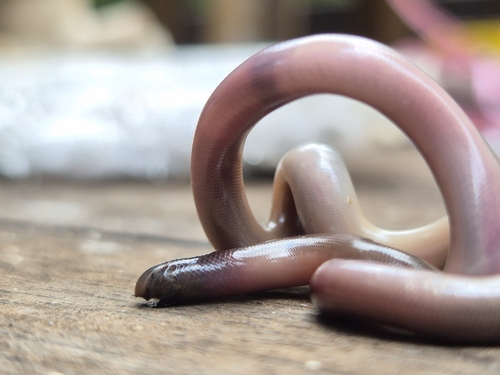
Members of this genus look more like earthworms than the snakes most people picture. The body is slender, cylindrical, and roughly the same thickness along its length, with a blunt tail and a head that is hard to tell apart from the rear end at a glance. The eyes are reduced to tiny dark spots under the head scales and detect little more than light and dark, an adaptation to life in the dark. The smooth, tightly overlapping scales let these snakes slide easily through soil, and the mouth sits low on the underside of the snout. The common name beaked blind snake refers to the slightly projecting, pointed shape of the snout used for pushing through earth.
Blind snakes in this genus are completely harmless to people. They are not venomous, they do not bite in any meaningful way, and their tiny mouths are built for eating soft-bodied prey, not for defense against anything large. Their diet is mostly the eggs, larvae, and pupae of ants and termites, along with other small soil invertebrates, which makes them quiet allies in the soil rather than a threat. Many typhlopids reproduce by laying eggs, and some are known to reproduce without males, though the specific reproductive details of Grypotyphlops are not well documented. If you find one, it is safe to leave it alone or gently move it back into damp soil or leaf litter where it can burrow again.
Grypotyphlops belongs to the Typhlopidae family (Blindsnakes). Tiny, worm-like burrowing snakes that raid ant and termite nests. Looks like a small, glossy earthworm with smooth scales and no obvious neck, eyes, or pattern.
Danger: Harmless. They do not bite people and have no venom.
All species (1)
Keep learning
- What Is a Snake? Anatomy and the BasicsA clear overview of what makes a snake a snake: limbless body plan, anatomy, evolution from lizards, species diversity, and why they are ectothermic.
- How Snakes Move, Hunt, and EatHow snakes move without legs, hunt as ambushers or active foragers, kill by constriction or venom, and swallow prey wider than their head.
- What Do Snakes Eat?All snakes are carnivores. Learn what snakes eat, how diet changes with size and age, how often they feed, and how they hunt and swallow prey.
- Venomous vs Nonvenomous: How to Tell the DifferenceThe folk rules for telling venomous snakes apart, where each one fails, and why location-based identification beats guessing by sight.