
Genus · Gerrhopilidae
Types of worm snakes
3 species make up the genus Gerrhopilus, the snakes commonly called worm snakes. None are considered dangerous to humans.
About Indo-Malayan blind snakes
Tiny burrowing worm-like snakes that spend almost their whole lives underground and pose no danger to people.
Gerrhopilus is a genus of small, secretive blind snakes and the type genus of the family Gerrhopilidae, one of several lineages within the typhlopoid blind snakes (infraorder Scolecophidia). For a long time these snakes were lumped in with the larger typhlopid blind snakes, but anatomical study, including the unusual glandular structures on their head scales, led researchers to recognize Gerrhopilidae as its own family. They sit among the most primitive living snakes, a group built entirely for a life spent tunneling through soil and leaf litter.
The genus is centered on South and Southeast Asia and the islands reaching toward New Guinea. Members occur across a band that includes the Indian subcontinent, Sri Lanka, parts of mainland Southeast Asia, and the Indo-Australian archipelago. They favor moist, loose substrates: forest floor soil, leaf litter, rotting logs, and the dirt of gardens and agricultural land. Because they live below the surface, they are rarely seen unless someone turns over a log, digs in damp ground, or finds one flushed out after heavy rain.
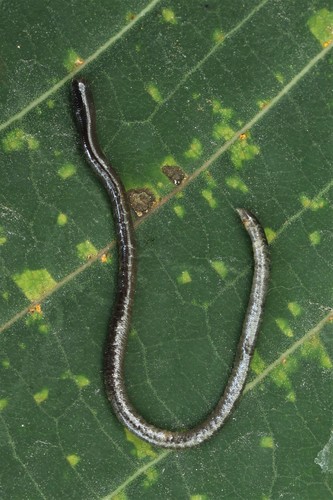
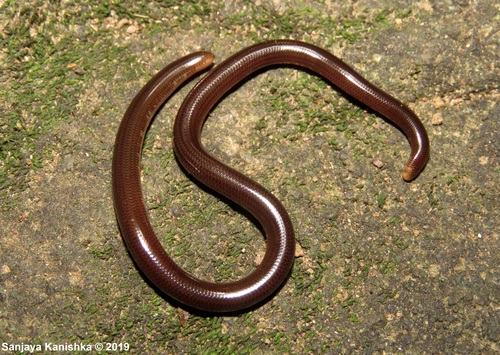
Recognizing a Gerrhopilus in general terms means recognizing a typical blind snake. They are slender and nearly uniform in width from head to tail, often only a few inches to a foot long, with smooth, tightly fitting scales that give a glossy, worm-like look. The eyes are reduced to dark spots beneath the head scales rather than functional eyes, the head is blunt and barely distinct from the body, and the tail ends in a short spine. Telling one species from another is a job for specialists using scale counts and head-gland detail, so field identification usually stops at recognizing the blind snake body plan.
These snakes are harmless. They are not venomous, they are not rear-fanged, and they have tiny mouths suited to swallowing soft-bodied prey, not biting people. There is no medical danger from a Gerrhopilus. As with any wild animal, the sensible practice is to leave it where it is and let it return to cover rather than handle it. If anyone is ever bitten by a snake they cannot confidently identify, treat it as a medical matter and contact emergency services or US Poison Control at 1-800-222-1222.
Ecologically, Gerrhopilus blind snakes are soil predators that feed largely on the eggs, larvae, and soft-bodied stages of ants and termites, hunting them inside the colonies and tunnels they share. This makes them quiet contributors to the underground food web. Like many blind snakes they are believed to reproduce by laying eggs, and some scolecophidians are known for very small clutches. Their behavior is shy and fossorial: they burrow, avoid light, and rely on staying hidden rather than on any defense, which is why even people living right above them rarely know they are there.
Gerrhopilus belongs to the Gerrhopilidae family (Indo-Malayan blindsnakes). Tiny burrowing blindsnakes of South and Southeast Asia. Worm-like and shiny, indistinguishable from other blindsnakes without close examination.
Danger: Harmless.
All species (3)
Keep learning
- What Is a Snake? Anatomy and the BasicsA clear overview of what makes a snake a snake: limbless body plan, anatomy, evolution from lizards, species diversity, and why they are ectothermic.
- How Snakes Move, Hunt, and EatHow snakes move without legs, hunt as ambushers or active foragers, kill by constriction or venom, and swallow prey wider than their head.
- What Do Snakes Eat?All snakes are carnivores. Learn what snakes eat, how diet changes with size and age, how often they feed, and how they hunt and swallow prey.
- Venomous vs Nonvenomous: How to Tell the DifferenceThe folk rules for telling venomous snakes apart, where each one fails, and why location-based identification beats guessing by sight.