
Genus · Colubridae
Types of hook-nosed snakes
5 species make up the genus Ficimia, the snakes commonly called hook-nosed snakes. None are considered dangerous to humans.
About hook-nosed snakes
Small, secretive burrowers named for the upturned, hooked scale on the tip of the snout.
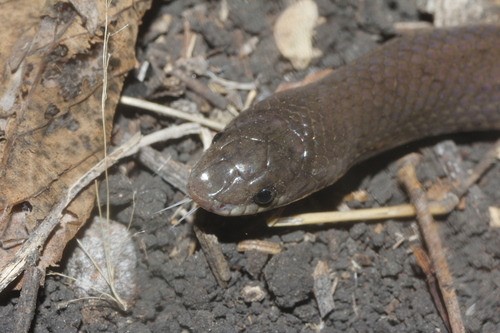
Ficimia is a genus of small New World snakes in the family Colubridae, the largest snake family worldwide and a group that holds most of the familiar nonvenomous and mildly venomous land snakes. The genus is known in plain language as the hook-nosed snakes, a name shared with the closely related genus Gyalopion. The hook refers to a distinctly enlarged, upturned rostral scale at the tip of the snout, the feature that defines the group and gives the animals a useful tool for pushing through soil.
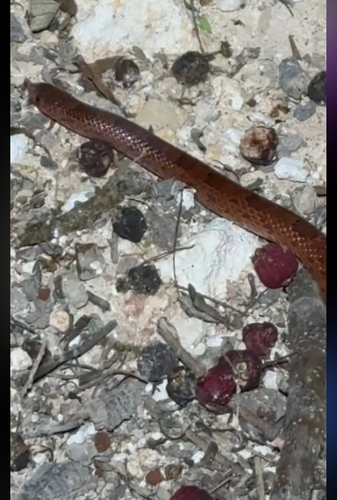
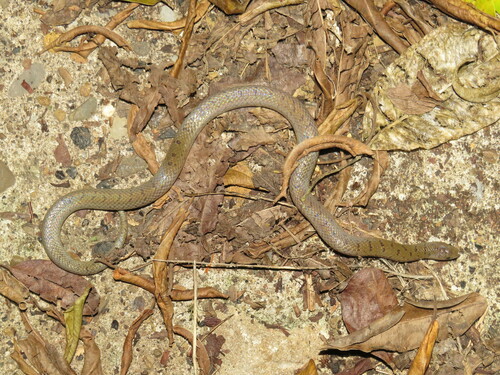
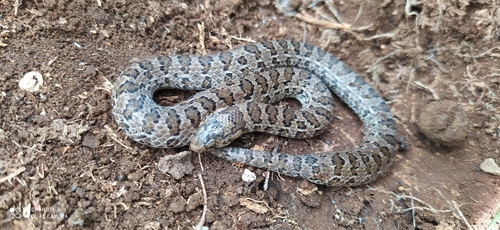
These snakes range across Mexico and Central America, with one species, the Mexican hook-nosed snake, reaching into the southwestern United States in Texas. Our database holds five species in the genus, including the Blotched Hook-nosed Snake, the Tamaulipan Hook-nosed Snake, the Mexican Hook-nosed Snake, and Hardy's Hook-nosed Snake. They favor arid and semiarid country: brushland, rocky slopes, thornscrub, and grassland where loose soil makes burrowing easy.
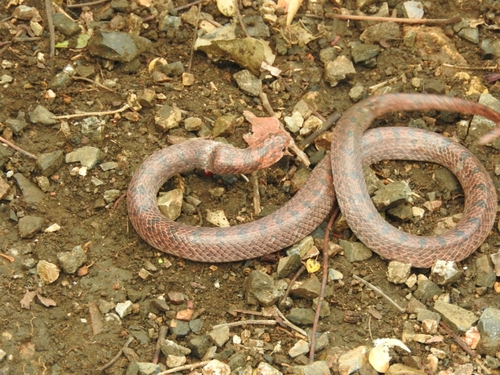
Recognizing a Ficimia is mostly about size and that nose. Adults are small and slender, typically well under a foot to roughly a foot in length, with a blunt head barely wider than the neck and the signature upturned rostral scale. Color and pattern vary by species, from plain to blotched or banded across the back. Their fossorial build, small smooth-scaled body and a head shaped for digging, separates them from larger, thicker-bodied snakes a person is more likely to notice above ground.
Hook-nosed snakes are harmless to people. They are not front-fanged venomous snakes and pose no danger in the way a rattlesnake or coral snake does. Some colubrids in this broad family carry mild rear-fanged secretions used to subdue small prey, and the safest practice with any wild snake is simply not to handle it. There is no reason to fear these animals, but leaving wildlife alone protects both the snake and the person. If anyone is ever bitten by a snake they cannot confidently identify, treat it as a medical matter and contact emergency services or US Poison Control at 1-800-222-1222 rather than attempting first aid alone.
Ecologically, Ficimia are nocturnal and highly secretive, spending most of their lives underground or under cover and emerging chiefly at night or after rain. They prey on small invertebrates, with spiders and centipedes commonly reported for hook-nosed snakes, hunting in the soil and leaf litter where these animals live. Like most colubrids in their region they are egg-laying, producing small clutches. A notable behavior in the group is a bluff display: when alarmed some hook-nosed snakes evert the cloacal lining with a popping sound, a harmless startle tactic rather than any kind of threat.
Ficimia belongs to the Colubridae family (Colubrids). The largest snake family, and the one most snakes you meet belong to. Typically round pupils, a head only slightly wider than the neck, and no heat-sensing facial pit or rattle. Scales may be smooth and glossy or keeled and matte depending on the species.
Danger: Almost all colubrids are harmless. A small number are rear-fanged with medically significant venom, the boomslang and the twig (vine) snakes of Africa being the dangerous exceptions. Most colubrids will flee or bluff rather than bite.
All species (5)
Keep learning
- What Is a Snake? Anatomy and the BasicsA clear overview of what makes a snake a snake: limbless body plan, anatomy, evolution from lizards, species diversity, and why they are ectothermic.
- How Snakes Move, Hunt, and EatHow snakes move without legs, hunt as ambushers or active foragers, kill by constriction or venom, and swallow prey wider than their head.
- What Do Snakes Eat?All snakes are carnivores. Learn what snakes eat, how diet changes with size and age, how often they feed, and how they hunt and swallow prey.
- Venomous vs Nonvenomous: How to Tell the DifferenceThe folk rules for telling venomous snakes apart, where each one fails, and why location-based identification beats guessing by sight.