
Genus · Colubridae
Eutrachelophis
The genus Eutrachelophis contains a single species. It is not considered dangerous to humans.
About Amazonian forest snakes
A tiny, little-known genus of slender Amazonian forest snakes in the colubrid family.
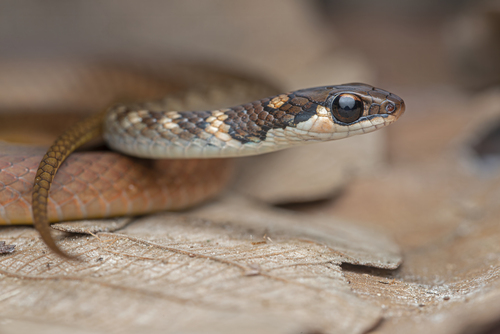
Eutrachelophis is a small South American genus placed in the broad colubrid lineage, the same enormous, mostly harmless family that includes the majority of the world's snakes. The genus was only formally described in modern times and contains very few recognized species, all native to the tropical lowlands of the Amazon Basin. Because these snakes are rarely encountered and lightly studied, much of what can be said honestly comes from their family and from the wet, forested regions where they live rather than from a deep record of field observations. They are best understood as obscure forest dwellers whose biology is still being filled in by researchers.
These are slender, modestly sized snakes adapted to humid tropical forest and the leaf litter, low vegetation, and stream margins typical of Amazonian habitat. In general terms, members of this group share the build common to many forest colubrids: a narrow body, a head only slightly distinct from the neck, and smooth or weakly keeled scales. Reliable identification of an obscure snake like this should rest on locality and on a herpetologist examining scale counts and other technical features, not on color or pattern alone, which can overlap with many unrelated forest species in the same range.
Like the great majority of colubrids, these snakes are not considered dangerous to people. They are small, secretive, and not front-fanged, and there is no record of them posing a medical threat. As with many colubrids, the possibility of mild rear-fanged saliva delivery cannot be ruled out for a poorly studied genus, but nothing here suggests a hazard to humans. The responsible practice with any wild snake is to leave it alone and not handle it, since identification in the field is easy to get wrong. If a bite from an unidentified snake occurs, contact emergency services or, in the United States, Poison Control at 1-800-222-1222. Ecologically these forest colubrids are presumed to feed on small prey such as amphibians and invertebrates and, like most of their relatives, to reproduce by laying eggs.
Eutrachelophis belongs to the Colubridae family (Colubrids). The largest snake family, and the one most snakes you meet belong to. Typically round pupils, a head only slightly wider than the neck, and no heat-sensing facial pit or rattle. Scales may be smooth and glossy or keeled and matte depending on the species.
Danger: Almost all colubrids are harmless. A small number are rear-fanged with medically significant venom, the boomslang and the twig (vine) snakes of Africa being the dangerous exceptions. Most colubrids will flee or bluff rather than bite.
All species (1)
Keep learning
- What Is a Snake? Anatomy and the BasicsA clear overview of what makes a snake a snake: limbless body plan, anatomy, evolution from lizards, species diversity, and why they are ectothermic.
- How Snakes Move, Hunt, and EatHow snakes move without legs, hunt as ambushers or active foragers, kill by constriction or venom, and swallow prey wider than their head.
- What Do Snakes Eat?All snakes are carnivores. Learn what snakes eat, how diet changes with size and age, how often they feed, and how they hunt and swallow prey.
- Venomous vs Nonvenomous: How to Tell the DifferenceThe folk rules for telling venomous snakes apart, where each one fails, and why location-based identification beats guessing by sight.