
Genus · Homalopsidae
Erpeton
The genus Erpeton contains a single species. It is not considered dangerous to humans.
About tentacled snake
The only snake on Earth with a pair of soft, scaled tentacles on its snout, built entirely for life underwater.
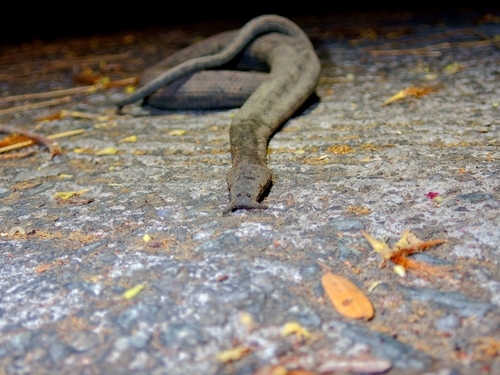
Erpeton is a single-species genus in the family Homalopsidae, the Indo-Australian mud and water snakes. Its one member, Erpeton tentaculatum, the tentacled snake, sits apart from every other snake by a single feature: two short, fleshy, scale-covered appendages projecting from the front of the snout. No other snake has anything like them. They are sensory organs that detect movement in the water, helping the snake aim strikes at fish in near-total darkness or murky conditions. Within Homalopsidae, a family of mostly rear-fanged, aquatic and semi-aquatic snakes of Southeast Asia and northern Australia, Erpeton is the most specialized and the most fully committed to an underwater existence.
The tentacled snake ranges across mainland Southeast Asia, including Thailand, Cambodia, Vietnam, and southern Laos. It lives in slow or still freshwater: rice paddies, ponds, lakes, canals, and muddy lowland streams, and it tolerates somewhat brackish water as well. Recognizing it is straightforward when the snout is visible, since the paired tentacles are unmistakable. The body is heavy for the snake's length, rough-scaled, and usually tan to grayish brown with darker stripes or blotches that blend into aquatic vegetation and mud. Adults are modest in size, roughly in the range of two to three feet, and the snake is almost helpless on land, where it can barely move with coordination.
Erpeton is rear-fanged, meaning it has enlarged grooved teeth at the back of the jaw and a mild venom used to subdue the small fish it eats. That venom is adapted to fish, not people, and the species is not considered dangerous to humans, but no wild snake should be handled casually. The tentacled snake is an ambush hunter that holds a rigid J-shaped pose and uses water-movement cues, sometimes startling prey into swimming straight toward its mouth, an unusually precise feeding strategy. It is fully aquatic, gives birth to live young rather than laying eggs, and can stay submerged for long periods. If anyone is bitten by an unidentified snake and symptoms develop, seek emergency care and in the US contact Poison Control at 1-800-222-1222 or local emergency services.
Erpeton belongs to the Homalopsidae family (Mud & water snakes). Aquatic, mud-dwelling snakes with upward-facing eyes and nostrils. Stout, often drab snakes with upturned nostrils, found in or near muddy water.
Danger: Rear-fanged with mild venom; not considered dangerous to humans.
All species (1)
Keep learning
- What Is a Snake? Anatomy and the BasicsA clear overview of what makes a snake a snake: limbless body plan, anatomy, evolution from lizards, species diversity, and why they are ectothermic.
- How Snakes Move, Hunt, and EatHow snakes move without legs, hunt as ambushers or active foragers, kill by constriction or venom, and swallow prey wider than their head.
- What Do Snakes Eat?All snakes are carnivores. Learn what snakes eat, how diet changes with size and age, how often they feed, and how they hunt and swallow prey.
- Venomous vs Nonvenomous: How to Tell the DifferenceThe folk rules for telling venomous snakes apart, where each one fails, and why location-based identification beats guessing by sight.