
Genus · Elapidae
Types of small-eyed snakes
5 species make up the genus Cryptophis, the snakes commonly called small-eyed snakes. All of them are venomous.
About small-eyed snakes
Small, secretive Australasian elapids that hide by day and hunt other reptiles by night.
Cryptophis is a genus of small-eyed snakes in the family Elapidae, the front-fanged group that also includes cobras, taipans, and sea snakes. The genus is centered on Australia, with representation extending into New Guinea, and currently holds about five recognized species. The name refers to the conspicuously small eyes that distinguish these snakes from many of their relatives, a trait tied to their secretive, largely nocturnal way of life.
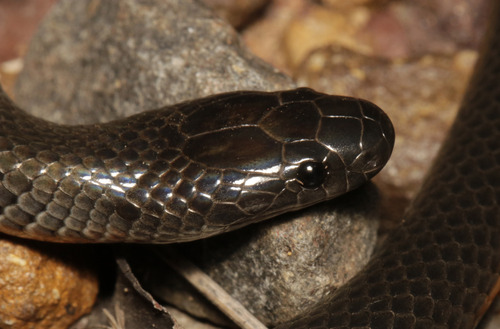
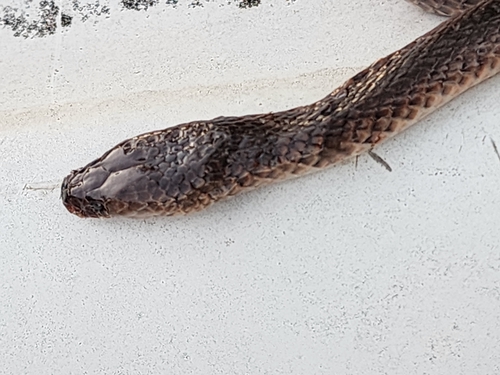
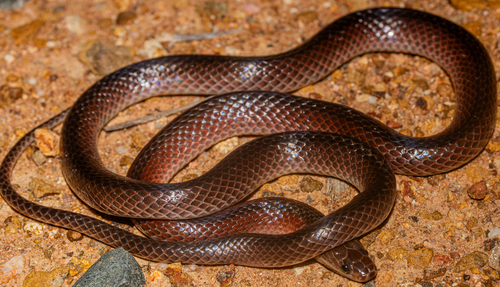
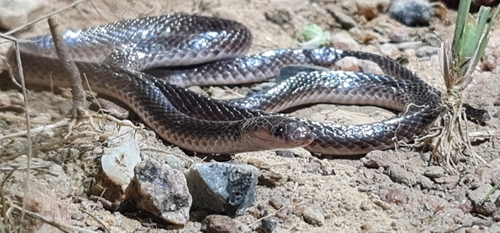
These are modest-sized snakes, generally well under a meter long, with smooth glossy scales and a cylindrical body. Coloration tends toward dark, even shades of black, brown, or reddish-brown, sometimes with a contrasting pale or pinkish belly. The Eastern Small-eyed Snake is glossy blue-black above with a pink to cream underside, while the Black-striped Snake shows a darker dorsal stripe over a lighter ground color. The small eyes, slender build, and uniform dark dorsum are the broad recognition cues, but reliable identification of any individual snake depends on local range, scale counts, and regional field guides rather than color alone.
Members of Cryptophis are found across a range of habitats including woodlands, forests, rocky outcrops, and rural and suburban margins. They are secretive and spend much of the day sheltering under rocks, logs, leaf litter, and other ground cover, emerging at night to forage. Their diet leans heavily on other reptiles, especially skinks and small lizards, and they may also take frogs and reptile eggs. Like a number of Australian elapids, several species in this group are live-bearing, giving birth to fully formed young rather than laying eggs.
As front-fanged elapids, small-eyed snakes are venomous. They are generally shy and not aggressive, and bites are uncommon, but the venom of some members is medically significant. The Eastern Small-eyed Snake in particular has caused serious envenomation, including documented cases of muscle damage, and at least one human fatality has been attributed to it. The small size of these snakes does not make them harmless, and the danger they pose is real even if encounters are rare.
Because these are venomous wild snakes, do not handle, catch, or attempt to kill one. Most bites happen during exactly those attempts. Give any wild snake space and let it move off on its own. If a person is bitten or you suspect envenomation, treat it as a medical emergency and seek professional care immediately. In the United States contact Poison Control at 1-800-222-1222 or call local emergency services, and in Australia or elsewhere call your local emergency number and follow regional first-aid guidance from medical authorities.
Cryptophis belongs to the Elapidae family (Cobras, mambas, coral & sea snakes). Front-fanged venomous snakes, many with potent neurotoxic venom. Usually slender with a head barely wider than the neck and fixed front fangs (not the folding fangs of vipers). Coral snakes are boldly ringed; sea snakes have a flattened, paddle-like tail.
Danger: All elapids are venomous and the family is responsible for a large share of fatal snakebites worldwide. Many are shy, but bites can be life-threatening. Treat any bite as a medical emergency.
All species (5)
Keep learning
- Venomous vs Nonvenomous: How to Tell the DifferenceThe folk rules for telling venomous snakes apart, where each one fails, and why location-based identification beats guessing by sight.
- Are Snakes Dangerous? The Real Risk, in PerspectiveMost snakes are harmless and avoid people. Here is the honest picture of snakebite risk worldwide and how to lower your own.
- Snake Venom Explained: How It Works and WhyWhat snake venom actually is, why it evolved, the main venom types, fang delivery, how antivenom works, and why ranking the most venomous snake is hard.
- How Snakes Move, Hunt, and EatHow snakes move without legs, hunt as ambushers or active foragers, kill by constriction or venom, and swallow prey wider than their head.