
Genus · Colubridae
Types of sharp-tailed snakes
2 species make up the genus Contia, the snakes commonly called sharp-tailed snakes. None are considered dangerous to humans.
About sharp-tailed snakes
Small, secretive West Coast burrowers built almost entirely around eating slugs and slug eggs.
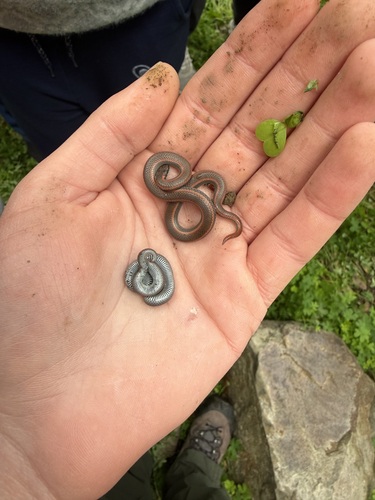
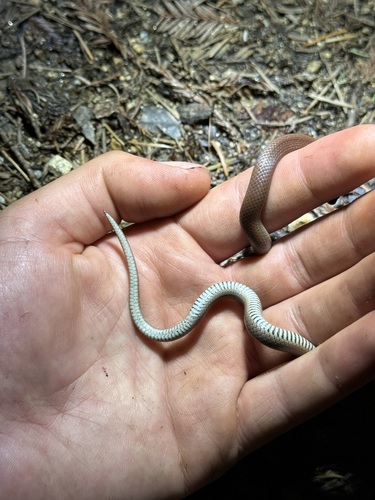
Contia is a tiny genus in the family Colubridae, the largest snake family, but it sits at the family's small and specialized end. It holds just two species: the Common Sharp-tailed Snake (Contia tenuis) and the Forest Sharp-tailed Snake (Contia longicaudae). Both are slender, modest in size, and named for the sharp little spine at the tip of the tail, a feature thought to help brace the snake against prey rather than to harm anything else. They are restricted to western North America, mainly the Pacific coast from British Columbia south through Washington, Oregon, and California.
These are animals of cool, damp places. They favor moist woodland, grassland edges, oak savanna, and rocky slopes where they spend most of their lives hidden under stones, logs, bark, and leaf litter. They are rarely seen in the open because they are secretive and surface mostly during mild, wet conditions in spring and fall. In general terms you recognize a Contia as a small, smooth-scaled snake, often gray, reddish, or brown above, sometimes with a faintly barred belly, and ending in that distinctive pointed tail tip.
Sharp-tailed snakes are harmless to people. They are not venomous and pose no danger to humans or pets; their diet is built around slugs and their eggs, and their slightly enlarged rear teeth are adapted to grip slippery, soft prey, not for defense. They lay eggs rather than giving live birth and are quiet, non-aggressive snakes that rely on hiding rather than biting. As with any wild animal, observe rather than handle, and if you are ever unsure about a snake or a bite, contact local emergency services or US Poison Control at 1-800-222-1222.
Contia belongs to the Colubridae family (Colubrids). The largest snake family, and the one most snakes you meet belong to. Typically round pupils, a head only slightly wider than the neck, and no heat-sensing facial pit or rattle. Scales may be smooth and glossy or keeled and matte depending on the species.
Danger: Almost all colubrids are harmless. A small number are rear-fanged with medically significant venom, the boomslang and the twig (vine) snakes of Africa being the dangerous exceptions. Most colubrids will flee or bluff rather than bite.
All species (2)
Keep learning
- What Is a Snake? Anatomy and the BasicsA clear overview of what makes a snake a snake: limbless body plan, anatomy, evolution from lizards, species diversity, and why they are ectothermic.
- How Snakes Move, Hunt, and EatHow snakes move without legs, hunt as ambushers or active foragers, kill by constriction or venom, and swallow prey wider than their head.
- What Do Snakes Eat?All snakes are carnivores. Learn what snakes eat, how diet changes with size and age, how often they feed, and how they hunt and swallow prey.
- Venomous vs Nonvenomous: How to Tell the DifferenceThe folk rules for telling venomous snakes apart, where each one fails, and why location-based identification beats guessing by sight.