
Genus · Homalopsidae
Brachyorrhos
3 species make up the genus Brachyorrhos. None are considered dangerous to humans.
About Indonesian short-tailed snakes
A small group of secretive, burrowing Southeast Asian snakes that hunt earthworms in damp forest soil.
Brachyorrhos is a genus in the family Homalopsidae, a group usually called the Indo-Australian water snakes or mud snakes. Most homalopsids live in water or mud, but Brachyorrhos is unusual within the family: its members are land-dwelling, fossorial snakes that spend their lives in moist soil and leaf litter rather than in streams or estuaries. The genus is small, with only a handful of recognized species, and it is restricted to the islands of Indonesia.
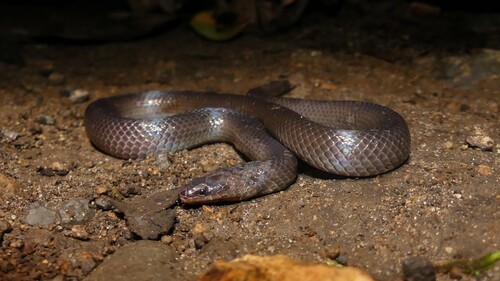
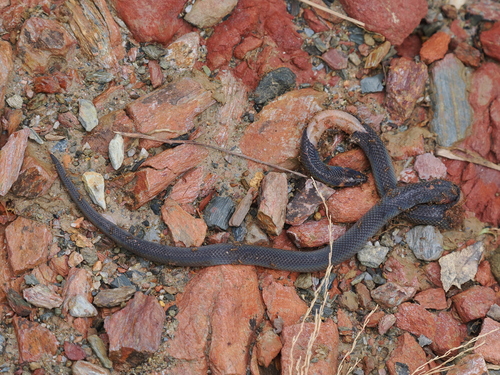
These are small, stout-bodied snakes with smooth scales, a blunt head that is barely distinct from the neck, small eyes, and a short tail, the feature that gives the genus its name. Their build is typical of snakes adapted to pushing through soil. Coloration is generally plain and dark, which fits an animal that spends most of its time hidden. Because reliable common-name and field-identification data for individual species is limited, the safest way to recognize one is by context: a small, smooth, dark, short-tailed snake found burrowing in damp ground on an Indonesian island.
Like other members of Homalopsidae, Brachyorrhos is rear-fanged, meaning it has enlarged grooved teeth toward the back of the upper jaw rather than hollow front fangs. Homalopsid venom is adapted to subduing small prey such as worms, fish, and amphibians, and these snakes are not considered dangerous to people. Brachyorrhos in particular is a small worm-eater with no record of causing medically significant bites. That said, no wild snake should be handled, and you should never assume any rear-fanged species is harmless to handle. If a bite occurs and symptoms develop, contact emergency services or, in the United States, Poison Control at 1-800-222-1222.
Ecologically, Brachyorrhos is a specialist earthworm predator, which sets it apart from the fish-eating and crustacean-eating habits common in the rest of the family. It forages through soft, moist substrate and is rarely seen above ground, so encounters with humans are uncommon. Reproduction in homalopsids is typically live-bearing, and these snakes are generally slow-moving and non-aggressive, relying on concealment rather than speed or defense.
The takeaway: Brachyorrhos is a quiet, harmless-to-people, soil-dwelling member of the otherwise water-loving Homalopsidae, confined to Indonesia and built for a life spent hunting worms underground. It is far more likely to flee into the soil than to confront anything larger than its prey.
Brachyorrhos belongs to the Homalopsidae family (Mud & water snakes). Aquatic, mud-dwelling snakes with upward-facing eyes and nostrils. Stout, often drab snakes with upturned nostrils, found in or near muddy water.
Danger: Rear-fanged with mild venom; not considered dangerous to humans.
All species (3)

Keep learning
- What Is a Snake? Anatomy and the BasicsA clear overview of what makes a snake a snake: limbless body plan, anatomy, evolution from lizards, species diversity, and why they are ectothermic.
- How Snakes Move, Hunt, and EatHow snakes move without legs, hunt as ambushers or active foragers, kill by constriction or venom, and swallow prey wider than their head.
- What Do Snakes Eat?All snakes are carnivores. Learn what snakes eat, how diet changes with size and age, how often they feed, and how they hunt and swallow prey.
- Venomous vs Nonvenomous: How to Tell the DifferenceThe folk rules for telling venomous snakes apart, where each one fails, and why location-based identification beats guessing by sight.