
Genus · Pythonidae
Bothrochilus
The genus Bothrochilus contains a single species. It is not considered dangerous to humans.
About Bismarck ringed python
A glossy, iridescent dwarf python from the islands of the Bismarck Archipelago, harmless to people and known for the bold rings it wears as a juvenile.
Bothrochilus is a small genus in the python family, Pythonidae, built around the Bismarck ringed python, Bothrochilus boa. As a python it is a nonvenomous constrictor, native to the Old World tropics rather than the Americas. The Bismarck ringed python lives on islands of the Bismarck Archipelago off New Guinea, where it occupies forest floor, plantation edges, and disturbed ground near human settlement, often hiding in leaf litter, under logs, or in burrows and being active mainly at night.
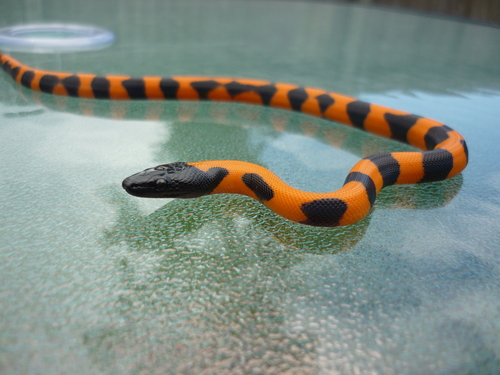
Members are recognized by their modest size and their highly polished, iridescent scales, which throw off a rainbow sheen in good light. Juveniles are the most striking, banded with bold dark and orange rings that give the group its common name. As the snakes mature those rings typically fade toward a more uniform dark brown or near black, so an adult can look plain while a youngster looks dramatically patterned. Adults are slender for a python and generally stay in the range of about 1.5 to 2 meters, making this one of the smaller python lineages.
Like all pythons, Bothrochilus is harmless to humans in terms of venom. It has no venom and is not dangerous to people, killing prey instead by constriction. Its diet centers on small mammals, especially rodents, along with other small vertebrates it can ambush at night, and it reproduces by laying eggs, with the female coiling around the clutch to brood it until hatching. A large snake of any kind can deliver a bite if cornered, so wild animals are best observed and not handled, but there is no venom risk here. If any snakebite leads to concern about the species or symptoms, contact local emergency services or, in the United States, Poison Control at 1-800-222-1222.
Bothrochilus belongs to the Pythonidae family (Pythons). Old-World egg-laying constrictors, including the longest snakes on Earth. Large and heavy-bodied with blotched or banded patterns, smooth scales, and heat-sensing pits along the lips. No rattle or fangs.
Danger: Non-venomous. Only the very largest species could be a physical danger, and bites are defensive, not venomous.
All species (1)
Keep learning
- What Is a Snake? Anatomy and the BasicsA clear overview of what makes a snake a snake: limbless body plan, anatomy, evolution from lizards, species diversity, and why they are ectothermic.
- How Snakes Move, Hunt, and EatHow snakes move without legs, hunt as ambushers or active foragers, kill by constriction or venom, and swallow prey wider than their head.
- What Do Snakes Eat?All snakes are carnivores. Learn what snakes eat, how diet changes with size and age, how often they feed, and how they hunt and swallow prey.
- Venomous vs Nonvenomous: How to Tell the DifferenceThe folk rules for telling venomous snakes apart, where each one fails, and why location-based identification beats guessing by sight.