
Genus · Colubridae
Types of racers
3 species make up the genus Borikenophis, the snakes commonly called racers. None are considered dangerous to humans.
About Puerto Rican racers
Fast, slender daytime hunters found across Puerto Rico and its satellite islands.
Borikenophis is a small genus of colubrid snakes in the family Colubridae, the largest snake family on Earth. The genus is part of the West Indian racer radiation and is named for Borike, an Indigenous Taino name for Puerto Rico. Members are sometimes still discussed under the older catch-all name Alsophis, since several Caribbean racers were reclassified as understanding of their relationships improved.
The genus is endemic to the Puerto Rican Bank, meaning it occurs naturally only in Puerto Rico and nearby islands and cays. The three species recognized in our database, the Puerto Rican Racer, the Mona Island Racer, and the Caja de Muertos Racer, illustrate how island isolation produces distinct forms on separate landmasses. Typical habitats follow the colubrid pattern for the region: dry forest, coastal scrub, rocky slopes, and edges near human settlement, where these snakes can find cover and abundant small prey.
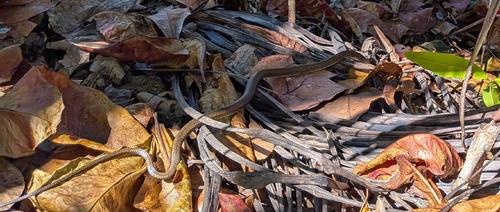
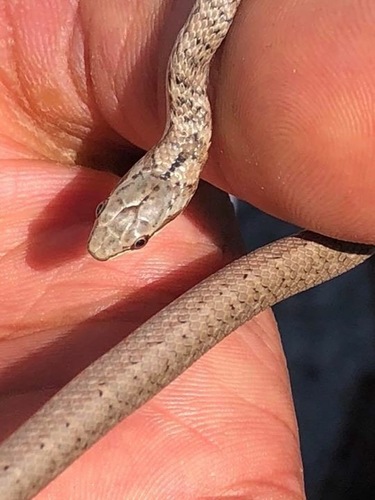
In general terms, a Borikenophis racer is a slim, agile, ground-active snake with a fairly long tail, large eyes suited to daytime vision, and smooth or lightly keeled scales. Coloration tends toward browns, grays, and olive tones, often with longitudinal striping or mottling that breaks up the body against leaf litter and rock. These are alert, quick-moving snakes rather than heavy-bodied ambushers, and they rely on speed and vision to chase down prey.
Like many colubrids, these racers are technically rear-fanged, carrying mild saliva-borne secretions delivered through grooved teeth at the back of the jaw. This is used to subdue small prey and is not considered medically dangerous to people. A bite from one of these snakes may cause local irritation but is not regarded as life threatening. Even so, no wild snake should be handled, and you should never assume a bite is harmless. If anyone is bitten by an unidentified snake, treat it as a medical matter, stay calm, keep the limb still, and contact emergency services or US Poison Control at 1-800-222-1222 for guidance.
Ecologically, Borikenophis racers act as active foragers. Their diet centers on the small animals available on Caribbean islands, including lizards, frogs, smaller snakes, and occasionally small mammals or nestlings. Like most colubrids in the region they are egg layers, and they are diurnal, doing their hunting during daylight hours. As mid-level predators they help regulate populations of lizards and other small prey, and island-restricted species in this group can be vulnerable to habitat loss and introduced predators such as cats and mongooses.
Borikenophis belongs to the Colubridae family (Colubrids). The largest snake family, and the one most snakes you meet belong to. Typically round pupils, a head only slightly wider than the neck, and no heat-sensing facial pit or rattle. Scales may be smooth and glossy or keeled and matte depending on the species.
Danger: Almost all colubrids are harmless. A small number are rear-fanged with medically significant venom, the boomslang and the twig (vine) snakes of Africa being the dangerous exceptions. Most colubrids will flee or bluff rather than bite.
All species (3)
Keep learning
- What Is a Snake? Anatomy and the BasicsA clear overview of what makes a snake a snake: limbless body plan, anatomy, evolution from lizards, species diversity, and why they are ectothermic.
- How Snakes Move, Hunt, and EatHow snakes move without legs, hunt as ambushers or active foragers, kill by constriction or venom, and swallow prey wider than their head.
- What Do Snakes Eat?All snakes are carnivores. Learn what snakes eat, how diet changes with size and age, how often they feed, and how they hunt and swallow prey.
- Venomous vs Nonvenomous: How to Tell the DifferenceThe folk rules for telling venomous snakes apart, where each one fails, and why location-based identification beats guessing by sight.