
Genus · Colubridae
Types of rustyhead snakes
2 species make up the genus Amastridium, the snakes commonly called rustyhead snakes. None are considered dangerous to humans.
About rustyhead snakes
A pair of small, secretive rainforest snakes from Central America, named for the rust-colored cap that marks the head.
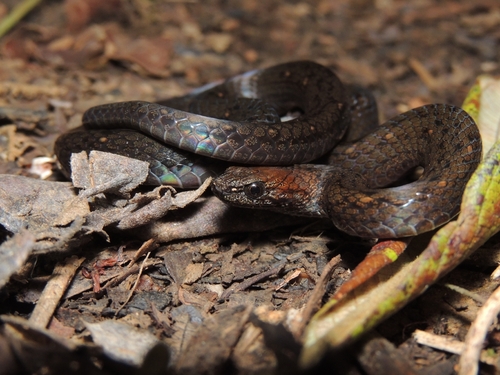
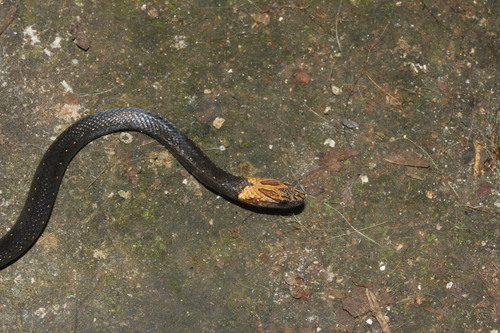
Amastridium is a tiny genus of small colubrid snakes in the family Colubridae, the largest and most diverse snake family in the world. Only two species are recognized: the Rustyhead Snake and Sapper's Rustyhead Snake. The genus name points to their most consistent field mark, a reddish or rusty wash across the head and nape that contrasts with an otherwise dark, slaty body. They are leaf-litter snakes of humid forest, and like most colubrids they are slender, smooth-scaled, and far more interested in escaping than confronting anything larger than themselves.
These snakes occur in the wet lowland and foothill forests of Central America, ranging through parts of Mexico, Guatemala, Honduras, Nicaragua, Costa Rica, and Panama. They live close to the ground, sheltering under logs, rocks, damp leaf litter, and forest debris, and they are most active in the moist conditions that rainforest floors provide. Because they are small, dark, and secretive, they are rarely seen even where they live, and most encounters come from turning cover objects or finding them moving after rain. In general terms you recognize them by their modest size, smooth scales, dark body, and the diagnostic rusty head color.
Members of Amastridium are non-venomous and harmless to people. They are not front-fanged venomous snakes and pose no medical danger; their defense is to flee, hide, or release musk rather than bite. They feed on small forest-floor prey such as frogs and other small animals they can overpower, and like most colubrids of this type they lay eggs rather than giving live birth. As with any wild animal, the responsible practice is to observe rather than handle, and to leave wild snakes undisturbed. If a person is ever bitten by a snake they cannot positively identify, treat it as a medical matter and contact emergency services or US Poison Control at 1-800-222-1222.
Amastridium belongs to the Colubridae family (Colubrids). The largest snake family, and the one most snakes you meet belong to. Typically round pupils, a head only slightly wider than the neck, and no heat-sensing facial pit or rattle. Scales may be smooth and glossy or keeled and matte depending on the species.
Danger: Almost all colubrids are harmless. A small number are rear-fanged with medically significant venom, the boomslang and the twig (vine) snakes of Africa being the dangerous exceptions. Most colubrids will flee or bluff rather than bite.
All species (2)
Keep learning
- What Is a Snake? Anatomy and the BasicsA clear overview of what makes a snake a snake: limbless body plan, anatomy, evolution from lizards, species diversity, and why they are ectothermic.
- How Snakes Move, Hunt, and EatHow snakes move without legs, hunt as ambushers or active foragers, kill by constriction or venom, and swallow prey wider than their head.
- What Do Snakes Eat?All snakes are carnivores. Learn what snakes eat, how diet changes with size and age, how often they feed, and how they hunt and swallow prey.
- Venomous vs Nonvenomous: How to Tell the DifferenceThe folk rules for telling venomous snakes apart, where each one fails, and why location-based identification beats guessing by sight.