
Species spotlight
Reticulated Python: The Longest Snake in the World
The reticulated python is the longest snake in the world, a non-venomous constrictor of Southeast Asia. Learn its range, diet, behavior, and how to identify it.
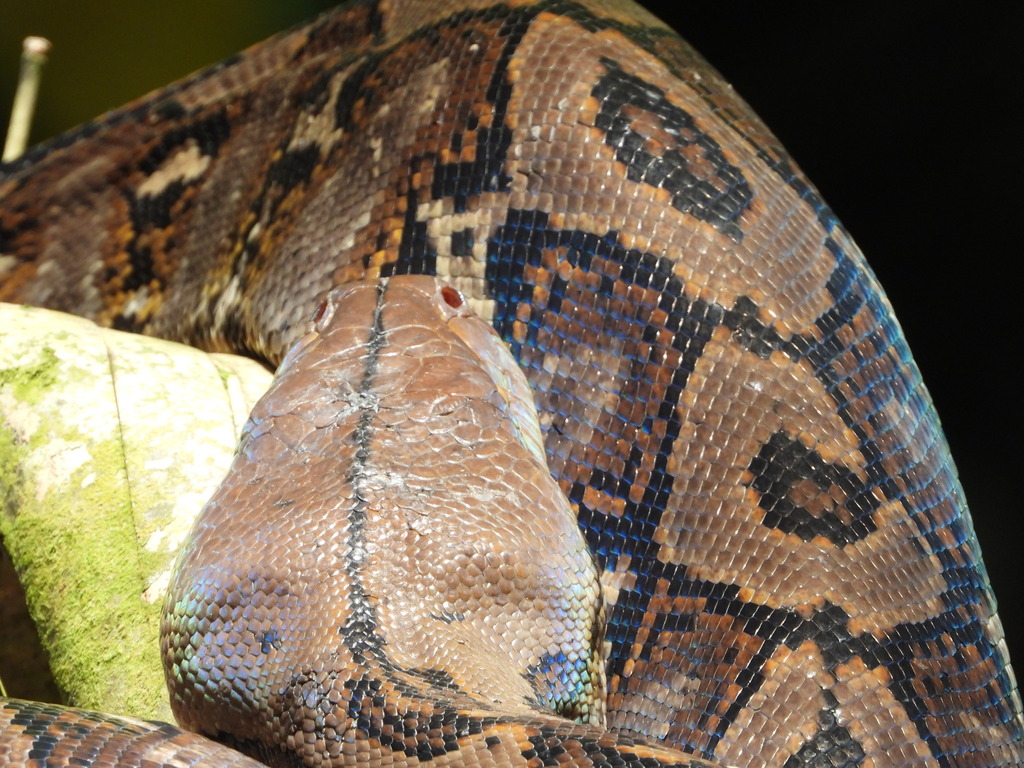
The reticulated python, Malayopython reticulatus, is the longest snake in the world. It is a non-venomous constrictor of Southeast Asia, draped in a complex net-like pattern that gives the species its name. Although it grows to extraordinary lengths and is a powerful predator, it kills by constriction rather than venom, and it is far more interested in avoiding people than confronting them.
Where it lives
The reticulated python is widespread across Southeast Asia, including Thailand and Indonesia, along with much of the surrounding mainland and island region. It thrives in rainforest, riverbanks, and wetlands, and it adapts readily to farmland, plantations, and the edges of towns. It is an excellent swimmer and has colonized small islands by crossing open water.
This adaptability sets it apart from many large snakes that fade away as forests are cleared. Reticulated pythons often do well around human settlements, where rats, chickens, and other small animals are abundant. They are frequently found near villages, oil palm plantations, and even storm drains in cities, which means people in their range encounter them more often than they might expect. That proximity is mostly a sign of the snake's flexibility, not of any interest in people.
Size and appearance
It is the longest snake in the world, regularly exceeding 14 feet and with reliable records well beyond 20 feet, though such giants are rare. The body is muscular but relatively slender for its length compared with the bulkier green anaconda. The pattern is a striking geometric web of black, gold, tan, and cream, broken into diamond-like shapes that blur into the dappled light of the forest floor.
- Very long body with a bold net-like, geometric pattern
- Colors of gold, tan, black, and cream
- A thin dark line running from the eye
- Iridescent sheen on the scales in good light
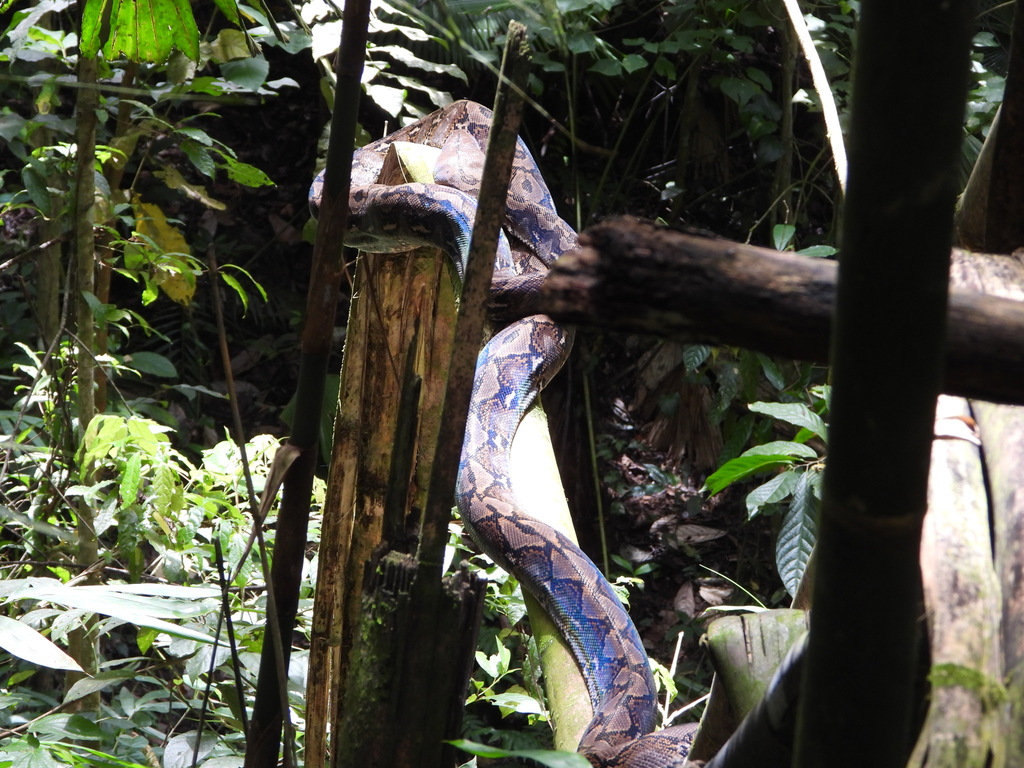
Diet and behavior
The reticulated python is an ambush predator that kills by constriction. It coils around prey and tightens with each exhalation, cutting off blood flow, then swallows the animal whole. Its diet is mostly mammals and birds, scaled to its size, from rats up to deer and wild pigs in the largest individuals. It is generally secretive and nocturnal, spending the day hidden near water or in dense cover and hunting after dark.
Like other constrictors, it has heat-sensing pits along the lips that help it detect warm-blooded prey in darkness, and backward-curving teeth that hold a struggling animal in place while the coils do their work. Between meals it can go a long time without eating, especially after taking large prey, and it spends much of its life simply resting in cover and digesting. This low-energy, sit-and-wait lifestyle is part of how it grows to such extreme lengths.
How to identify it
The geometric, net-like pattern and the great length are the key clues, along with the dark line through the eye. It is sometimes confused with the shorter, blotchier Burmese python and, outside its range, with other large constrictors. To see how it compares with the world's other giants, including the heavier green anaconda, read the largest snakes guide, and browse more profiles on the species hub.
Notable facts
- It is the longest snake species in the world, longer than the heavier green anaconda.
- It is non-venomous and kills entirely by constriction.
- It is a strong swimmer and has reached offshore islands across open sea.
- It is widely kept in the reptile trade, where selective breeding has produced many color forms.
It is worth being clear about risk. Reticulated pythons are not venomous, and the overwhelming majority pose no threat to an adult who simply leaves them alone. Very large individuals are powerful animals and should be respected, but serious incidents with people are rare and usually involve very big snakes encountered at close quarters or captive animals handled carelessly. In the wild, the sensible response to a python is the same as for any large snake: keep your distance and do not try to catch or move it.
The reticulated python is proof that a snake can be record-breaking and formidable without being venomous. It is a constrictor built for ambush, best appreciated from a respectful distance in the wild. Explore how it stacks up against the planet's other giants in the largest snakes guide, or discover more species on the species hub.